Department of Neurosurgery, Second Affiliated Hospital, School of Medicine, Zhejiang University, Hangzhou, 310009, China.
Department of Orthopaedics, Second Affiliated Hospital, School of Medicine, Zhejiang University, Hangzhou, 310009, China.
Sci Rep. 2017 Aug 23;7(1):9201. doi: 10.1038/s41598-017-08196-3.
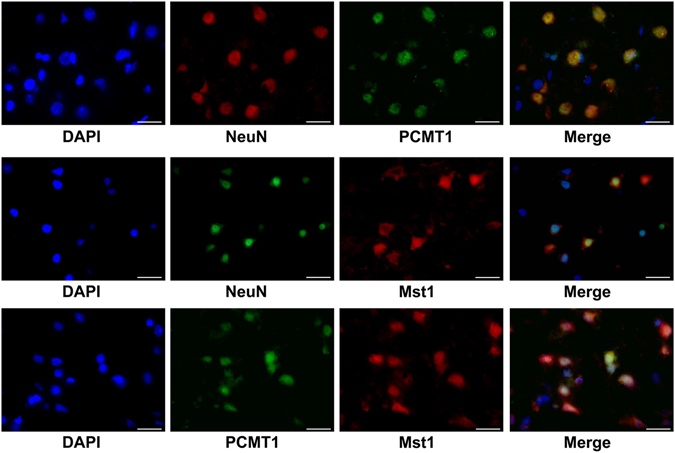
Neuronal apoptosis chiefly contributes to the cell loss following traumatic brain injury (TBI). CGP3466B is a compound related to the anti-Parkinsonism drug R-(-)-deprenyl. Previous studies have illuminated anti-apoptosis effects of CGP3466B in different cell lines, but the underlying mechanisms have not been fully elucidated. Mammalian sterile 20 (STE20)-like kinase1 (Mst1) is a core component of the Hippo signaling pathway. Protein-L-isoaspartate (D-aspartate) O-methyltransferase (PCMT1) is an enzyme that repairs damaged L-isoaspartyl residues in proteins. The present study was performed to investigate the neuroprotective effects of CGP3466B and to determine a potential PCMT1/Mst1 neuronal anti-apoptotic pathway after TBI. Double immunofluorescence staining demonstrated that PCMT1 and Mst1 are co-located in neurons. Administration of CGP3466B improved neurological function, downregulated the ROS level and alleviated brain edema at 24 h after TBI. CGP3466B alleviates neuronal apoptosis by increasing PCMT1 expression and subsequently inhibiting MST1 activation, resulting in changing the expression levels of Bax, Bcl-2 and active-caspase3. The TUNEL staining results also support the anti-apoptosis effects of CGP3466B. The anti-apoptotic effects of CGP3466B were abolished by chelerythrine, an Mst1 activator, without changing PCMT1 levels. In conclusion, our findings suggest CGP3466B may have a promising therapeutic potential by modulating PCMT1/Mst1 signaling pathway after TBI injury.
神经元凋亡主要导致创伤性脑损伤 (TBI) 后的细胞丢失。CGP3466B 是一种与抗帕金森病药物 R-(-)-deprenyl 相关的化合物。先前的研究已经阐明了 CGP3466B 在不同细胞系中的抗细胞凋亡作用,但潜在的机制尚未完全阐明。哺乳动物不育 20 (STE20)-样激酶 1 (Mst1) 是 Hippo 信号通路的核心组成部分。蛋白-L-异天冬氨酸 (D-天冬氨酸) O-甲基转移酶 (PCMT1) 是一种修复蛋白质中受损 L-异天冬酰残基的酶。本研究旨在探讨 CGP3466B 的神经保护作用,并确定 TBI 后 PCMT1/Mst1 神经元抗凋亡途径的潜在机制。双重免疫荧光染色表明 PCMT1 和 Mst1 共定位在神经元中。CGP3466B 给药可改善 TBI 后 24 小时的神经功能,降低 ROS 水平并减轻脑水肿。CGP3466B 通过增加 PCMT1 表达并随后抑制 MST1 激活来减轻神经元凋亡,从而改变 Bax、Bcl-2 和活性 caspase3 的表达水平。TUNEL 染色结果也支持 CGP3466B 的抗细胞凋亡作用。Mst1 激活剂 Chelerythrine 可消除 CGP3466B 的抗凋亡作用,而不改变 PCMT1 水平。综上所述,我们的研究结果表明,CGP3466B 通过调节 TBI 损伤后的 PCMT1/Mst1 信号通路可能具有潜在的治疗作用。