Bor Renáta, Fábián Anna, Bálint Anita, Farkas Klaudia, Szűcs Mónika, Milassin Ágnes, Czakó László, Rutka Mariann, Molnár Tamás, Szepes Zoltán
First Department of Medicine, University of Szeged, Szeged, Hungary.
Department of Medical Physics and Informatics, University of Szeged, Szeged, Hungary.
Therap Adv Gastroenterol. 2017 Aug;10(8):599-607. doi: 10.1177/1756283X17718408. Epub 2017 Jul 10.
Self-expandable metal stent (SEMS) implantation may rapidly improve the symptoms of malignant esophageal stenosis and tracheoesophageal fistulas (TEF). However, dysphagia often returns subsequently and repeated endoscopic intervention may be necessary. The aims of the study were to identify the risk factors of complications, and the frequency and efficacy of repeated endoscopic interventions; and to provide technical recommendations on appropriate stent selection.
We analyzed retrospectively the clinical data of 212 patients with locally advanced esophageal cancer who underwent SEMS implantation.
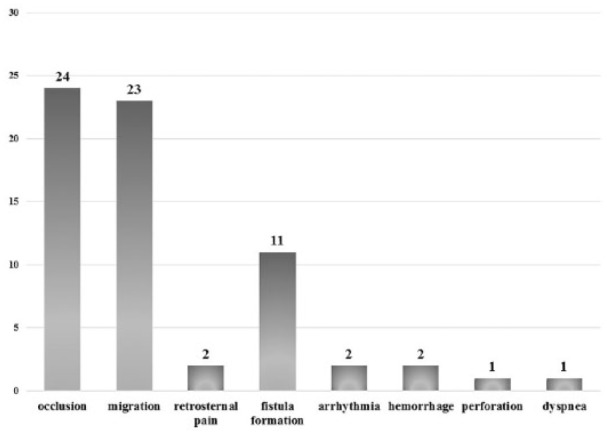
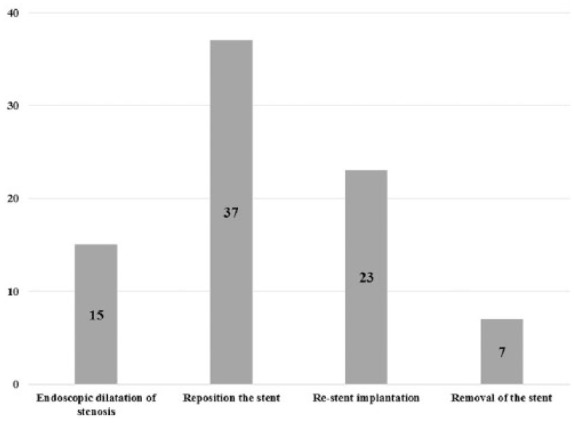
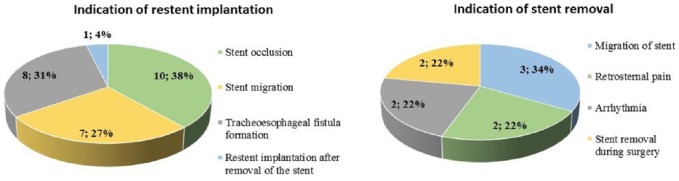
A total of 238 SEMS implantations were performed with 99.06% technical success and 1.26% procedure-related deaths in the enrolled 212 cases. Complications occurred in 84 patients (39.62%) and in 55 cases (25.94%) repeated endoscopic procedures were required. Early reintervention 24-48 h after the stent implantations was necessary due to stent migration (12 cases), arrhythmia (2 cases), intolerable retrosternal pain (1 case) and dyspnea (1 case). An average of 1.98 repeated gastroscopies (range 1-6; median 2), 13.58 weeks (range 1.5-48; median 11) after the stent implantation were performed during the follow-up period: 37 stent repositions, 23 restent implantations, 15 endoscopic esophageal dilations and 7 stent removals. In 48 cases (87.3%) oral feeding of patients was made possible by endoscopic interventions.
In a quarter of SEMS implantations, complications occur that can be successfully managed by endoscopic interventions. Our experiences have shown that individualized stent choice may substantially reduce the complications rate and make repeated endoscopic interventions easier.
自膨式金属支架(SEMS)植入术可迅速改善恶性食管狭窄和气管食管瘘(TEF)的症状。然而,吞咽困难随后常复发,可能需要重复进行内镜干预。本研究的目的是确定并发症的危险因素、重复内镜干预的频率和疗效,并提供关于合适支架选择的技术建议。
我们回顾性分析了212例局部晚期食管癌患者接受SEMS植入术的临床资料。
在纳入的212例病例中,共进行了238次SEMS植入术,技术成功率为99.06%,与手术相关的死亡率为1.26%。84例患者(39.62%)出现并发症,55例患者(25.94%)需要重复进行内镜操作。由于支架移位(12例)、心律失常(2例)、难以忍受的胸骨后疼痛(1例)和呼吸困难(1例),在支架植入后24 - 48小时需要进行早期再次干预。在随访期间,平均进行了1.98次重复胃镜检查(范围1 - 6次;中位数2次),在支架植入后13.58周(范围1.5 - 48周;中位数11周)进行:37次支架复位、23次再次支架植入、15次内镜下食管扩张和7次支架取出。通过内镜干预,48例患者(87.3%)能够经口进食。
在四分之一的SEMS植入术中会出现并发症,这些并发症可通过内镜干预成功处理。我们的经验表明,个体化的支架选择可能会显著降低并发症发生率,并使重复内镜干预更容易。