Chen Tao, Yang Sha, Chai Jinsong, Song Yongbo, Fan Jiqiang, Rao Bo, Sheng Hongting, Yu Haizhu, Zhu Manzhou
Department of Chemistry and Centre for Atomic Engineering of Advanced Materials, Anhui University, Hefei, Anhui 230601, P. R. China.
AnHui Province Key Laboratory of Chemistry for Inorganic/Organic Hybrid Functionalized Materials, Anhui University, Hefei, Anhui 230601, P. R. China.
Sci Adv. 2017 Aug 18;3(8):e1700956. doi: 10.1126/sciadv.1700956. eCollection 2017 Aug.
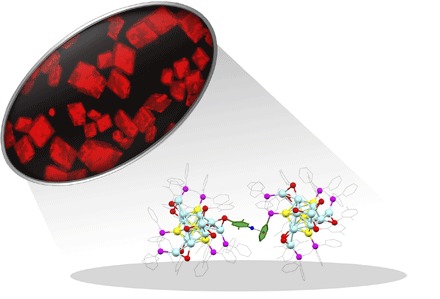
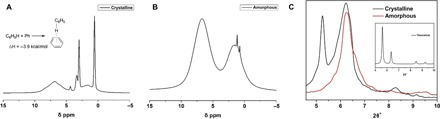
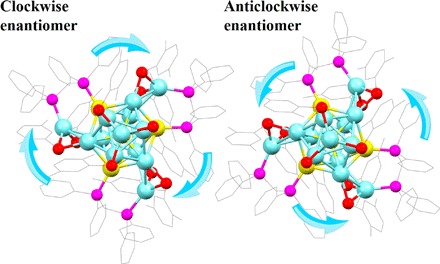
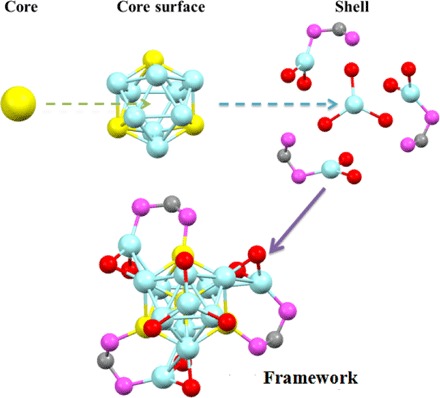
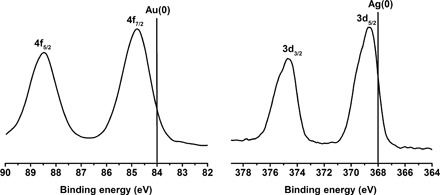
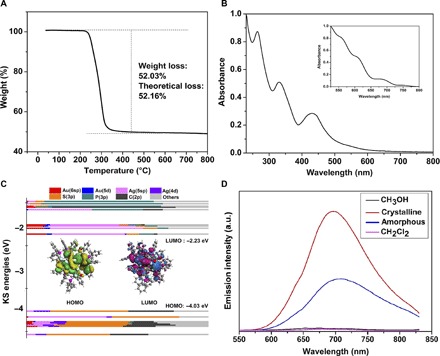
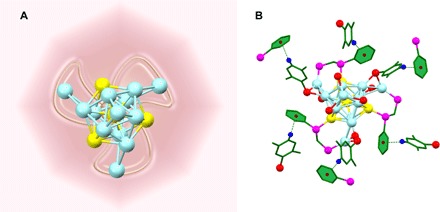
We report the first noble metal nanocluster with a formula of AuAg(DPPM)(SR) exhibiting crystallization-induced emission enhancement (CIEE), where DPPM denotes bis(diphenylphosphino)methane and HSR denotes 2,5-dimethylbenzenethiol. The precise atomic structure is determined by x-ray crystallography. The crystalline state of AuAg shows strong luminescence at 695 nm, in striking contrast to the weak emission of the amorphous state and hardly any emission in solution phase. The structural analysis and the density functional theory calculations imply that the compact C-H⋯π interactions significantly restrict the intramolecular rotations and vibrations and thus considerably enhance the radiative transitions in the crystalline state. Because the noncovalent interactions can be easily modulated via varying the chemical environments, the CIEE phenomenon might represent a general strategy to amplify the fluorescence from weakly (or even non-) emissive nanoclusters.
我们报道了首个化学式为AuAg(DPPM)(SR)的贵金属纳米团簇,其表现出结晶诱导发光增强(CIEE),其中DPPM表示双(二苯基膦基)甲烷,HSR表示2,5 - 二甲基苯硫酚。通过X射线晶体学确定了精确的原子结构。AuAg的晶体状态在695 nm处显示出强烈的发光,这与非晶态的微弱发射形成鲜明对比,并且在溶液相中几乎不发光。结构分析和密度泛函理论计算表明,紧密的C-H⋯π相互作用显著限制了分子内的旋转和振动,从而大大增强了晶体状态下的辐射跃迁。由于非共价相互作用可以通过改变化学环境轻松调节,CIEE现象可能代表了一种从弱(甚至无)发射纳米团簇放大荧光的通用策略。