Brandis Gerrit, Cao Sha, Huseby Douglas L, Hughes Diarmaid
Department of Medical Biochemistry and Microbiology, Biomedical Center, Uppsala University, Uppsala, Sweden.
Microb Cell. 2017 Aug 1;4(8):275-277. doi: 10.15698/mic2017.08.587.
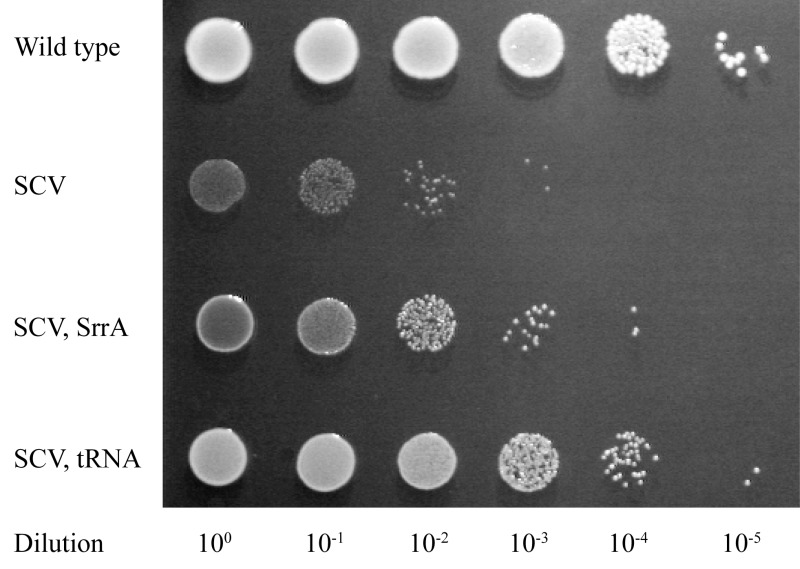
can produce small colony variants (SCVs) during infections. These cause significant clinical problems because they are difficult to detect in standard microbiological screening and are associated with persistent infections. The major causes of the SCV phenotype are mutations that inhibit respiration by inactivation of genes of the menadione or hemin biosynthesis pathways. This reduces the production of ATP required to support fast growth. Importantly, it also decreases cross-membrane potential in SCVs, resulting in decreased uptake of cationic compounds, with reduced susceptibility to aminoglycoside antibiotics as a consequence. Because SCVs are slow-growing (mutations in genes are associated with growth rates in rich medium ~30% of the wild-type growth rate) bacterial cultures are very susceptible to rapid takeover by faster-growing mutants (revertants or suppressors). In the case of reversion, the resulting fast growth is obviously associated with the loss of antibiotic resistance. However, direct reversion is relatively rare due to the very small genetic target size for such mutations. We explored the phenotypic consequences of SCVs evolving faster growth by routes other than direct reversion, and in particular whether any of those routes allowed for the maintenance of antibiotic resistance. In a recent paper (mBio 8: e00358-17) we demonstrated the existence of several different routes of SCV evolution to faster growth, one of which maintained the antibiotic resistance phenotype. This discovery suggests that SCVs might be more adaptable and problematic that previously thought. They are capable of surviving as a slow-growing persistent form, before evolving into a significantly faster-growing form without sacrificing their antibiotic resistance phenotype.
在感染过程中可产生小菌落变体(SCV)。这些变体引发了重大的临床问题,因为它们在标准微生物筛查中难以检测到,且与持续性感染相关。SCV表型的主要原因是通过甲萘醌或血红素生物合成途径的基因失活来抑制呼吸作用的突变。这减少了支持快速生长所需的ATP的产生。重要的是,这也降低了SCV中的跨膜电位,导致阳离子化合物的摄取减少,结果对氨基糖苷类抗生素的敏感性降低。由于SCV生长缓慢(基因中的突变与在丰富培养基中的生长速率相关,约为野生型生长速率的30%),细菌培养物极易被生长更快的突变体(回复体或抑制子)迅速取代。在回复的情况下,由此产生的快速生长显然与抗生素抗性的丧失有关。然而,由于此类突变的遗传靶点非常小,直接回复相对罕见。我们探索了SCV通过直接回复以外的途径进化出更快生长的表型后果,特别是这些途径中是否有任何一种允许维持抗生素抗性。在最近一篇论文(《mBio》8:e00358 - 17)中,我们证明了存在几种不同的SCV进化到更快生长的途径,其中一种维持了抗生素抗性表型。这一发现表明,SCV可能比之前认为的更具适应性且问题更大。它们能够以缓慢生长的持续形式存活,然后在不牺牲其抗生素抗性表型的情况下进化成明显更快生长的形式。