Thavarajah Dil, Abare Alex, Mapa Indika, Coyne Clarice J, Thavarajah Pushparajah, Kumar Shiv
Plant and Environmental Sciences, 270 Poole Agricultural Center, Clemson University, Clemson, SC 29634, USA.
USDA Agriculture Research Service, Western Regional Plant Introduction Station, Washington State University, Pullman, WA 99164-6434, USA.
Plants (Basel). 2017 Aug 26;6(3):34. doi: 10.3390/plants6030034.
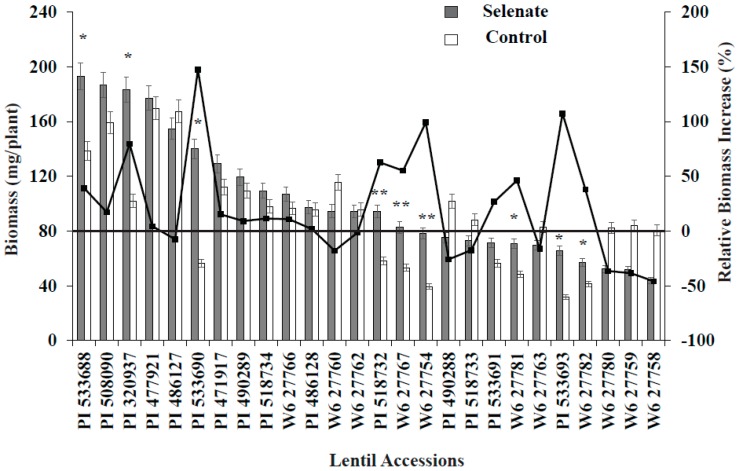
The biofortification of lentil ( Medikus.) has the potential to provide adequate daily selenium (Se) to human diets. The objectives of this study were to (1) determine how low-dose Se fertilizer application at germination affects seedling biomass, antioxidant activity, and Se uptake of 26 cultivated lentil genotypes; and (2) quantify the seed Se concentration of 191 lentil wild accessions grown in Terbol, Lebanon. A germination study was conducted with two Se treatments [0 (control) and 30 kg of Se/ha] with three replicates. A separate field study was conducted in Lebanon for wild accessions without Se fertilizer. Among cultivated lentil accessions, PI533690 and PI533693 showed >100% biomass increase vs.
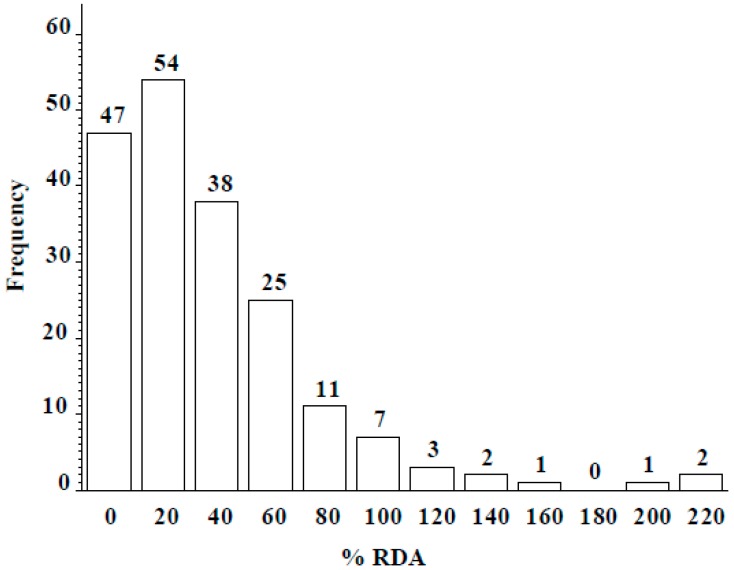
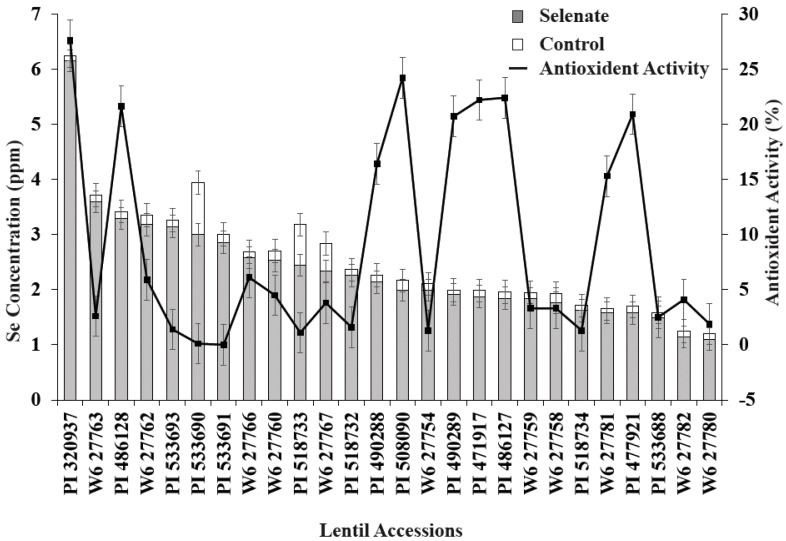
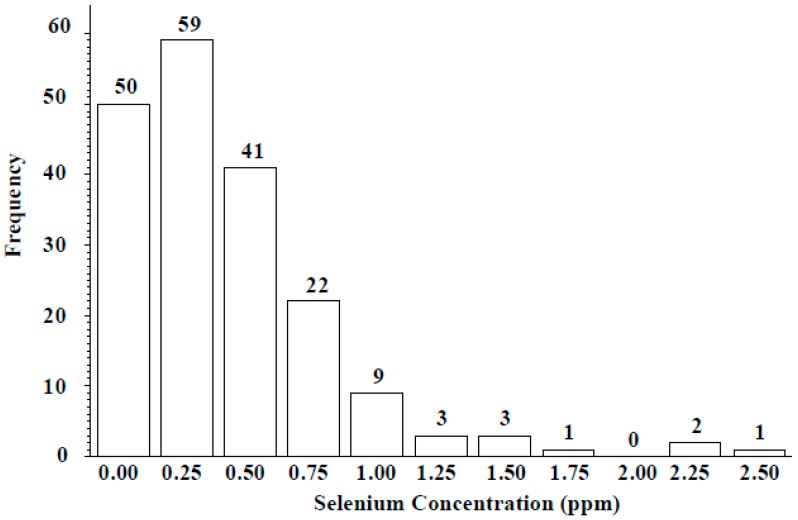
Se addition significantly increased seedling Se uptake, with the greatest uptake (6.2 µg g) by PI320937 and the least uptake (1.1 µg g) by W627780. Seed Se concentrations of wild accessions ranged from 0 to 2.5 µg g; accessions originating from Syria (0-2.5 µg g) and Turkey (0-2.4 µg g) had the highest seed Se. Frequency distribution analysis revealed that seed Se for 63% of accessions was between 0.25 and 0.75 µg g, and thus a single 50 g serving of lentil has the potential to provide adequate dietary Se (20-60% of daily recommended daily allowance). As such, Se application during plant growth for certain lentil genotypes grown in low Se soils may be a sustainable Se biofortification solution to increase seed Se concentration. Incorporating a diverse panel of lentil wild germplasm into Se biofortification programs will increase genetic diversity for effective genetic mapping for increased lentil seed Se nutrition and plant productivity.
小扁豆(Medikus.)的生物强化有潜力为人类饮食提供足够的每日硒摄入量。本研究的目的是:(1)确定在发芽时施用低剂量硒肥如何影响26个栽培小扁豆基因型的幼苗生物量、抗氧化活性和硒吸收;(2)量化在黎巴嫩特尔博尔种植的191个小扁豆野生种质的种子硒浓度。进行了一项发芽研究,设置两种硒处理[0(对照)和30千克硒/公顷],重复三次。在黎巴嫩对野生种质进行了一项单独的田间研究,不施硒肥。在栽培小扁豆种质中,PI533690和PI533693的生物量比对照增加了100%以上。
添加硒显著增加了幼苗对硒的吸收,PI320937吸收量最大(6.2微克/克),W627780吸收量最小(1.1微克/克)。野生种质的种子硒浓度范围为0至2.5微克/克;来自叙利亚(0至2.5微克/克)和土耳其(0至2.4微克/克)的种质种子硒含量最高。频率分布分析表明,63%的种质种子硒含量在0.25至0.75微克/克之间,因此一份50克的小扁豆有可能提供足够的膳食硒(占每日推荐摄入量的20 - 60%)。因此,在低硒土壤中种植某些小扁豆基因型时,在植物生长期间施用硒可能是一种可持续的生物强化解决方案,以提高种子硒浓度。将不同的小扁豆野生种质纳入硒生物强化计划将增加遗传多样性,以便进行有效的基因定位,从而提高小扁豆种子硒营养和植物生产力。