Sharott Andrew, Vinciati Federica, Nakamura Kouichi C, Magill Peter J
Medical Research Council Brain Network Dynamics Unit, University of Oxford, Oxford OX1 3TH, United Kingdom, and
Medical Research Council Brain Network Dynamics Unit, University of Oxford, Oxford OX1 3TH, United Kingdom, and.
J Neurosci. 2017 Oct 11;37(41):9977-9998. doi: 10.1523/JNEUROSCI.0658-17.2017. Epub 2017 Aug 28.
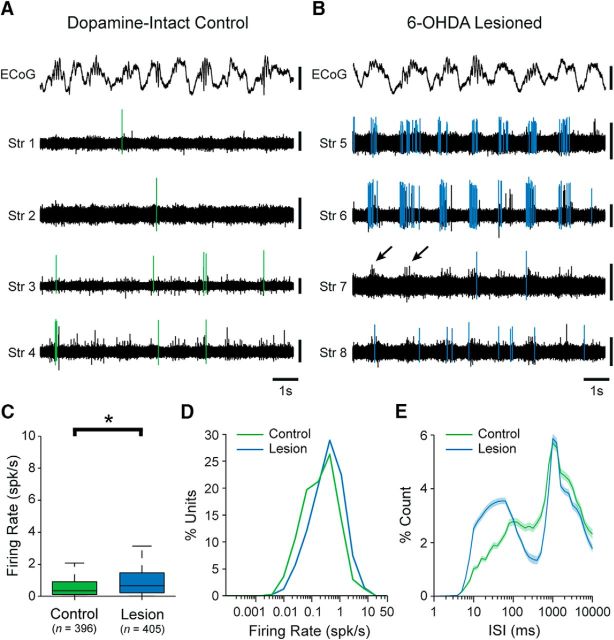
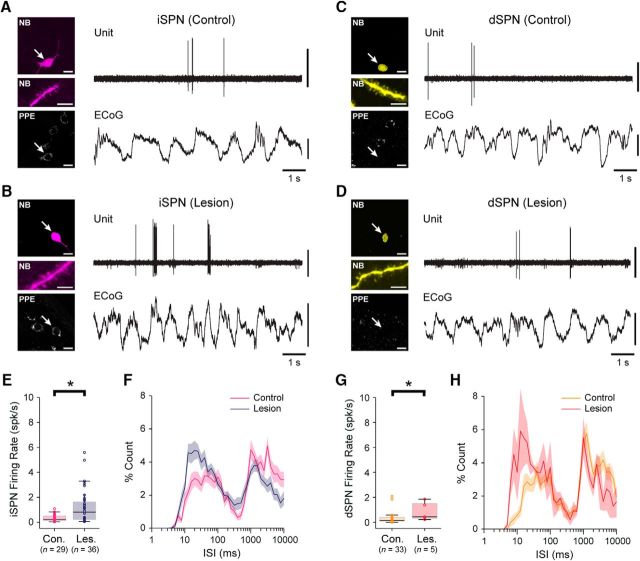
Classical schemes of basal ganglia organization posit that parkinsonian movement difficulties presenting after striatal dopamine depletion stem from the disproportionate firing rates of spiny projection neurons (SPNs) therein. There remains, however, a pressing need to elucidate striatal SPN firing in the context of the synchronized network oscillations that are abnormally exaggerated in cortical-basal ganglia circuits in parkinsonism. To address this, we recorded unit activities in the dorsal striatum of dopamine-intact and dopamine-depleted rats during two brain states, respectively defined by cortical slow-wave activity (SWA) and activation. Dopamine depletion escalated striatal net output but had contrasting effects on "direct pathway" SPNs (dSPNs) and "indirect pathway" SPNs (iSPNs); their firing rates became imbalanced, and they disparately engaged in network oscillations. Disturbed striatal activity dynamics relating to the slow (∼1 Hz) oscillations prevalent during SWA partly generalized to the exaggerated beta-frequency (15-30 Hz) oscillations arising during cortical activation. In both cases, SPNs exhibited higher incidences of phase-locked firing to ongoing cortical oscillations, and SPN ensembles showed higher levels of rhythmic correlated firing, after dopamine depletion. Importantly, in dopamine-depleted striatum, a widespread population of iSPNs, which often displayed excessive firing rates and aberrant phase-locked firing to cortical beta oscillations, preferentially and excessively synchronized their firing at beta frequencies. Conversely, dSPNs were neither hyperactive nor synchronized to a large extent during cortical activation. These data collectively demonstrate a cell type-selective entrainment of SPN firing to parkinsonian beta oscillations. We conclude that a population of overactive, excessively synchronized iSPNs could orchestrate these pathological rhythms in basal ganglia circuits. Chronic depletion of dopamine from the striatum, a part of the basal ganglia, causes some symptoms of Parkinson's disease. Here, we elucidate how dopamine depletion alters striatal neuron firing , with an emphasis on defining whether and how spiny projection neurons (SPNs) engage in the synchronized beta-frequency (15-30 Hz) oscillations that become pathologically exaggerated throughout basal ganglia circuits in parkinsonism. We discovered that a select population of so-called "indirect pathway" SPNs not only fire at abnormally high rates, but are also particularly prone to being recruited to exaggerated beta oscillations. Our results provide an important link between two complementary theories that explain the presentation of disease symptoms on the basis of changes in firing rate or firing synchronization/rhythmicity.
基底神经节组织的经典模式认为,纹状体多巴胺耗竭后出现的帕金森氏症运动困难源于其中棘状投射神经元(SPN)的 firing 率不成比例。然而,在帕金森病中,皮质 - 基底神经节回路中异常夸大的同步网络振荡背景下,仍迫切需要阐明纹状体 SPN 的 firing 情况。为了解决这个问题,我们分别在两种脑状态下记录了多巴胺完整和多巴胺耗竭大鼠背侧纹状体的单位活动,这两种脑状态分别由皮质慢波活动(SWA)和激活来定义。多巴胺耗竭使纹状体净输出增加,但对“直接通路”SPN(dSPN)和“间接通路”SPN(iSPN)有相反的影响;它们的 firing 率变得不平衡,并且它们以不同方式参与网络振荡。与 SWA 期间普遍存在的缓慢(约 1Hz)振荡相关的纹状体活动动态紊乱部分扩展到皮质激活期间出现的夸大的β频率(15 - 30Hz)振荡。在这两种情况下,多巴胺耗竭后,SPN 对正在进行的皮质振荡表现出更高的锁相 firing 发生率,并且 SPN 集合表现出更高水平的节律相关 firing。重要的是,在多巴胺耗竭的纹状体中,大量的 iSPN,其通常表现出过高的 firing 率和对皮质β振荡的异常锁相 firing,优先且过度地在β频率上同步它们的 firing。相反,在皮质激活期间,dSPN 既不过度活跃也没有在很大程度上同步。这些数据共同证明了 SPN firing 对帕金森氏症β振荡的细胞类型选择性夹带。我们得出结论,一群过度活跃、过度同步的 iSPN 可能在基底神经节回路中编排这些病理节律。基底神经节的一部分纹状体中多巴胺的慢性耗竭会导致帕金森病的一些症状。在这里,我们阐明了多巴胺耗竭如何改变纹状体神经元的 firing,重点是确定棘状投射神经元(SPN)是否以及如何参与同步的β频率(15 - 30Hz)振荡,这种振荡在帕金森病中整个基底神经节回路中会病理性地夸大。我们发现一群所谓的“间接通路”SPN 不仅以异常高的速率 firing,而且特别容易被招募到夸大的β振荡中。我们的结果在两种互补理论之间提供了一个重要联系,这两种理论基于 firing 率或 firing 同步/节律性的变化来解释疾病症状的表现。