Qureshi Aslam Hyder, Ajayi Oluwaseun, Schwaderer Andrew Lawrence, Hains David S
Innate Immunity Translational Research Center, Children Foundation Research Institute, Le Bonheur Children's Hospital, Memphis, TN, United States.
Department of Pediatrics, University of Tennessee Health Science Center, Memphis, TN, United States.
Front Pediatr. 2017 Aug 11;5:175. doi: 10.3389/fped.2017.00175. eCollection 2017.
To find the trend in patient's visits to our centers for vesicoureteral reflux (VUR). We hypothesize that VUR diagnosis and hence possible nephropathy recognition may be diminishing because of changing practice patterns.
Data were extracted from electronic medical records for new and follow-up patients aged 0-18 years with ICD-9/10 codes to correspond with VUR, VUR unilateral, VUR bilateral, and VUR with reflux nephropathy, as well as new patients with diagnoses of urinary tract infections (UTI) and pyelonephritis at two major pediatric centers from 2012 to 2015. Figures and statistics to reflect absolute clinic visits and annual trends were created with SPSS 2010. Linear regression was applied.
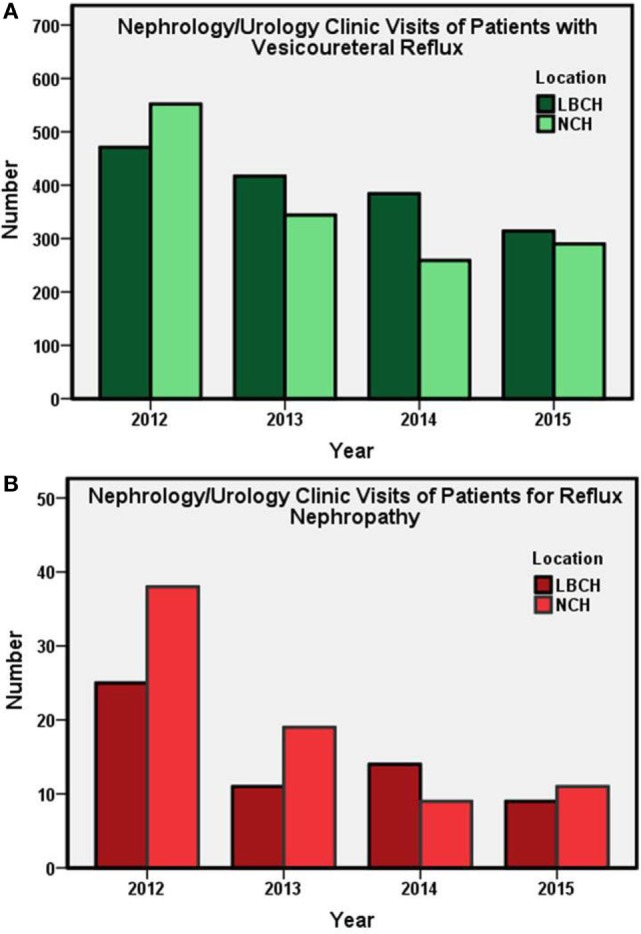
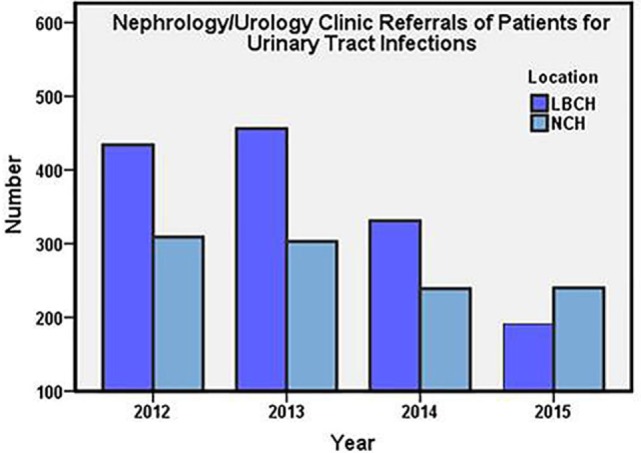
Annually, Le Bonheur Children's Hospital and Nationwide Children's Hospital experienced an average decrease of 13 and 17% in total VUR visits, and an average decrease of 22 and 27% in VUR nephropathy visits, respectively, for each institution. Patient visits for UTIs were reduced an average of 16% annually in both centers. Linear regression demonstrated that number of patients (patients/year ± SE) decreased annually 69 ± 19 ( = 0.02), 7 ± 2 ( = 0.02), and 67 ± 25 ( = 0.04) for VUR, VUR nephropathy, and UTI, respectively.
We conclude that the decreased number of VUR and VUR nephropathy cases identified in subspecialty clinics (Nephrology/Urology) at two major children's hospitals reflect a possible decreased identification of VUR. This trend may also be due to decreased referral of low grade cases of VUR. We cannot conclude that "undifferentiated UTI" referrals increased concomitantly to account for the decreased VUR as our data reflects a decreased trend in those visits as well. We suggest that clinicians following the American Academy of Pediatrics guidelines ensure that all UTI are accounted for and surveillance is appropriately escalated for recurrent UTI or abnormal imaging results.
探究患者前来我们中心就诊膀胱输尿管反流(VUR)的趋势。我们推测,由于诊疗模式的变化,VUR的诊断以及由此可能识别出的肾病可能正在减少。
从电子病历中提取2012年至2015年期间两家主要儿科中心0至18岁新患者及随访患者的数据,这些患者的ICD - 9/10编码与VUR、单侧VUR、双侧VUR以及伴有反流性肾病的VUR相对应,同时还包括诊断为尿路感染(UTI)和肾盂肾炎的新患者。使用SPSS 2010生成反映绝对门诊量和年度趋势的图表及统计数据。应用线性回归分析。
每年,勒博内尔儿童医院和全国儿童医院的VUR总就诊量平均分别下降13%和17%,VUR肾病就诊量平均分别下降22%和27%。两个中心UTI患者就诊量每年平均下降16%。线性回归分析表明,VUR、VUR肾病和UTI的患者数量(每年患者数±标准误)分别每年下降69±19(P = 0.02)、7±2(P = 0.02)和67±25(P = 0.04)。
我们得出结论,两家主要儿童医院专科门诊(肾病科/泌尿科)中VUR和VUR肾病病例数量的减少反映出VUR的识别可能减少。这种趋势也可能是由于低级别VUR病例的转诊减少。我们不能得出“未分化UTI”转诊量随之增加以解释VUR减少的结论,因为我们的数据也反映出这些就诊量呈下降趋势。我们建议遵循美国儿科学会指南的临床医生确保对所有UTI进行记录,并针对复发性UTI或异常影像学结果适当加强监测。