Department of Rheumatology, The First People's Hospital of Lianyungang, Lianyungang, Jiangsu 222002, P.R. China.
Mol Med Rep. 2017 Oct;16(4):5257-5262. doi: 10.3892/mmr.2017.7285. Epub 2017 Aug 18.
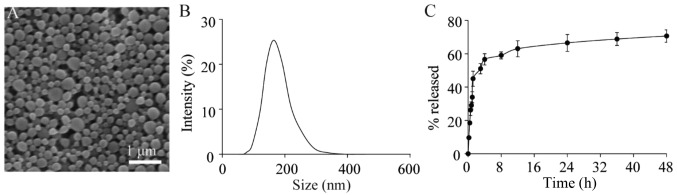
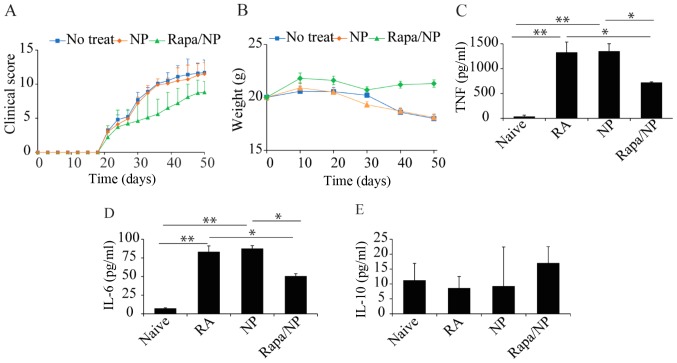
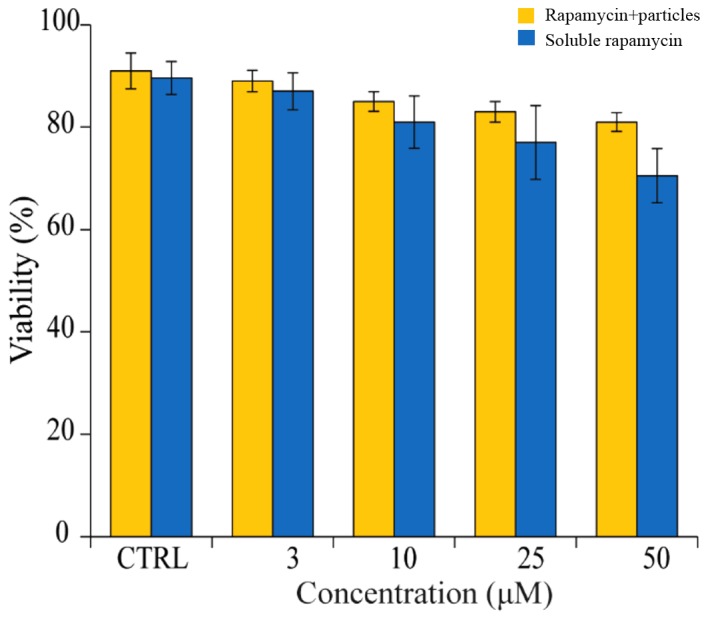
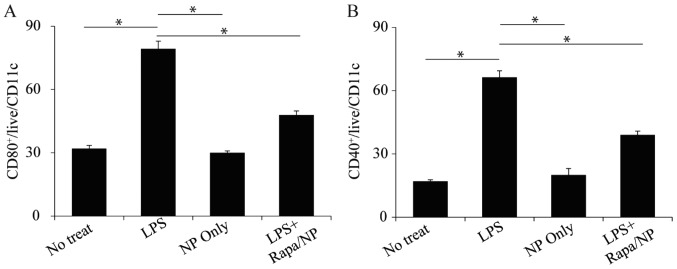
Rheumatoid arthritis (RA) is a chronic inflammatory disease, which is associated with symptoms, including synovial membrane inflammatory pain, joint synovitis and stiffness. However, there are no effective methods available to cure this disease. In the present study, rapamycin was used to modulate immunity in RA. To limit the cytotoxicity of rapamycin, rapamycin was loaded into well‑characterized biocompatible nanoparticles. In vitro, rapamycin particles downregulated the activation of dendritic cell surface markers, including CD80+ and CD40+, upon interacting with macrophages. The rapamycin particles reduced the secretion of inflammatory cytokines, including interleukin (IL)‑6, tumor necrosis factor (TNF) and IL‑1β, which are characteristic of RA. In vivo, the rapamycin particles decreased the symptoms of RA in mice, and the production of inflammatory cytokines was associated with the occurrence of RA. The present study partially revealed the interactions between rapamycin and two types of immune cell in RA disease, and may potentially offer a solution to improve the treatment of RA.
类风湿关节炎(RA)是一种慢性炎症性疾病,其症状包括滑膜膜炎症性疼痛、关节滑膜炎和僵硬。然而,目前尚无有效的方法可以治愈这种疾病。在本研究中,雷帕霉素被用于调节 RA 的免疫。为了限制雷帕霉素的细胞毒性,将雷帕霉素装载到具有良好特性的生物相容性纳米颗粒中。体外实验中,雷帕霉素颗粒与巨噬细胞相互作用时,下调树突状细胞表面标志物(包括 CD80+和 CD40+)的激活。雷帕霉素颗粒减少了炎症细胞因子(包括白细胞介素(IL)-6、肿瘤坏死因子(TNF)和 IL-1β)的分泌,这些细胞因子是 RA 的特征。在体内,雷帕霉素颗粒减轻了小鼠的 RA 症状,并且炎症细胞因子的产生与 RA 的发生有关。本研究部分揭示了雷帕霉素与 RA 疾病中两种类型免疫细胞之间的相互作用,可能为改善 RA 的治疗提供一种解决方案。