Brain Center, Shenzhen Key Laboratory of Neurosurgery, Shenzhen Second People's Hospital, Shenzhen University 1st Affiliated Hospital, Shenzhen, Guangdong 518035, P.R. China.
Mol Med Rep. 2017 Nov;16(5):5908-5914. doi: 10.3892/mmr.2017.7325. Epub 2017 Aug 22.
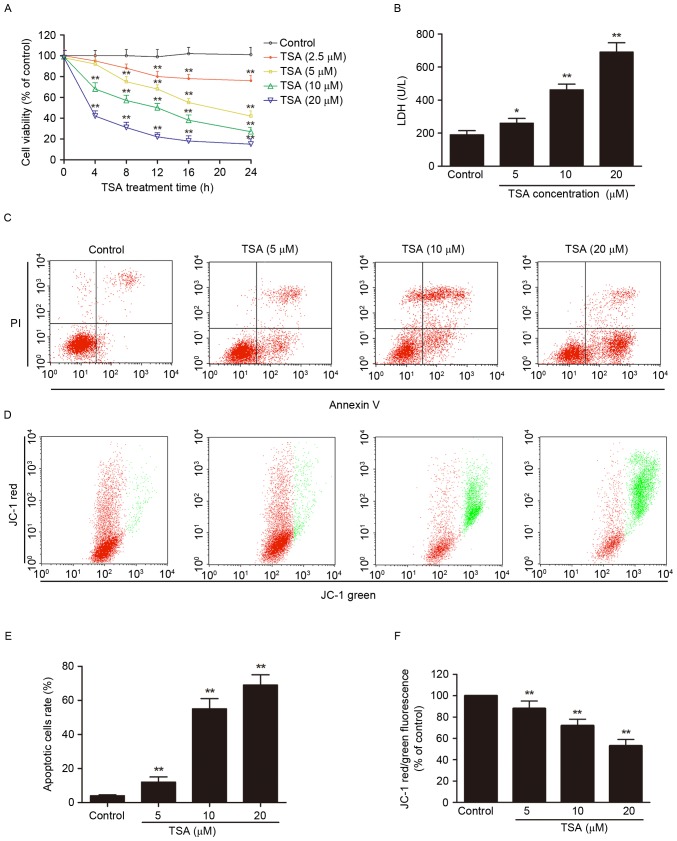
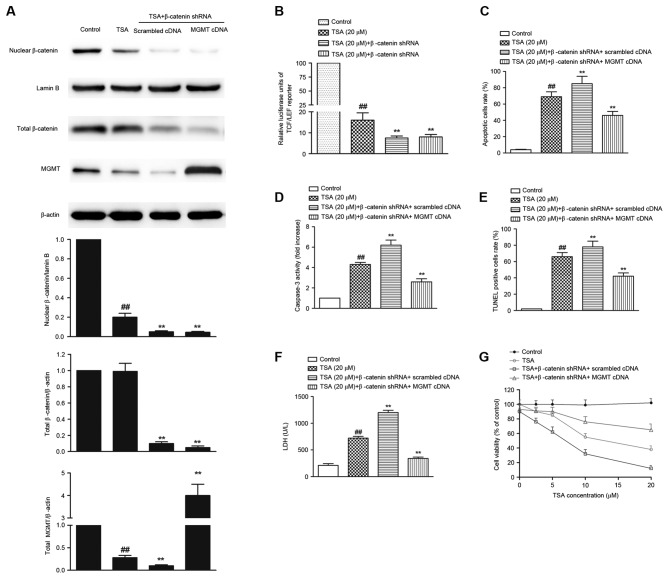
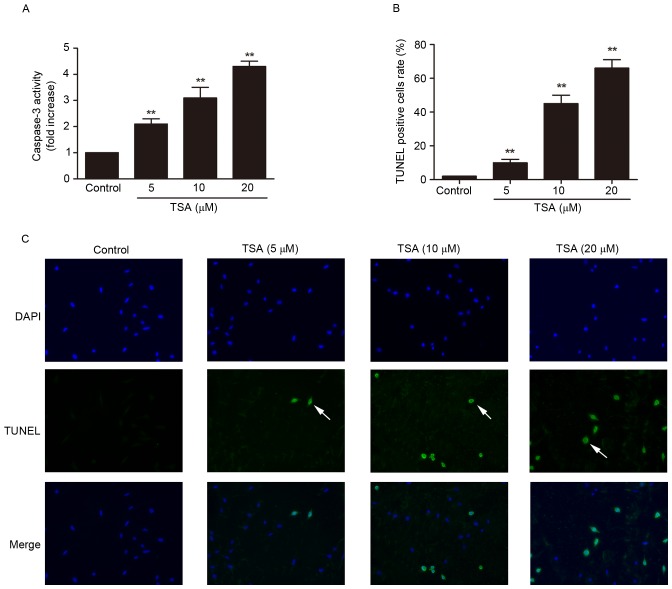
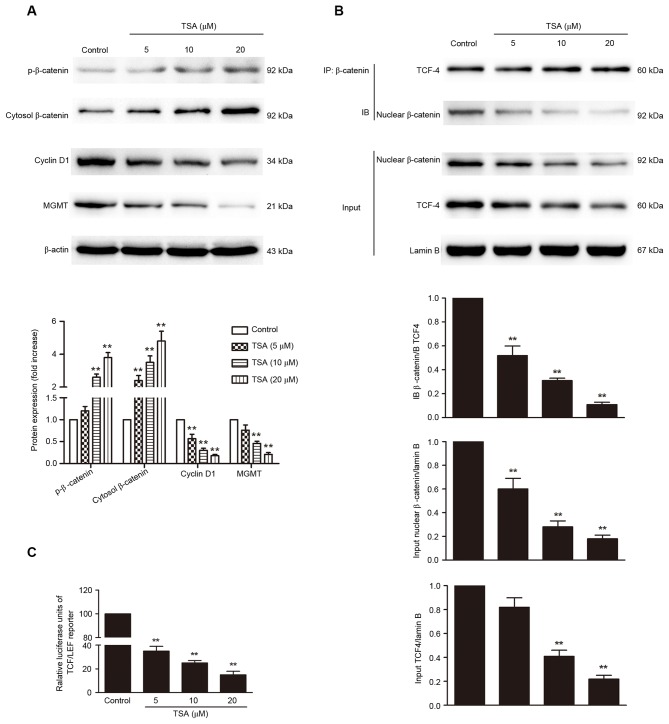
A strategy to suppress the expression of the DNA repair enzyme O6‑methylguanine‑DNA methyltransferase (MGMT) by inhibition of Wnt/β‑catenin signaling may be useful as a novel treatment for pituitary adenoma. Previous studies have reported that Tanshinone IIA (TSA), a major quinone compound isolated from Salvia miltiorrhiza, had antitumor effects. However, whether TSA has antitumor effects against pituitary adenoma and whether the mechanisms are associated with the Wnt/β‑catenin/MGMT pathway remains to be clarified. In the present study, TSA treatment caused apoptosis in AtT‑20 cells in a concentration‑dependent manner, as demonstrated by cell viability reduction, phophatidylserine externalization detected by Annexin V staining and mitochondrial membrane potential disruption detected by JC‑1 staining, which were associated with activation of caspase‑3 and DNA fragmentation detected by TUNEL in AtT‑20 cells. T‑cell factor (TCF)‑lymphoid‑enhancing factor (LEF) reporter activity was determined by dual luciferase reporter assay and the interaction between β‑catenin and TCF‑4 were detected using a co‑immunoprecipitation kit. The results indicated TSA treatment increased β‑catenin phosphorylation, inhibited β‑catenin nuclear translocation, reduced β‑catenin/TCF‑4 complex formation and TCF‑LEF luciferase reporter activity, and subsequently reduced the expression of cyclin D1 and MGMT. Notably, overexpression of MGMT in β‑catenin knock down AtT‑20 cells abrogated the TSA‑mediated effects in AtT‑20 cells. In conclusion, TSA induced apoptosis via inhibition of Wnt/β‑catenin‑dependent MGMT expression, which may provide novel insights into the understanding of the mechanism of the antitumor effects of Salvia miltiorrhiza.
通过抑制 Wnt/β-catenin 信号来抑制 DNA 修复酶 O6-甲基鸟嘌呤-DNA 甲基转移酶 (MGMT) 的表达的策略可能是治疗垂体腺瘤的一种新方法。先前的研究表明,丹参酮 IIA (TSA) 是从丹参中分离出来的一种主要醌类化合物,具有抗肿瘤作用。然而,TSA 是否对垂体腺瘤具有抗肿瘤作用,以及机制是否与 Wnt/β-catenin/MGMT 途径有关,仍有待阐明。在本研究中,TSA 处理以浓度依赖性方式引起 AtT-20 细胞凋亡,这表现在细胞活力降低、Annexin V 染色检测到的磷脂酰丝氨酸外化以及 JC-1 染色检测到的线粒体膜电位破坏,与 caspase-3 激活和 AtT-20 细胞中的 DNA 片段化有关。通过双荧光素酶报告基因检测 TCF-淋巴增强因子 (LEF) 报告活性,并使用共免疫沉淀试剂盒检测 β-catenin 和 TCF-4 之间的相互作用。结果表明,TSA 处理增加了 β-catenin 的磷酸化,抑制了 β-catenin 的核转位,减少了 β-catenin/TCF-4 复合物的形成和 TCF-LEF 荧光素酶报告活性,随后降低了 cyclin D1 和 MGMT 的表达。值得注意的是,在β-catenin 敲低的 AtT-20 细胞中转染 MGMT 过表达可消除 TSA 在 AtT-20 细胞中的作用。总之,TSA 通过抑制 Wnt/β-catenin 依赖性 MGMT 表达诱导细胞凋亡,这可能为理解丹参抗肿瘤作用的机制提供新的见解。