Joensuu Heikki, Blay Jean-Yves, Comandone Alessandro, Martin-Broto Javier, Fumagalli Elena, Grignani Giovanni, Del Muro Xavier Garcia, Adenis Antoine, Valverde Claudia, Pousa Antonio Lopez, Bouché Olivier, Italiano Antoine, Bauer Sebastian, Barone Carlo, Weiss Claudia, Crippa Stefania, Camozzi Maura, Castellana Ramon, Le Cesne Axel
Department of Oncology, Helsinki University Hospital and University of Helsinki, Haartmaninkatu 4, Helsinki, Finland.
University Claude Bernard Lyon I, Centre Leon Berard, Lyon, France.
Br J Cancer. 2017 Oct 24;117(9):1278-1285. doi: 10.1038/bjc.2017.290. Epub 2017 Aug 29.
This multicentre phase II trial (DOVIGIST) evaluated the antitumour activity of dovitinib as second-line treatment of patients with gastrointestinal stromal tumour (GIST) refractory to imatinib or who do not tolerate imatinib.
Patients received oral dovitinib 500 mg day, 5 days on/2 days off, until GIST progression or unacceptable toxicity, with an objective to evaluate efficacy, assessed as the disease control rate (DCR) at 12 weeks. Tumour assessment and response to dovitinib therapy were evaluated by Response Evaluation Criteria In Solid Tumours (RECIST v1.1) and the Choi criteria. Secondary objectives included assessment of progression-free survival (PFS), safety and tolerability, and DCR at the end of treatment.
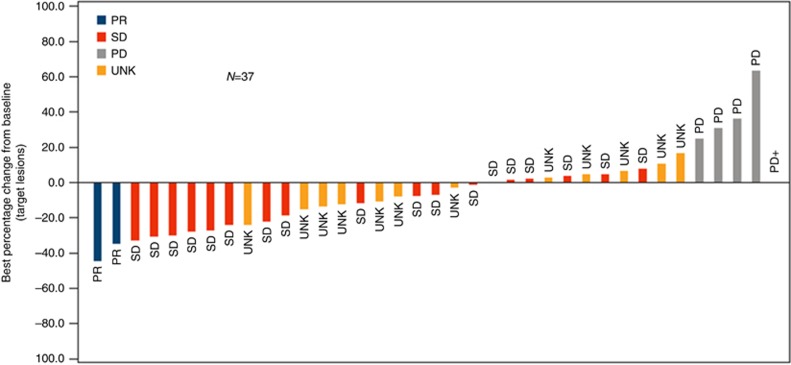
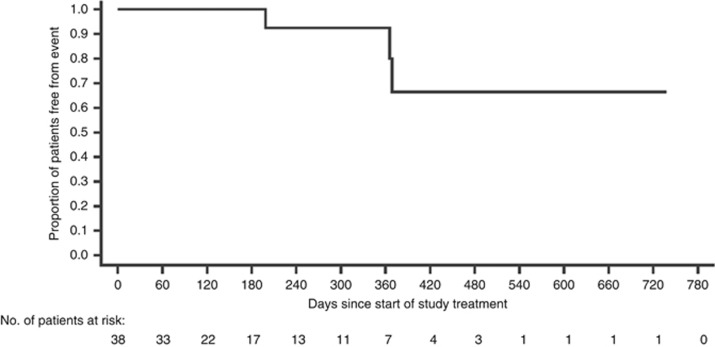
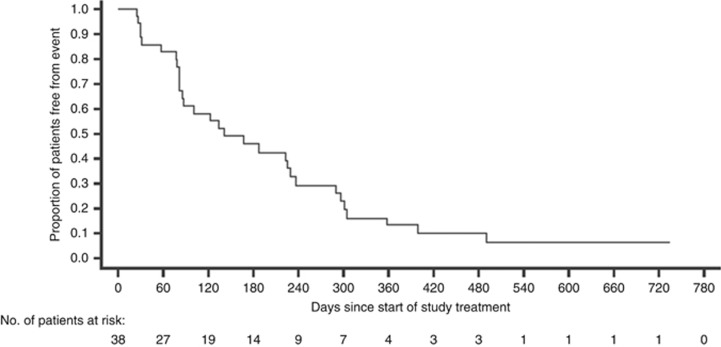
Thirty-eight of the 39 patients enrolled had histologically confirmed GIST. The DCR at 12 weeks was 52.6% (90% confidence interval (CI), 38.2-66.7%) meeting the preset efficacy criterion for the primary end point. The objective response rate (complete response+partial response) was 2.6% (1 of 38; 90% CI, 0.1-11.9%), and 5.3% (n=2; 90% CI, 0.9-15.7%) at the end of the study. The median PFS was 4.6 months (90% CI, 2.8-7.4 months). Dose interruption was required in 26 patients (66.7%), of which 18 (69.2%) were due to adverse events. The most frequently observed grade 3 adverse events included hypertension (n=7), fatigue (n=5), vomiting (n=4), hypertriglyceridaemia (n=4), and γ-glutamyltransferase increase (n=4).
Dovitinib is an active treatment for patients with GIST who are intolerant to imatinib or whose GIST progresses on imatinib.
这项多中心II期试验(DOVIGIST)评估了多韦替尼作为伊马替尼难治或不耐受的胃肠道间质瘤(GIST)患者二线治疗的抗肿瘤活性。
患者接受口服多韦替尼500毫克/天,服用5天,停药2天,直至GIST进展或出现不可接受的毒性,目的是评估疗效,以12周时的疾病控制率(DCR)进行评估。通过实体瘤疗效评价标准(RECIST v1.1)和Choi标准评估肿瘤评估和对多韦替尼治疗的反应。次要目标包括评估无进展生存期(PFS)、安全性和耐受性以及治疗结束时的DCR。
入组的39例患者中有38例经组织学确诊为GIST。12周时的DCR为52.6%(90%置信区间(CI),38.2 - 66.7%),达到了主要终点的预设疗效标准。客观缓解率(完全缓解 + 部分缓解)为2.6%(38例中的1例;90% CI,0.1 - 11.9%),研究结束时为5.3%(n = 2;90% CI,0.9 - 15.7%)。中位PFS为4.6个月(90% CI,2.8 - 7.4个月)。26例患者(66.7%)需要中断剂量,其中18例(69.2%)是由于不良事件。最常观察到的3级不良事件包括高血压(n = 7)、疲劳(n = 5)、呕吐(n = 4)、高甘油三酯血症(n = 4)和γ-谷氨酰转移酶升高(n = 4)。
多韦替尼对于不耐受伊马替尼或伊马替尼治疗期间GIST进展的患者是一种有效的治疗方法。