Wisniewski Nicholas, Bondar Galyna, Rau Christoph, Chittoor Jay, Chang Eleanor, Esmaeili Azadeh, Cadeiras Martin, Deng Mario
Department of Medicine, Division of Cardiology, University of California Los Angeles, 100 UCLA Medical Plaza, Suite 630, Los Angeles, California, 90095, USA.
Department of Integrative Biology and Physiology, University of California Los Angeles, 612 Charles E. Young Drive East, Los Angeles, California, 90095, USA.
BMC Med Genomics. 2017 Aug 29;10(1):52. doi: 10.1186/s12920-017-0288-8.
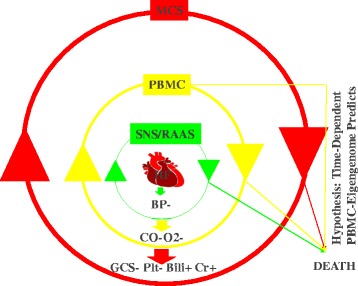
The implantation of mechanical circulatory support devices in heart failure patients is associated with a systemic inflammatory response, potentially leading to death from multiple organ dysfunction syndrome. Previous studies point to the involvement of many mechanisms, but an integrative hypothesis does not yet exist. Using time-dependent whole-genome mRNA expression in circulating leukocytes, we constructed a systems-model to improve mechanistic understanding and prediction of adverse outcomes.
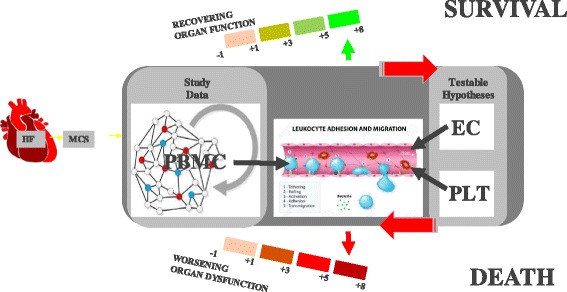
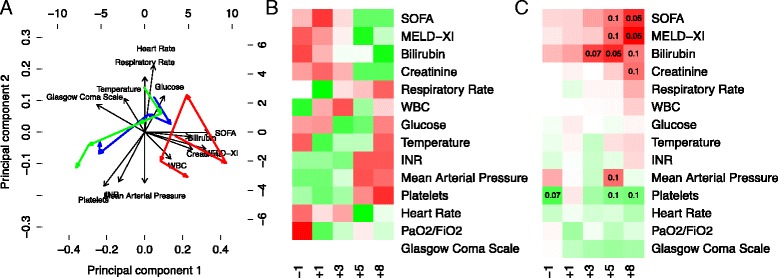
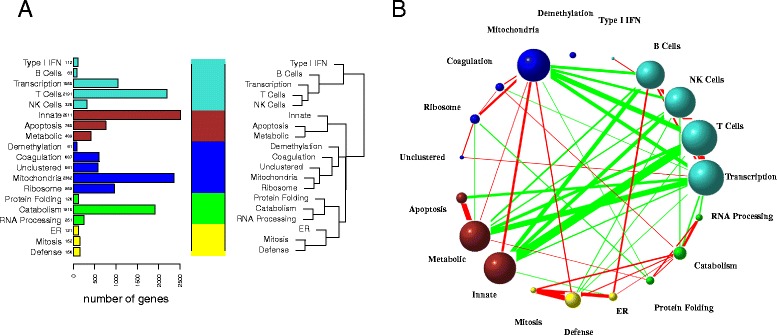
We sampled peripheral blood mononuclear cells from 22 consecutive patients undergoing mechanical circulatory support device (MCS) surgery, at 5 timepoints: day -1 preoperative, and postoperative days 1, 3, 5, and 8. Clinical phenotyping was performed using 12 clinical parameters, 2 organ dysfunction scoring systems, and survival outcomes. We constructed a strictly phenotype-driven time-dependent non-supervised systems-representation using weighted gene co-expression network analysis, and annotated eigengenes using gene ontology, pathway, and transcription factor binding site enrichment analyses. Genes and eigengenes were mapped to the clinical phenotype using a linear mixed-effect model, with Cox models also fit at each timepoint to survival outcomes.
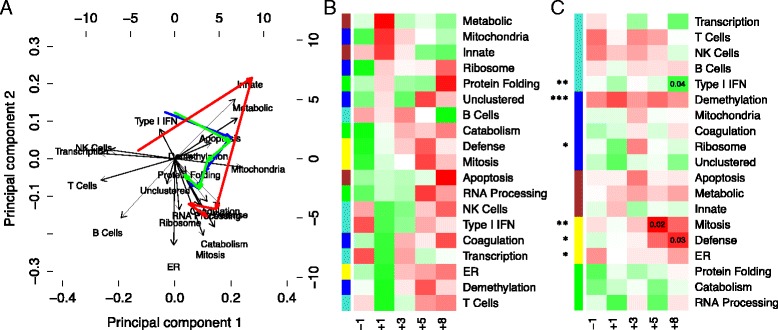
We inferred a 19-module network, in which most module eigengenes correlated with at least one aspect of the clinical phenotype. We observed a response of advanced heart failure patients to surgery orchestrated into stages: first, activation of the innate immune response, followed by anti-inflammation, and finally reparative processes such as mitosis, coagulation, and apoptosis. Eigengenes related to red blood cell production and extracellular matrix degradation became predictors of survival late in the timecourse corresponding to multiorgan dysfunction and disseminated intravascular coagulation.
Our model provides an integrative representation of leukocyte biology during the systemic inflammatory response following MCS device implantation. It demonstrates consistency with previous hypotheses, identifying a number of known mechanisms. At the same time, it suggests novel hypotheses about time-specific targets.
心力衰竭患者植入机械循环支持装置与全身炎症反应相关,这可能导致多器官功能障碍综合征死亡。以往研究指出多种机制的参与,但尚未存在一个综合假说。利用循环白细胞中随时间变化的全基因组mRNA表达,我们构建了一个系统模型,以提高对不良结局的机制理解和预测。
我们在5个时间点采集了22例连续接受机械循环支持装置(MCS)手术患者的外周血单核细胞:术前第-1天以及术后第1、3、5和8天。使用12项临床参数、2种器官功能障碍评分系统和生存结局进行临床表型分析。我们使用加权基因共表达网络分析构建了一个严格由表型驱动的随时间变化的非监督系统表征,并使用基因本体、通路和转录因子结合位点富集分析对特征基因进行注释。使用线性混合效应模型将基因和特征基因映射到临床表型,同时在每个时间点使用Cox模型拟合生存结局。
我们推断出一个19模块网络,其中大多数模块特征基因与临床表型的至少一个方面相关。我们观察到晚期心力衰竭患者对手术的反应分为几个阶段:首先是先天免疫反应的激活,随后是抗炎反应,最后是有丝分裂、凝血和凋亡等修复过程。与红细胞生成和细胞外基质降解相关的特征基因在对应多器官功能障碍和弥散性血管内凝血的病程后期成为生存的预测指标。
我们的模型提供了MCS装置植入后全身炎症反应期间白细胞生物学的综合表征。它与先前的假说一致,识别出许多已知机制。同时,它提出了关于时间特异性靶点的新假说。