Picco Louisa, Lau Ying Wen, Pang Shirlene, Abdin Edimansyah, Vaingankar Janhavi Ajit, Chong Siow Ann, Subramaniam Mythily
Research Division, Institute of Mental Health, Singapore.
BMJ Open. 2017 Aug 29;7(8):e018228. doi: 10.1136/bmjopen-2017-018228.
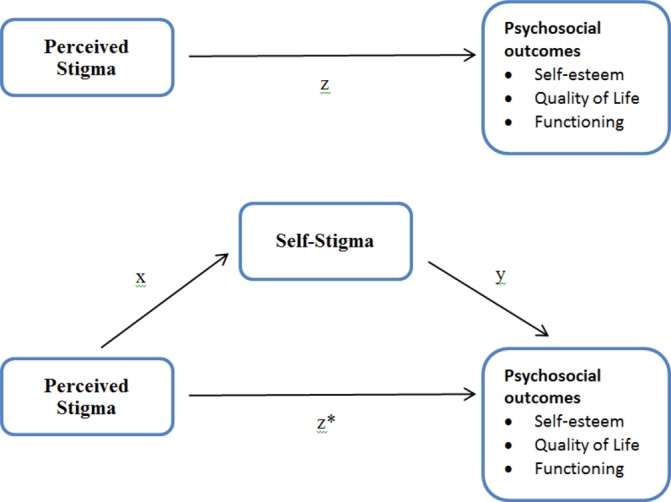
To examine whether self-stigma mediates the relationship between perceived stigma and quality of life, self-esteem and general functioning among outpatients with depression, schizophrenia, anxiety and obsessive-compulsive disorder (OCD).
Cross-sectional survey.
Outpatient clinics at a tertiary psychiatric hospital in Singapore.
280 outpatients with a primary clinical diagnosis of either schizophrenia, depression, anxiety or OCD.
Data were collected in relation to self-stigma, perceived stigma, self-esteem, functioning and quality of life. In order to examine the mediating role of self-stigma on the relationship between perceived stigma and psychosocial outcomes, bootstrapping mediation analyses were used.
Mediation analyses revealed that the relationship between perceived stigma and psychosocial outcomes was subject to the effects of self-stigma among the overall sample. Separate mediation analyses were conducted by diagnoses and showed differences in the mediating effects of self-stigma. Among the whole sample and the subsample with OCD, self-stigma mediated the relationship between perceived stigma and all psychosocial outcomes. For those with anxiety, depression and schizophrenia, the mediating effects of self-stigma were present in all relationships except (1) perceived stigma with physical health in the anxiety sample, (2) perceived stigma with social relationships in the depression sample and (3) perceived stigma with physical health in the schizophrenia sample.
The mediating effects of self-stigma on the relationship between perceived stigma and various psychosocial outcomes are evident and differ across diagnoses. Interventions to address and reduce the effects of self-stigma along with targeted treatments and psychoeducation to assist people with mental illness overcome or better manage self-stigma while providing them the skills to counteract public stigma are needed.
探讨自我污名是否在患有抑郁症、精神分裂症、焦虑症和强迫症(OCD)的门诊患者中,介导了感知污名与生活质量、自尊及总体功能之间的关系。
横断面调查。
新加坡一家三级精神病医院的门诊诊所。
280名初步临床诊断为精神分裂症、抑郁症、焦虑症或强迫症的门诊患者。
收集有关自我污名、感知污名、自尊、功能及生活质量的数据。为了检验自我污名在感知污名与心理社会结果之间关系中的中介作用,采用了自抽样中介分析。
中介分析显示,在总体样本中,感知污名与心理社会结果之间的关系受到自我污名的影响。按诊断进行了单独的中介分析,结果显示自我污名的中介作用存在差异。在整个样本和强迫症子样本中,自我污名介导了感知污名与所有心理社会结果之间的关系。对于焦虑症、抑郁症和精神分裂症患者,自我污名的中介作用存在于所有关系中,但以下情况除外:(1)焦虑症样本中感知污名与身体健康的关系;(2)抑郁症样本中感知污名与社会关系的关系;(3)精神分裂症样本中感知污名与身体健康的关系。
自我污名在感知污名与各种心理社会结果之间关系中的中介作用是明显的,且因诊断不同而有所差异。需要采取干预措施来解决和减少自我污名的影响,同时提供针对性治疗和心理教育,以帮助精神疾病患者克服或更好地应对自我污名,并为他们提供应对公众污名的技能。