López García de Lomana Adrián, Kaur Amardeep, Turkarslan Serdar, Beer Karlyn D, Mast Fred D, Smith Jennifer J, Aitchison John D, Baliga Nitin S
Institute for Systems Biology, Seattle, Washington.
Centers for Disease Control and Prevention, Atlanta, Georgia.
Genome Biol Evol. 2017 Jun 1;9(6):1616-1623. doi: 10.1093/gbe/evx116.
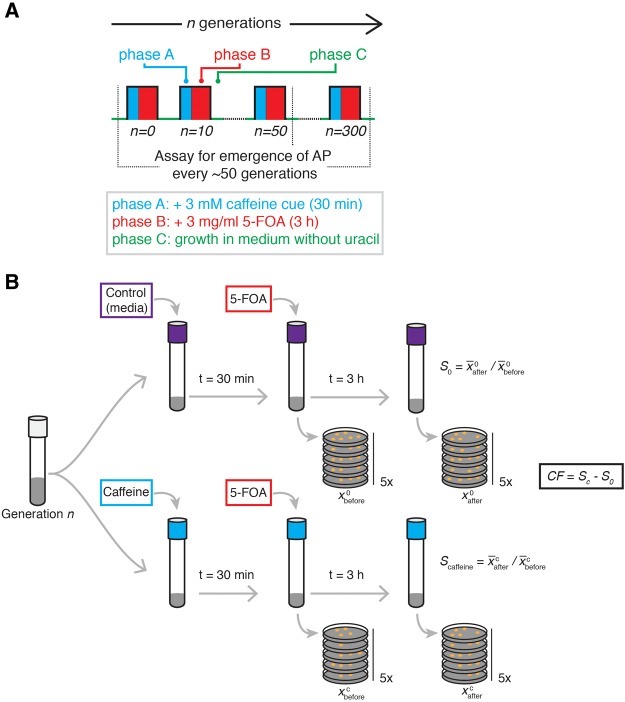
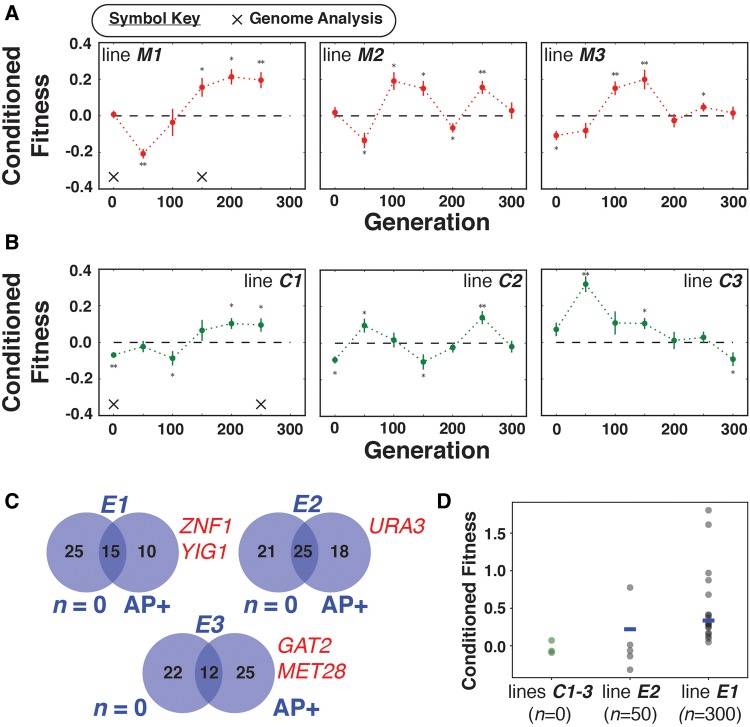
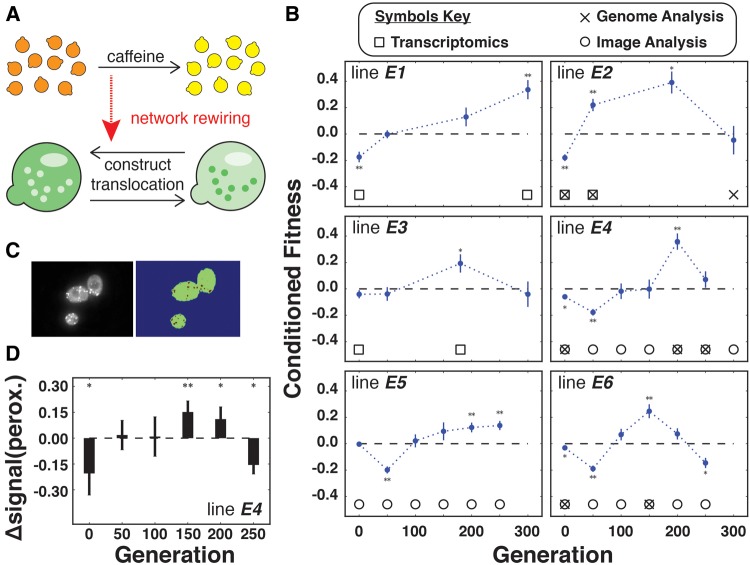
Adaptive prediction is a capability of diverse organisms, including microbes, to sense a cue and prepare in advance to deal with a future environmental challenge. Here, we investigated the timeframe over which adaptive prediction emerges when an organism encounters an environment with novel structure. We subjected yeast to laboratory evolution in a novel environment with repetitive, coupled exposures to a neutral chemical cue (caffeine), followed by a sublethal dose of a toxin (5-FOA), with an interspersed requirement for uracil prototrophy to counter-select mutants that gained constitutive 5-FOA resistance. We demonstrate the remarkable ability of yeast to internalize a novel environmental pattern within 50-150 generations by adaptively predicting 5-FOA stress upon sensing caffeine. We also demonstrate how novel environmental structure can be internalized by coupling two unrelated response networks, such as the response to caffeine and signaling-mediated conditional peroxisomal localization of proteins.
适应性预测是包括微生物在内的多种生物体感知某种线索并提前做好应对未来环境挑战准备的一种能力。在此,我们研究了生物体遇到具有新结构的环境时适应性预测出现的时间范围。我们让酵母在一种新环境中进行实验室进化,该环境中反复、耦合地暴露于一种中性化学线索(咖啡因),随后是亚致死剂量的毒素(5-氟乳清酸),同时穿插对尿嘧啶原养型的需求以反选获得组成型5-氟乳清酸抗性的突变体。我们证明了酵母具有非凡的能力,即在50 - 150代内通过在感知咖啡因时适应性地预测5-氟乳清酸胁迫来内化一种新的环境模式。我们还展示了如何通过耦合两个不相关的反应网络,如对咖啡因的反应和信号介导的蛋白质条件性过氧化物酶体定位,来内化新的环境结构。