Department of Pharmacology & Therapeutics, Faculty of Pharmacy, Kuwait City, Kuwait.
Department of Anatomy, Faculty of Medicine, Kuwait University, Kuwait City, Kuwait.
Sci Rep. 2017 Aug 30;7(1):9919. doi: 10.1038/s41598-017-09349-0.
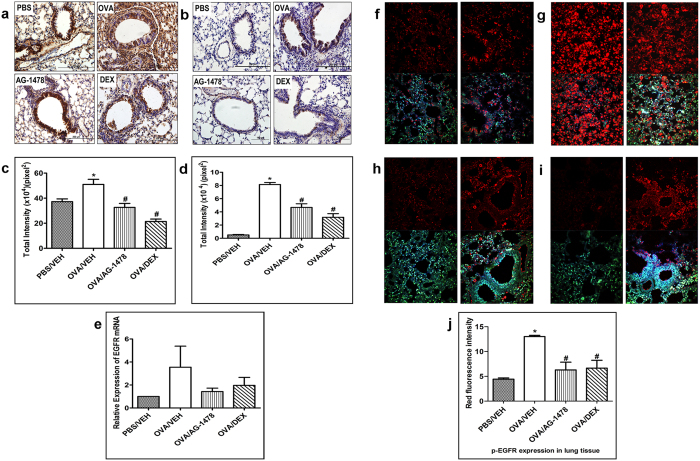
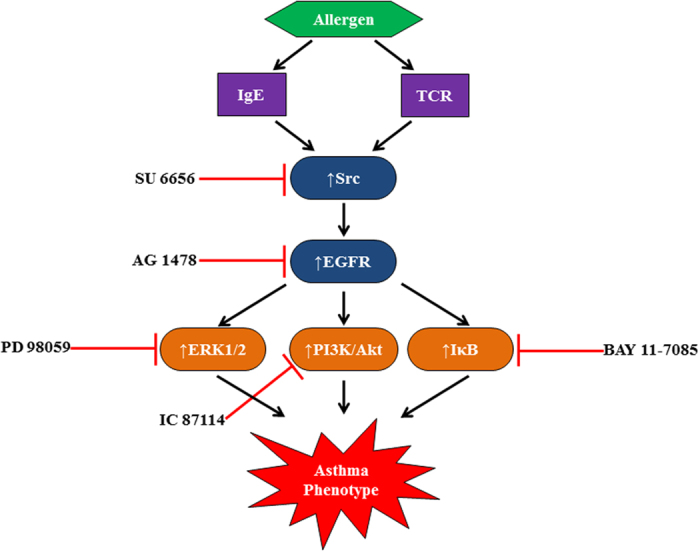
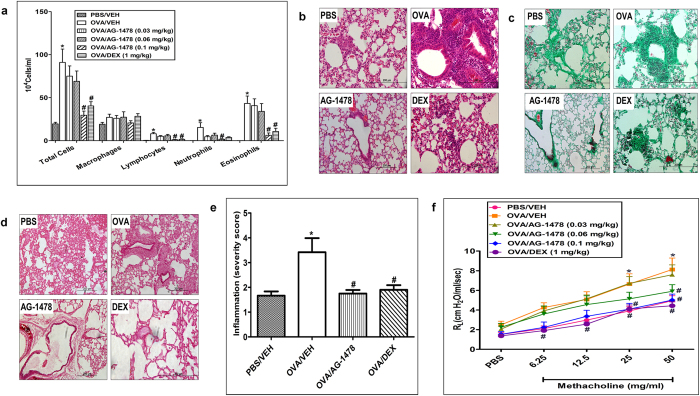
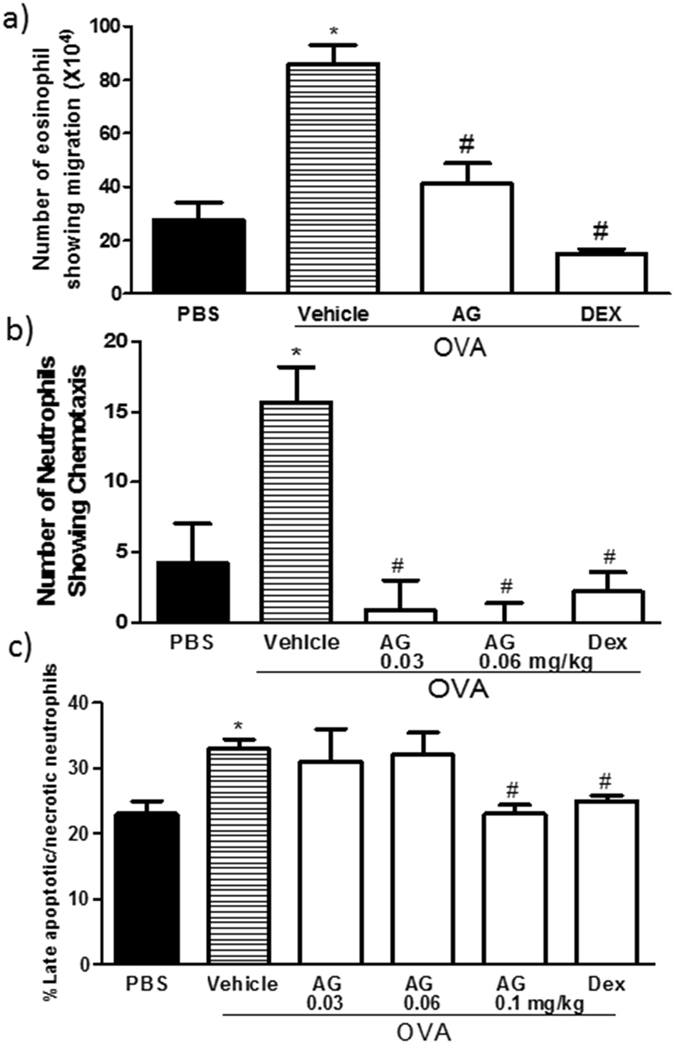
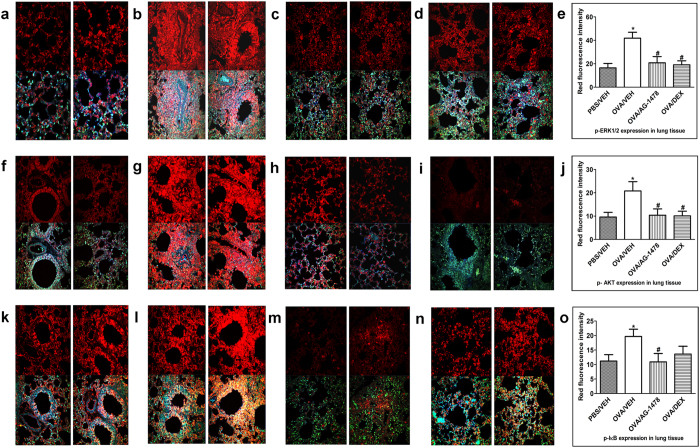
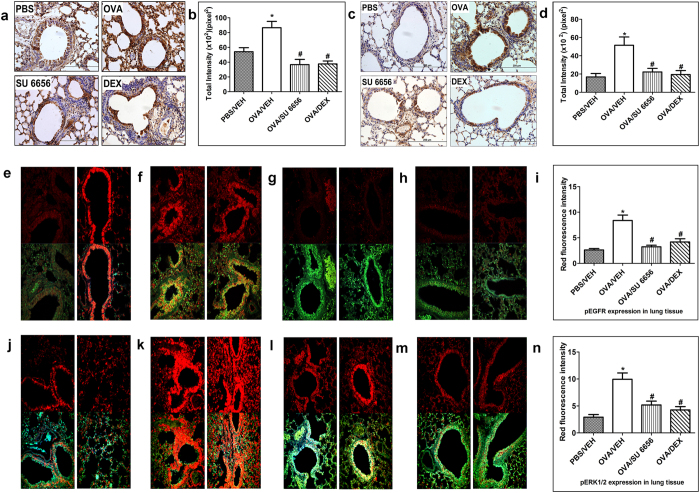
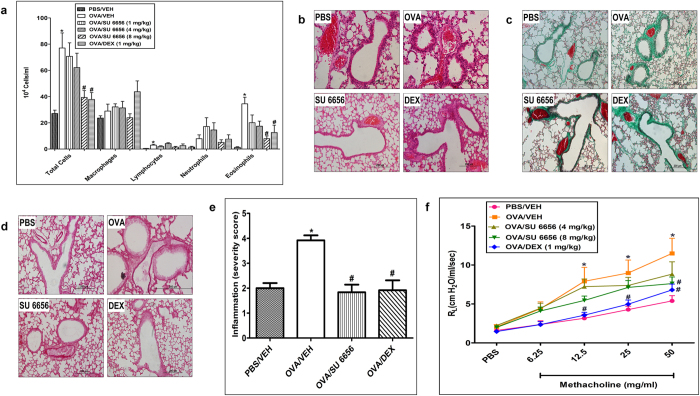
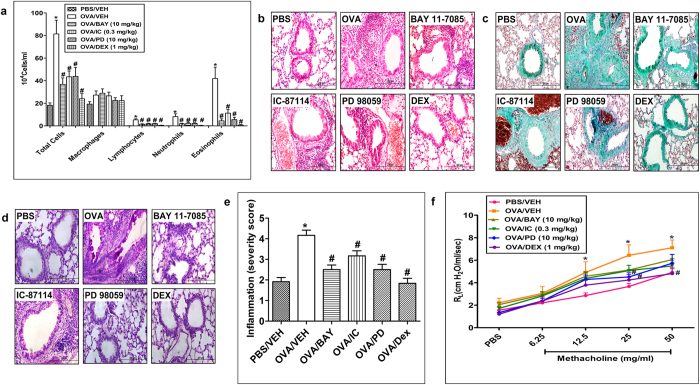
The molecular mechanisms underlying asthma pathogenesis are poorly characterized. In this study, we investigated (1) whether Src mediates epidermal growth factor receptor (EGFR) transactivation; (2) if ERK1/2, PI3Kδ/Akt and NF-κB are signaling effectors downstream of Src/EGFR activation; and (3) if upstream inhibition of Src/EGFR is more effective in downregulating the allergic inflammation than selective inhibition of downstream signaling pathways. Allergic inflammation resulted in increased phosphorylation of EGFR, Akt, ERK1/2 and IκB in the lung tissues from ovalbumin (OVA)-challenged BALB/c mice. Treatment with inhibitors of Src (SU6656) or EGFR (AG1478) reduced EGFR phosphorylation and downstream signaling which resulted in the inhibition of the OVA-induced inflammatory cell influx in bronchoalveolar lavage fluid (BALF), perivascular and peribronchial inflammation, fibrosis, goblet cell hyper/metaplasia and airway hyper-responsiveness. Treatment with pathway-selective inhibitors for ERK1/2 (PD89059) and PI3Kδ/Akt (IC-87114) respectively, or an inhibitor of NF-κB (BAY11-7085) also reduced the OVA-induced asthmatic phenotype but to a lesser extent compared to Src/EGFR inhibition. Thus, Src via EGFR transactivation and subsequent downstream activation of multiple pathways regulates the allergic airway inflammatory response. Furthermore, a broader upstream inhibition of Src/EGFR offers an attractive therapeutic alternative in the treatment of asthma relative to selectively targeting the individual downstream signaling effectors.
哮喘发病机制的分子机制尚未完全阐明。在这项研究中,我们研究了:(1)Src 是否介导表皮生长因子受体(EGFR)的转激活;(2)ERK1/2、PI3Kδ/Akt 和 NF-κB 是否是 Src/EGFR 激活的下游信号效应物;(3)Src/EGFR 的上游抑制是否比下游信号通路的选择性抑制更能有效下调过敏炎症。卵清蛋白(OVA)激发 BALB/c 小鼠的肺部组织中,过敏炎症导致 EGFR、Akt、ERK1/2 和 IκB 的磷酸化增加。Src(SU6656)或 EGFR(AG1478)抑制剂的治疗降低了 EGFR 的磷酸化和下游信号,从而抑制了 OVA 诱导的支气管肺泡灌洗液(BALF)中炎症细胞浸润、血管周围和支气管周围炎症、纤维化、杯状细胞增生/化生和气道高反应性。ERK1/2(PD89059)和 PI3Kδ/Akt(IC-87114)的通路选择性抑制剂或 NF-κB(BAY11-7085)抑制剂的单独治疗也降低了 OVA 诱导的哮喘表型,但与 Src/EGFR 抑制相比,程度较小。因此,Src 通过 EGFR 的转激活和随后的多条下游信号通路的激活来调节过敏气道炎症反应。此外,与选择性靶向单个下游信号效应物相比,Src/EGFR 的广泛上游抑制为哮喘的治疗提供了一种有吸引力的治疗选择。