Dkhil Mohamed A, Khalil Mona F, Diab Marwa S M, Bauomy Amira A, Al-Quraishy Saleh
Department of Zoology, College of Science, King Saud University, Saudi Arabia.
Department of Zoology and Entomology, Faculty of Science, Helwan University, Cairo, Egypt.
Saudi J Biol Sci. 2017 Sep;24(6):1418-1423. doi: 10.1016/j.sjbs.2016.12.017. Epub 2016 Dec 28.
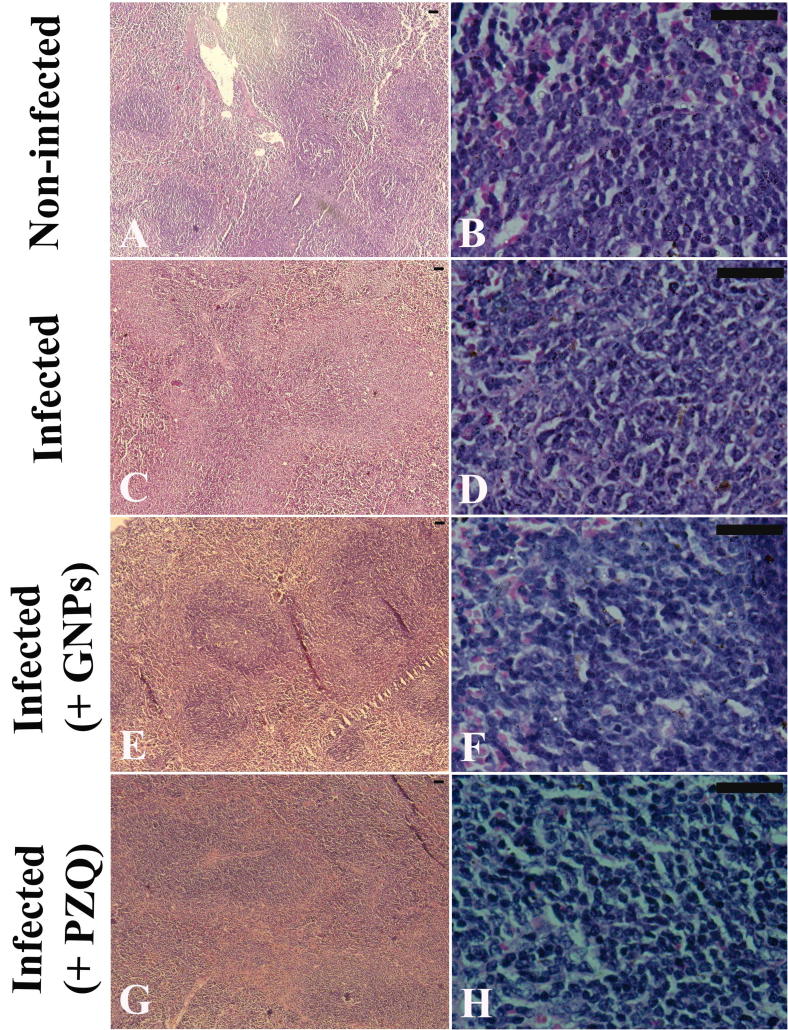
Schistosomiasis is still one of the main parasitic diseases that affect human health in tropical regions. Whilst praziquantel (PZQ) is the main classic antischistosomal drug, the need for new drugs is still a must due to the low effectiveness of the drug on the schistosome young worms, and the evolving of PZQ resistant strains. Nanotechnology is one of the most important recent and current methods used to treat human diseases including parasitic ones. Therefore, the present study aimed to examine the curative role of gold nanoparticles (GNPs) on splenic tissue of mice infected with Sambon, 1907. High-resolution transmission electron microscopy was used for characterization of nanoparticles (NP). GNPs of 1 mg/kg mice body weight were inoculated into mice infected with . The parasite caused deteriorations in histological architecture of the spleen tissue, and splenomegaly. Additionally, the parasite induced a significant reduction in splenic tissue glutathione levels; however, the concentrations of nitric oxide and malondialdehyde were significantly increased. Treatment of mice with GNPs reduced the extent of histological impairment and oxidative stress in spleen tissue. Therefore, our results demonstrate the protective role of GNPs against splenic damage in mice infected with
血吸虫病仍然是影响热带地区人类健康的主要寄生虫病之一。虽然吡喹酮(PZQ)是主要的经典抗血吸虫药物,但由于该药物对血吸虫幼虫效果不佳以及吡喹酮耐药菌株的不断出现,新药的需求仍然必不可少。纳米技术是近年来用于治疗包括寄生虫病在内的人类疾病的最重要方法之一。因此,本研究旨在探讨金纳米颗粒(GNPs)对感染1907年桑邦血吸虫的小鼠脾脏组织的治疗作用。使用高分辨率透射电子显微镜对纳米颗粒(NP)进行表征。将1mg/kg小鼠体重的GNPs接种到感染血吸虫的小鼠体内。该寄生虫导致脾脏组织的组织结构恶化和脾肿大。此外,该寄生虫导致脾脏组织谷胱甘肽水平显著降低;然而,一氧化氮和丙二醛的浓度显著增加。用GNPs治疗小鼠可减轻脾脏组织的组织学损伤程度和氧化应激。因此,我们的结果证明了GNPs对感染血吸虫的小鼠脾脏损伤具有保护作用。