Programa de Fisiopatología, Instituto de Ciencias Biomédicas, Facultad de Medicina, Universidad de Chile, Santiago, 8380453, Chile.
Departamento de Ciencias Biológicas, Facultad de Ciencias Biológicas and Facultad de Medicina, Universidad Andrés Bello, Avenida Republica 239, Santiago, 8370146, Chile.
Sci Rep. 2017 Aug 31;7(1):10131. doi: 10.1038/s41598-017-10474-z.
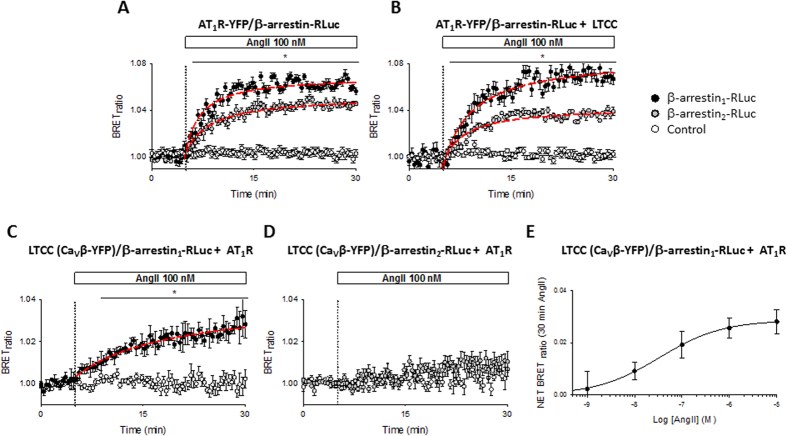
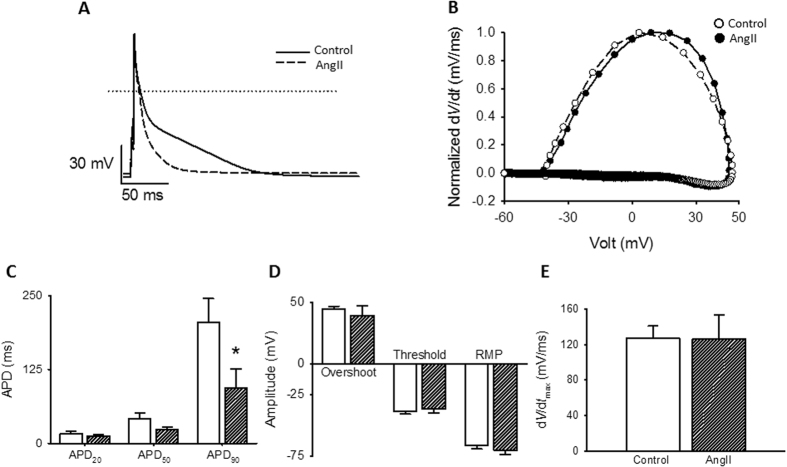
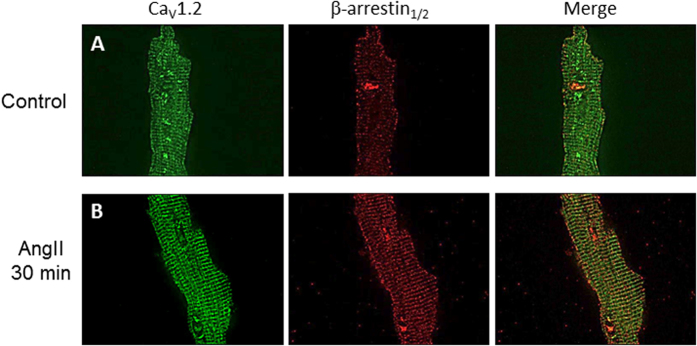
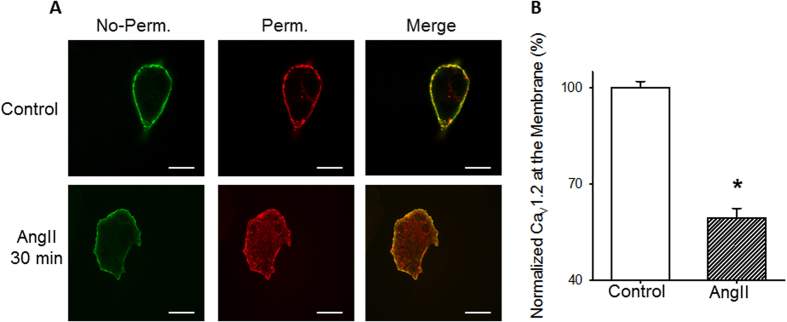
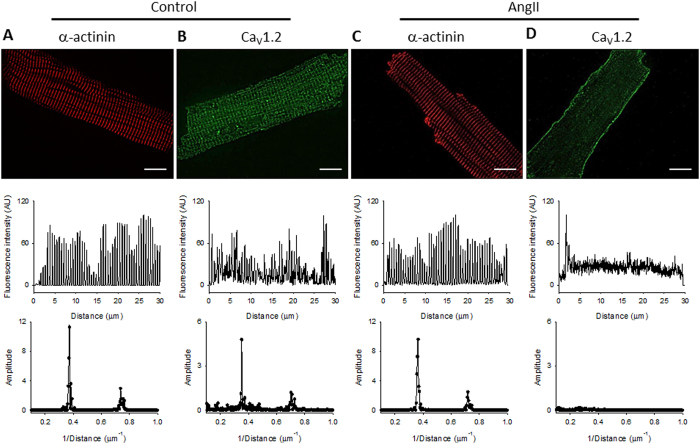
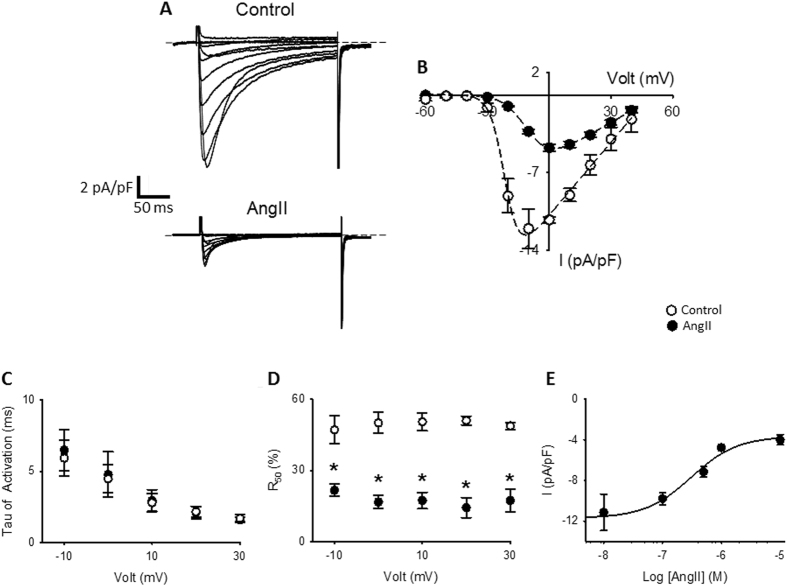
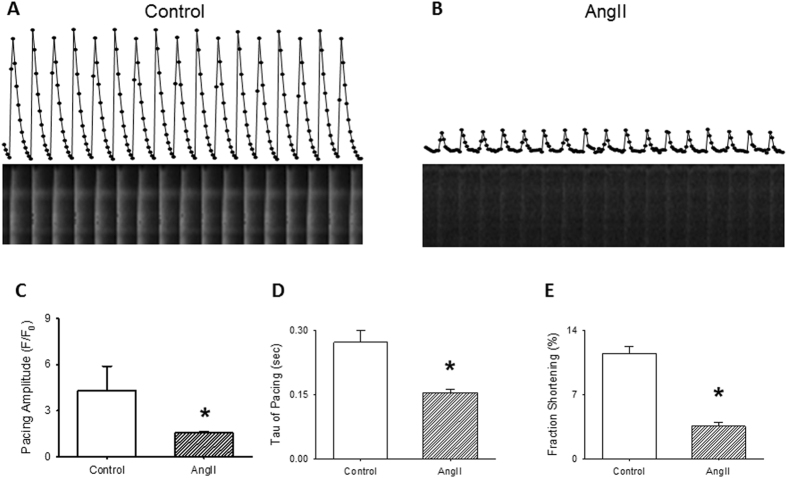
The cardiac L-type calcium channel is a multi-subunit complex that requires co-assembling of the pore-forming subunit Ca1.2 with auxiliary subunits Caαδ and Caβ. Its traffic has been shown to be controlled by these subunits and by the activation of various G-protein coupled receptors (GPCR). Here, we explore the consequences of the prolonged activation of angiotensin receptor type 1 (ATR) over Ca1.2 channel trafficking. Bioluminescence Resonance Energy Transfer (BRET) assay between β-arrestin and L-type channels in angiotensin II-stimulated cells was used to assess the functional consequence of ATR activation, while immunofluorescence of adult rat cardiomyocytes revealed the effects of GPCR activation on Ca1.2 trafficking. Angiotensin II exposure results in β-arrestin recruitment to the channel complex and an apparent loss of Ca1.2 immunostaining at the T-tubules. Accordingly, angiotensin II stimulation causes a decrease in L-type current, Ca transients and myocyte contractility, together with a faster repolarization phase of action potentials. Our results demonstrate that prolonged ATR activation induces β-arrestin recruitment and the subsequent internalization of Ca1.2 channels with a half-dose of AngII on the order of 100 nM, suggesting that this effect depends on local renin-angiotensin system. This novel ATR-dependent Ca1.2-trafficking modulation likely contributes to angiotensin II-mediated cardiac remodeling.
心脏 L 型钙通道是一个多亚基复合物,需要将孔形成亚基 Ca1.2 与辅助亚基 Caαδ 和 Caβ 共同组装。已经表明,其流量受到这些亚基和各种 G 蛋白偶联受体(GPCR)的激活的控制。在这里,我们探讨了血管紧张素受体 1(ATR)的长时间激活对 Ca1.2 通道转运的影响。在血管紧张素 II 刺激的细胞中,β-抑制蛋白和 L 型通道之间的生物发光共振能量转移(BRET)测定用于评估 ATR 激活的功能后果,而成年大鼠心肌细胞的免疫荧光显示了 GPCR 激活对 Ca1.2 转运的影响。血管紧张素 II 的暴露导致β-抑制蛋白募集到通道复合物,并且在 T 小管处 Ca1.2 免疫染色明显丢失。因此,血管紧张素 II 刺激会导致 L 型电流、Ca 瞬变和心肌细胞收缩力降低,以及动作电位复极化阶段更快。我们的结果表明,长时间的 ATR 激活诱导β-抑制蛋白募集,随后 Ca1.2 通道内化,AngII 的半效剂量约为 100 nM,这表明这种效应取决于局部肾素-血管紧张素系统。这种新型的 ATR 依赖性 Ca1.2 转运调节可能有助于血管紧张素 II 介导的心脏重塑。