Institute for Cardiogenetics, University of Lübeck, 23562, Lübeck, Germany.
DZHK (German Research Center for Cardiovascular Research), partner site Hamburg/Lübeck/Kiel, 23562, Lübeck, Germany.
Sci Rep. 2017 Aug 31;7(1):10252. doi: 10.1038/s41598-017-10928-4.
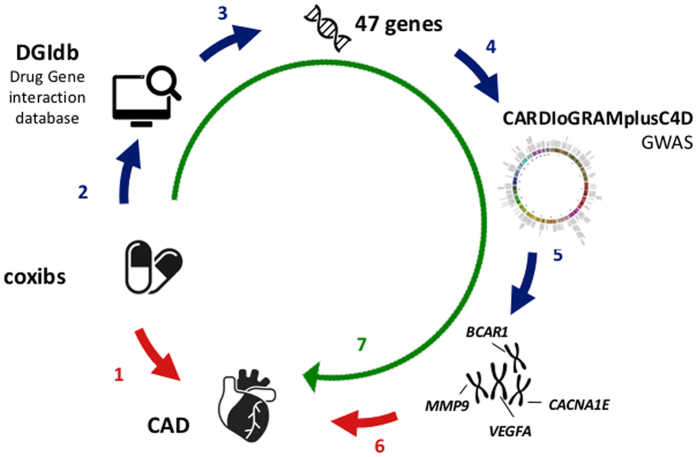
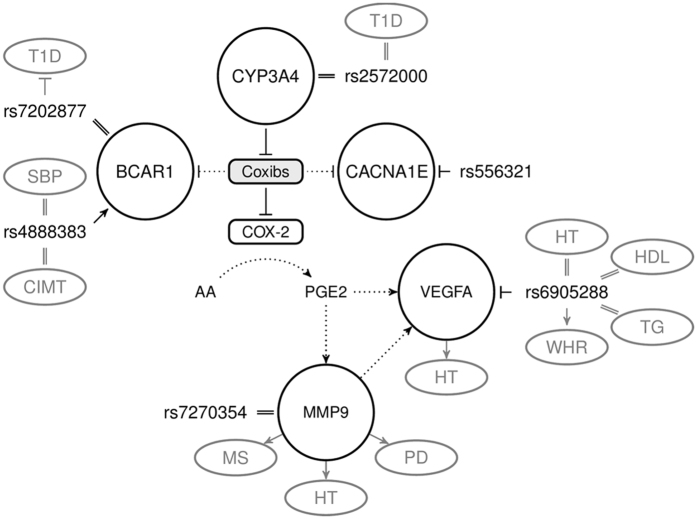
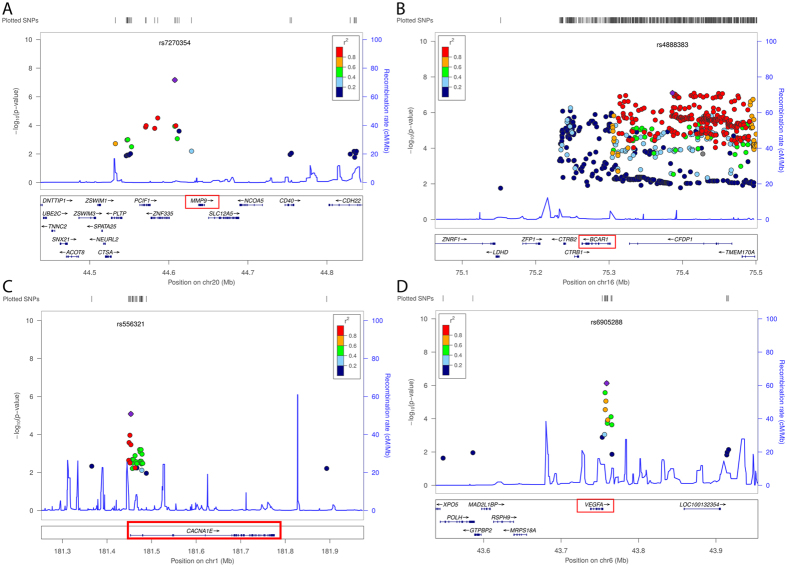
Cyclooxygenase-2 inhibitors (coxibs) are characterized by multiple molecular off-target effects and increased coronary artery disease (CAD) risk. Here, we systematically explored common variants of genes representing molecular targets of coxibs for association with CAD. Given a broad spectrum of pleiotropic effects of coxibs, our intention was to narrow potential mechanisms affecting CAD risk as we hypothesized that the affected genes may also display genomic signals of coronary disease risk. A Drug Gene Interaction Database search identified 47 gene products to be affected by coxibs. We traced association signals in 200-kb regions surrounding these genes in 84,813 CAD cases and 202,543 controls. Based on a threshold of 1 × 10 (Bonferroni correction for 3131 haplotype blocks), four gene loci yielded significant associations. The lead SNPs were rs7270354 (MMP9), rs4888383 (BCAR1), rs6905288 (VEGFA1), and rs556321 (CACNA1E). By additional genotyping, rs7270354 at MMP9 and rs4888383 at BCAR1 also reached the established GWAS threshold for genome-wide significance. The findings demonstrate overlap of genes affected by coxibs and those mediating CAD risk and points to further mechanisms, which are potentially responsible for coxib-associated CAD risk. The novel approach furthermore suggests that genetic studies may be useful to explore the clinical relevance of off-target drug effects.
环氧化酶-2 抑制剂(COXIBs)的特点是具有多种分子非靶效应,并增加了冠状动脉疾病(CAD)的风险。在这里,我们系统地探索了 COXIBs 的分子靶基因的常见变体与 CAD 的关联。鉴于 COXIBs 的广泛多效性作用,我们的意图是缩小可能影响 CAD 风险的潜在机制,因为我们假设受影响的基因也可能显示出冠心病风险的基因组信号。药物基因相互作用数据库搜索确定了 47 种受 COXIBs 影响的基因产物。我们在 84813 例 CAD 病例和 202543 例对照中,围绕这些基因的 200kb 区域追踪了关联信号。基于 1 × 10(3131 个单倍型块的 Bonferroni 校正)的阈值,有四个基因座产生了显著的关联。主要 SNP 是 rs7270354(MMP9)、rs4888383(BCAR1)、rs6905288(VEGFA1)和 rs556321(CACNA1E)。通过额外的基因分型,MMP9 上的 rs7270354 和 BCAR1 上的 rs4888383 也达到了全基因组关联研究的既定 GWAS 阈值。这些发现表明 COXIB 影响的基因与介导 CAD 风险的基因重叠,并指出了潜在的进一步机制,这些机制可能是 COXIB 相关 CAD 风险的原因。这种新方法还表明,遗传研究可能有助于探索非靶标药物作用的临床相关性。