Ji Hongwei, Zhang Han, Xiong Jing, Yu Shikai, Chi Chen, Bai Bin, Li Jue, Blacher Jacques, Zhang Yi, Xu Yawei
Department of Cardiology, Shanghai Tenth People's Hospital.
Department of Prevention, Tongji University School of Medicine, Shanghai, People's Republic of China.
Clin Interv Aging. 2017 Aug 18;12:1297-1308. doi: 10.2147/CIA.S141102. eCollection 2017.
With increasing age, estimated glomerular filtration rate (eGFR) decline is a frequent manifestation and is strongly associated with other preclinical target organ damage (TOD). In literature, many equations exist in assessing patients' eGFR. However, these equations were mainly derived and validated in the population from Western countries, which equation should be used for risk stratification in the Chinese population remains unclear, as well as their comparison. Considering that TOD is a good marker for risk stratification in the elderly, in this analysis, we aimed to investigate whether the recent eGFR equations derived from Asian and Chinese are better associated with preclinical TOD than the other equations in elderly Chinese.
A total of 1,599 community-dwelling elderly participants (age >65 years) in northern Shanghai were prospectively recruited from June 2014 to August 2015. Conventional cardiovascular risk factors were assessed, and hypertensive TOD including left ventricular mass index (LVMI), carotid-femoral pulse wave velocity (cf-PWV), carotid intima-media thickness (IMT), ankle-brachial index (ABI) and urine albumin to creatinine ratio (UACR) was evaluated for each participant. Participant's eGFR was calculated from the Modification of Diet in Renal Disease (MDRD), Chronic Kidney Disease Epidemiology Collaboration (CKD-EPI), Chinese-abbreviated MDRD (c-aMDRD), Asian-modified CKD-EPI (aCKD-EPI) equation and Chinese-modified CKD-EPI (cCKD-EPI) equation.
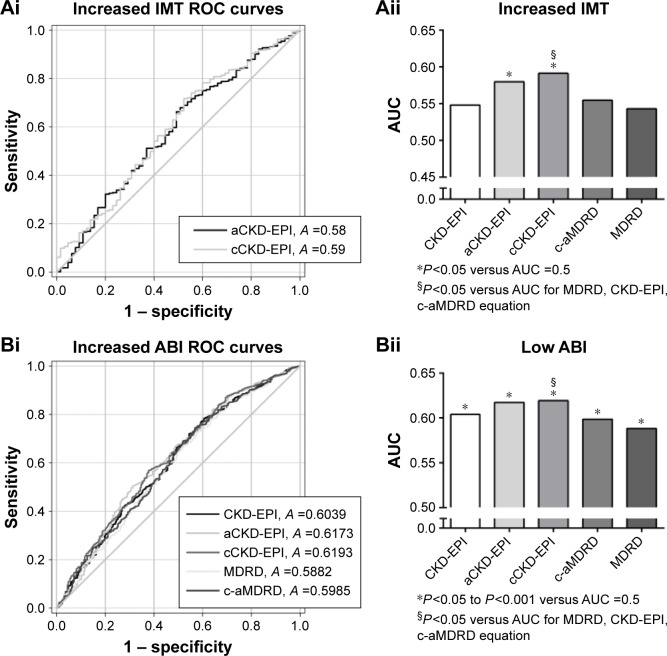
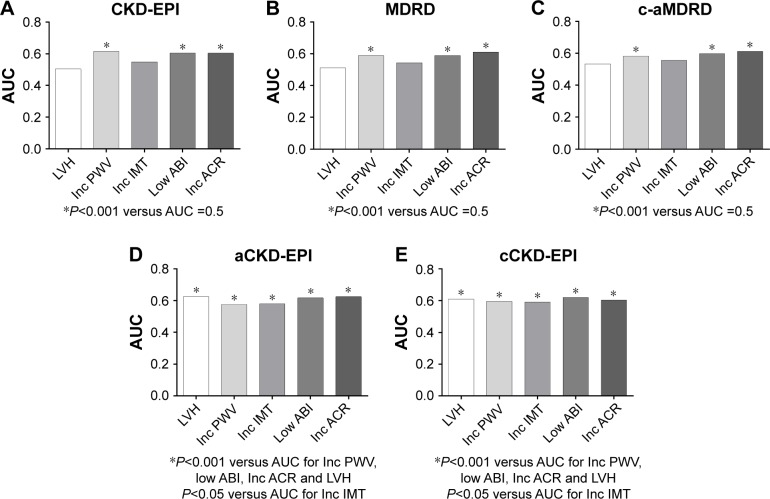
In multivariate regression analysis, only eGFRs from aCKD-EPI were significantly and inversely associated with carotid IMT (=0.005). In multivariate logistic models, decreased eGFR from all the equations were significantly associated with lower ABI (<0.001), microalbuminuria (=0.02 to <0.001) and increased cf-PWV (<0.001). Only decreased eGFRs from aCKD-EPI and cCKD-EPI equations were significantly associated with increased IMT (both crude <0.05). In the receiver operator characteristic (ROC) analysis, only aCKD-EPI and cCKD-EPI equations presented significant associations with all the listed preclinical TODs (-value from <0.05 to <0.001).
In community-dwelling elderly Chinese, eGFRs from aCKD-EPI and cCKD-EPI equations are better associated with preclinical TOD. aCKD-EPI and cCKD-EPI equations should be preferred when making risk assessment.
随着年龄增长,估算肾小球滤过率(eGFR)下降是常见表现,且与其他临床前期靶器官损害(TOD)密切相关。文献中有多种评估患者eGFR的公式。然而,这些公式主要是在西方国家人群中推导和验证的,在中国人群中用于风险分层应使用哪种公式尚不清楚,它们之间的比较也不明确。鉴于TOD是老年人风险分层的良好指标,在本分析中,我们旨在研究源自亚洲和中国的最新eGFR公式与中国老年人群临床前期TOD的关联是否优于其他公式。
2014年6月至2015年8月,前瞻性招募了上海市北部1599名社区居住的老年参与者(年龄>65岁)。评估了传统心血管危险因素,并对每位参与者评估了高血压TOD,包括左心室质量指数(LVMI)、颈股脉搏波速度(cf-PWV)、颈动脉内膜中层厚度(IMT)、踝臂指数(ABI)和尿白蛋白肌酐比值(UACR)。根据肾脏病饮食改良(MDRD)公式、慢性肾脏病流行病学协作组(CKD-EPI)公式、中国简化MDRD(c-aMDRD)公式、亚洲改良CKD-EPI(aCKD-EPI)公式和中国改良CKD-EPI(cCKD-EPI)公式计算参与者的eGFR。
在多变量回归分析中,只有aCKD-EPI公式得出的eGFR与颈动脉IMT显著负相关(=0.005)。在多变量逻辑模型中,所有公式得出的eGFR降低均与较低的ABI(<0.001)、微量白蛋白尿(=0.02至<0.001)和cf-PWV升高(<0.001)显著相关。只有aCKD-EPI公式和cCKD-EPI公式得出的eGFR降低与IMT增加显著相关(两者粗P值<0.05)。在受试者工作特征(ROC)分析中,只有aCKD-EPI公式和cCKD-EPI公式与所有列出的临床前期TOD显著相关(P值从<0.05至<0.001)。
在社区居住的中国老年人中,aCKD-EPI公式和cCKD-EPI公式得出的eGFR与临床前期TOD的关联更好。进行风险评估时应优先选择aCKD-EPI公式和cCKD-EPI公式。