Liu Yong-Liang, Liu Peng-Fei, Shao Wei, Du Hong-Peng, Li Zhen-Zhu, Guo Chong, Li Ze-Fu
Department of Neurosurgery, Affiliated Hospital of Binzhou Medical University, Binzhou, Shandong, Yantai, People's Republic of China.
Onco Targets Ther. 2017 Aug 14;10:4029-4035. doi: 10.2147/OTT.S123473. eCollection 2017.
At present, there is no consensus regarding the standard treatment for glioblastoma (GBM) in elderly patients with impaired Karnofsky performance status (KPS) scores. This study aimed to determine the effects of temozolomide (TMZ) versus best supportive care (BSC) in this population.
We conducted a retrospective observational study of patients aged ≥65 years with histologically confirmed GBM and KPS scores ≤70 who were treated at our institution between January 2006 and July 2014. Demographic data, treatments, and outcomes were evaluated. Univariate and multivariate analyses were performed to identify the independent prognostic factors of overall survival (OS) and progression-free survival (PFS). The impact of TMZ on survival was analyzed by the application of propensity score matching of clinicopathological factors among patients who received TMZ vs BSC.
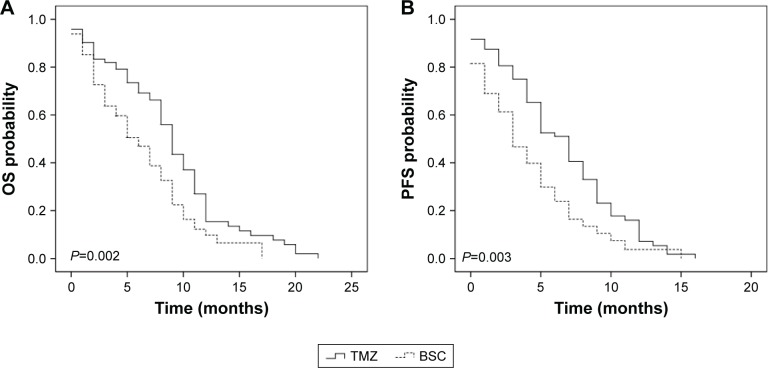
There were 153 patients (86 men, 56.2%) in this study. The median patient age was 70 years (range: 65-83 years). The median KPS score was 60 (range: 30-70). Seventy-eight patients (51.0%) received TMZ, whereas 75 (49.0%) received BSC. Median OS and PFS were 6.0 and 4.5 months, respectively. Compared with BSC, TMZ was associated with improved OS (hazard ratio [HR]: 0.38, 95% CI: 0.17-0.70; =0.002) and PFS (HR: 0.41, 95% CI: 0.21-0.76; =0.003) after propensity score matching. Factors independently associated with OS were KPS score (HR: 2.11, 95% CI: 1.48-7.67; =0.016), extent of resection (HR: 1.98, 95% CI: 1.45-5.14; =0.026), and treatment group (HR: 0.49, 95% CI: 0.23-0.87; =0.019). The most frequent toxicity in the TMZ group was myelosuppression.
Compared with BSC, TMZ increased survival with acceptable toxicity in elderly GBM patients with KPS scores ≤70.
目前,对于卡诺夫斯基功能状态(KPS)评分受损的老年胶质母细胞瘤(GBM)患者的标准治疗尚无共识。本研究旨在确定替莫唑胺(TMZ)与最佳支持治疗(BSC)在此类人群中的效果。
我们对2006年1月至2014年7月在我院接受治疗的年龄≥65岁、组织学确诊为GBM且KPS评分≤70的患者进行了一项回顾性观察研究。评估了人口统计学数据、治疗方法和结果。进行单因素和多因素分析以确定总生存期(OS)和无进展生存期(PFS)的独立预后因素。通过对接受TMZ与BSC治疗的患者的临床病理因素进行倾向评分匹配,分析TMZ对生存的影响。
本研究中有153例患者(86例男性,56.2%)。患者中位年龄为70岁(范围:65 - 83岁)。中位KPS评分为60(范围:30 - 70)。78例患者(51.0%)接受了TMZ治疗,而75例(49.0%)接受了BSC治疗。中位OS和PFS分别为6.0个月和4.5个月。倾向评分匹配后,与BSC相比,TMZ与改善的OS(风险比[HR]:0.38,95%置信区间:0.17 - 0.70;P = 0.002)和PFS(HR:0.41,95%置信区间:0.21 - 0.76;P = 0.003)相关。与OS独立相关的因素为KPS评分(HR:2.11,95%置信区间:I.48 - 7.67;P = 0.016)、切除范围(HR:1.98,95%置信区间:1.45 - 5.14;P = 0.026)和治疗组(HR:0.49,95%置信区间:0.23 - 0.87;P = 0.019)。TMZ组最常见的毒性是骨髓抑制。
与BSC相比,TMZ可提高KPS评分≤70的老年GBM患者的生存率,且毒性可接受。