Seo Seung Suk, Kim Ok Gul, Seo Jin Hyeok, Kim Do Hoon, Kim Youn Gu, Park Beyoung Yun
Department of Orthopedic Surgery, Bumin Hospital, Busan, Korea.
Clin Orthop Surg. 2017 Sep;9(3):303-309. doi: 10.4055/cios.2017.9.3.303. Epub 2017 Aug 4.
This study aimed to compare the effects of femoral nerve block and adductor canal block on postoperative pain, quadriceps strength, and walking ability after primary total knee arthroplasty.
Between November 2014 and February 2015, 60 patients underwent primary total knee arthroplasty. Thirty patients received femoral nerve block and the other 30 received adductor canal block for postoperative pain control. Before spinal anesthesia, the patients received nerve block via a catheter (20 mL 0.75% ropivacaine was administered initially, followed by intermittent bolus injection of 10 mL 0.2% ropivacaine every 6 hours for 3 days). The catheters were maintained in the exact location of nerve block in 24 patients in the femoral nerve block group and in 19 patients in the adductor canal block group. Data collection was carried out from these 43 patients. To evaluate postoperative pain control, the numerical rating scale scores at rest and 45° flexion of the knee were recorded. To evaluate quadriceps strength, manual muscle testing was performed. Walking ability was assessed using the Timed Up and Go test. We also evaluated analgesic consumption and complications of peripheral nerve block.
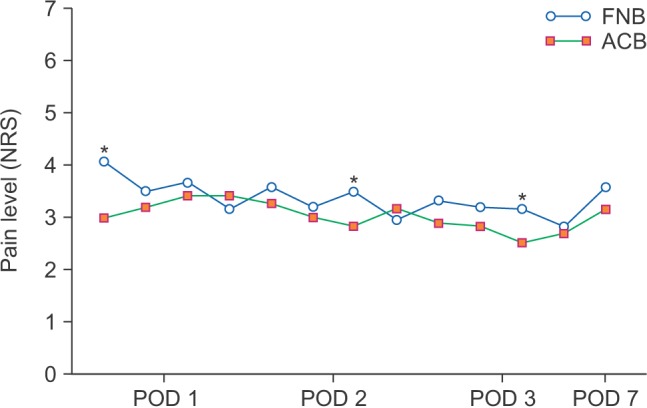
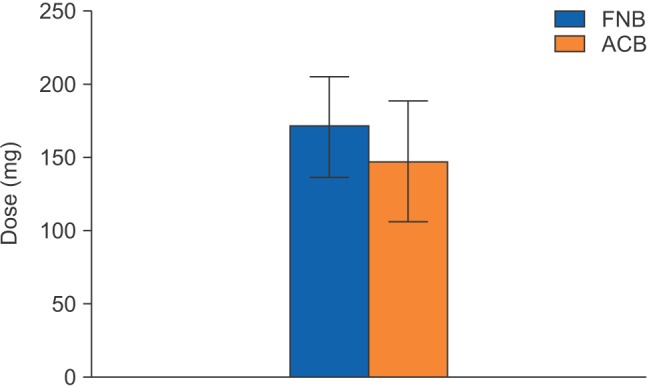
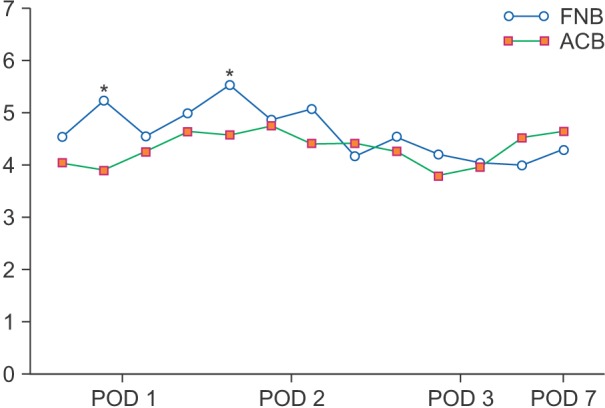
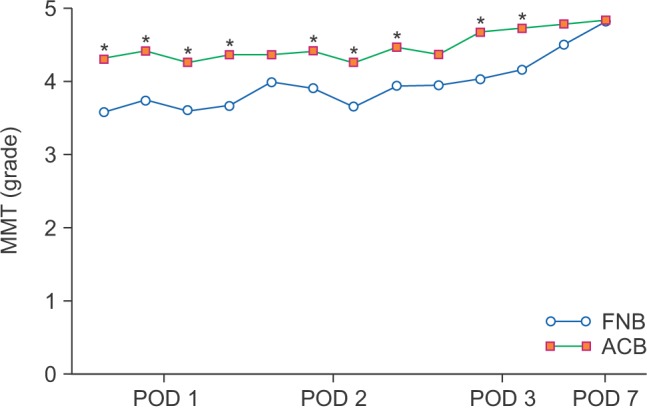
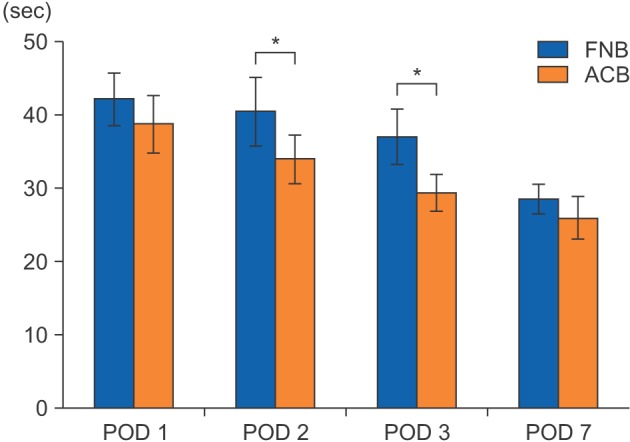
No significant intergroup difference was observed in the numerical rating scale scores at rest and 45° flexion of the knee on postoperative days 1, 2, 3, and 7. The adductor canal block group had significantly greater quadriceps strength than did the femoral nerve block group, as assessed by manual muscle testing on postoperative days 1, 2, and 3. The 2 groups showed no difference in walking ability on postoperative day 1, but on postoperative days 2, 3, walking ability was significantly better in the adductor canal block group than in the femoral nerve block group. No significant intergroup difference was observed in analgesic consumption.
The groups showed no difference in postoperative pain control. Adductor canal block was superior to femoral nerve block in preserving quadriceps strength and walking ability. However, adductor canal block was inferior to femoral nerve block in maintaining the exact location of the catheter.
本研究旨在比较股神经阻滞和收肌管阻滞对初次全膝关节置换术后疼痛、股四头肌力量及步行能力的影响。
2014年11月至2015年2月期间,60例患者接受了初次全膝关节置换术。30例患者接受股神经阻滞,另外30例接受收肌管阻滞以控制术后疼痛。在脊髓麻醉前,患者通过导管接受神经阻滞(最初给予20 mL 0.75%罗哌卡因,随后每6小时间歇性推注10 mL 0.2%罗哌卡因,持续3天)。股神经阻滞组24例患者和收肌管阻滞组19例患者的导管保持在神经阻滞的精确位置。从这43例患者中进行数据收集。为评估术后疼痛控制情况,记录静息时及膝关节屈曲45°时的数字评分量表得分。为评估股四头肌力量,进行徒手肌力测试。使用计时起立行走测试评估步行能力。我们还评估了镇痛药物的消耗量及周围神经阻滞的并发症。
术后第1、2、3和7天,静息时及膝关节屈曲45°时的数字评分量表得分在两组间未观察到显著差异。通过术后第1、2和3天的徒手肌力测试评估,收肌管阻滞组的股四头肌力量明显大于股神经阻滞组。两组在术后第1天的步行能力无差异,但在术后第2、3天,收肌管阻滞组的步行能力明显优于股神经阻滞组。镇痛药物消耗量在两组间未观察到显著差异。
两组在术后疼痛控制方面无差异。收肌管阻滞在保留股四头肌力量和步行能力方面优于股神经阻滞。然而,收肌管阻滞在维持导管精确位置方面不如股神经阻滞。