Ko Sang Hun, Cho Sung Do, Lee Chae Chil, Choi Jang Kyu, Kim Han Wook, Park Seon Jae, Bae Mun Hee, Cha Jae Ryong
Department of Orthopedics Surgery, Ulsan University Hospital, University of Ulsan College of Medicine, Ulsan, Korea.
Clin Orthop Surg. 2017 Sep;9(3):340-347. doi: 10.4055/cios.2017.9.3.340. Epub 2017 Aug 4.
The purpose of this study was to compare the results of arthroscopically guided suprascapular nerve block (SSNB) and blinded axillary nerve block with those of blinded SSNB in terms of postoperative pain and satisfaction within the first 48 hours after arthroscopic rotator cuff repair.
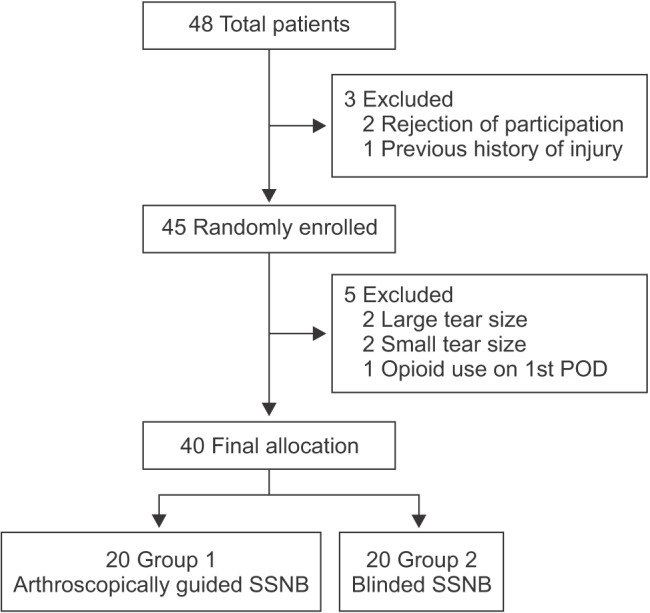
Forty patients who underwent arthroscopic rotator cuff repair for medium-sized full thickness rotator cuff tears were included in this study. Among them, 20 patients were randomly assigned to group 1 and preemptively underwent blinded SSNB and axillary nerve block of 10 mL 0.25% ropivacaine and received arthroscopically guided SSNB with 10 mL of 0.25% ropivacaine. The other 20 patients were assigned to group 2 and received blinded SSNB with 10 mL of 0.25% ropivacaine. Visual analog scale (VAS) score for pain and patient satisfaction score were assessed 4, 8, 12, 24, 36, and 48 hours postoperatively.
The mean VAS score for pain was significantly lower 4, 8, 12, 24, 36, and 48 hours postoperatively in group 1 (group 1 vs. group 2; 5.2 vs. 7.4, 4.1 vs. 6.1, 3.0 vs. 5.1, 2.1 vs. 4.2, 0.9 vs. 3.9, and 1.3 vs. 3.3, respectively). The mean patient satisfaction score was significantly higher at postoperative 4, 8, 12, 24, 36, and 48 hours in group 1 (group 1 vs. group 2; 6.7 vs. 3.9, 7.4 vs. 5.1, 8.8 vs. 5.9, 9.2 vs. 6.7, 9.5 vs. 6.9, and 9.0 vs. 7.2, respectively).
Arthroscopically guided SSNB and blinded axillary nerve block in arthroscopic rotator cuff repair for medium-sized rotator cuff tears provided more improvement in VAS for pain and greater patient satisfaction in the first 48 postoperative hours than blinded SSNB.
本研究的目的是比较关节镜引导下肩胛上神经阻滞(SSNB)联合盲法腋神经阻滞与单纯盲法SSNB在关节镜下肩袖修补术后48小时内的术后疼痛及满意度方面的效果。
本研究纳入40例因中型全层肩袖撕裂接受关节镜下肩袖修补术的患者。其中,20例患者被随机分配至第1组,预先接受10 mL 0.25%罗哌卡因的盲法SSNB和腋神经阻滞,并接受关节镜引导下10 mL 0.25%罗哌卡因的SSNB。另外20例患者被分配至第2组,接受10 mL 0.25%罗哌卡因的盲法SSNB。术后4、8、12、24、36和48小时评估视觉模拟量表(VAS)疼痛评分及患者满意度评分。
第1组术后4、8、12、24、36和48小时的平均VAS疼痛评分显著更低(第1组与第2组分别为:5.2对7.4、4.1对6.1、3.0对5.1、2.1对4.2、0.9对3.9、1.3对3.3)。第1组术后4、8、12、24、36和48小时的平均患者满意度评分显著更高(第1组与第2组分别为:6.7对3.9、7.4对5.1、8.8对5.9、9.2对6.7、9.5对6.9、9.0对7.2)。
对于中型肩袖撕裂的关节镜下肩袖修补术,关节镜引导下SSNB联合盲法腋神经阻滞在术后48小时内,与单纯盲法SSNB相比,在VAS疼痛评分改善方面更显著,患者满意度更高。