Shin Young Ho, Kim Jihyeung, Gong Hyun Sik, Rhee Seung Hwan, Cho Min Joon, Baek Goo Hyun
Department of Orthopedic Surgery, Asan Medical Center, University of Ulsan College of Medicine, Seoul, Korea.
Department of Orthopedic Surgery, Seoul National University College of Medicine, Seoul, Korea.
Clin Orthop Surg. 2017 Sep;9(3):355-362. doi: 10.4055/cios.2017.9.3.355. Epub 2017 Aug 4.
Radius osteotomies showed favorable clinical outcome in Kienböck's disease. However, few articles have been published on the long-term outcome of lateral wedge osteotomy of the radius in patients with advanced stage Kienböck's disease.
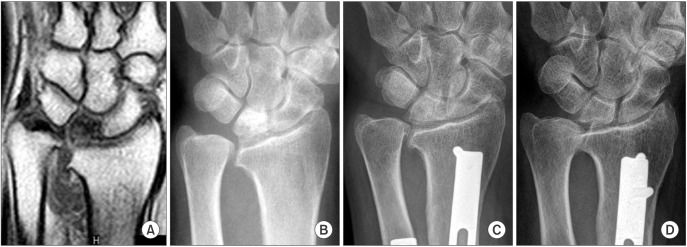
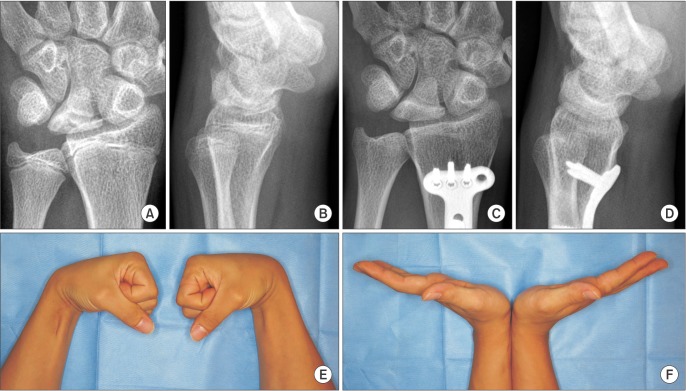
Eleven patients with Lichtman stage IIIB/IV Kienböck's disease (group A; mean follow-up period, 86.1 months; range, 48 to 163 months) and 14 patients with Lichtman stage IIIA Kienböck's disease (group B; mean follow-up period, 85.1 months; range, 49 to 144 months) underwent radial wedge osteotomy between August 2004 and August 2012. Radiological changes of the lunate and radiocarpal joint were compared between two groups after osteotomy. The wrist flexion/extension angle, grip strength, and Disabilities of the Arm, Shoulder and Hand (DASH) scores were evaluated preoperatively and at the final follow-up. The Nakamura Scoring System (NSSK) was used for comprehensive understanding of radiological and clinical outcomes.
Nine patients of group A and 11 patients of group B showed radiological improvement in the lunate regarding sclerosis, cystic changes, or fragmentation. No patients showed progression of arthritic changes in radiocarpal and midcarpal joints. The wrist flexion/extension angle, grip strength, and DASH score were significantly improved in both groups after operation, but intergroup difference was not statistically significant at the final follow-up ( = 0.149, = 0.267, and = 0.536, respectively). The mean NSSK was 21.6 (range, 15 to 27) in group A and 21.8 (range, 15 to 26) in group B.
Radial wedge osteotomy yielded excellent radiological and functional outcomes in advanced stages of Kienböck's disease and these results were comparable to those of Lichtman stage IIIA disease. This technique could be a useful alternative to salvage procedures in the treatment of Lichtman stage IIIB/IV Kienböck's disease without severe radiocarpal arthritis.
桡骨截骨术在月骨无菌性坏死疾病中显示出良好的临床效果。然而,关于晚期月骨无菌性坏死患者桡骨外侧楔形截骨术的长期疗效的文章发表较少。
2004年8月至2012年8月期间,11例Lichtman IIIB/IV期月骨无菌性坏死患者(A组;平均随访期86.1个月;范围48至163个月)和14例Lichtman IIIA期月骨无菌性坏死患者(B组;平均随访期85.1个月;范围49至144个月)接受了桡骨楔形截骨术。比较两组截骨术后月骨和桡腕关节的放射学变化。在术前和末次随访时评估腕关节屈伸角度、握力以及手臂、肩部和手部功能障碍(DASH)评分。采用中村评分系统(NSSK)全面了解放射学和临床结果。
A组9例患者和B组11例患者的月骨在硬化、囊性变或碎裂方面显示出放射学改善。没有患者出现桡腕关节和腕中关节关节炎改变的进展。两组术后腕关节屈伸角度、握力和DASH评分均有显著改善,但在末次随访时组间差异无统计学意义(分别为 = 0.149、 = 0.267和 = 0.536)。A组平均NSSK为21.6(范围15至27),B组为21.8(范围15至26)。
桡骨楔形截骨术在晚期月骨无菌性坏死中产生了优异的放射学和功能结果,这些结果与Lichtman IIIA期疾病的结果相当。该技术可能是治疗无严重桡腕关节炎的Lichtman IIIB/IV期月骨无菌性坏死挽救手术的一种有用替代方法。