Pasricha Shivani, MacRae James I, Chua Hwa H, Chambers Jenny, Boyce Kylie J, McConville Malcolm J, Andrianopoulos Alex
Genetics, Genomics and Systems Biology, School of BioSciences, University of MelbourneParkville, VIC, Australia.
Department of Biochemistry and Molecular Biology, Bio21 Institute of Molecular Science and Biotechnology, University of MelbourneParkville, VIC, Australia.
Front Cell Infect Microbiol. 2017 Aug 17;7:368. doi: 10.3389/fcimb.2017.00368. eCollection 2017.
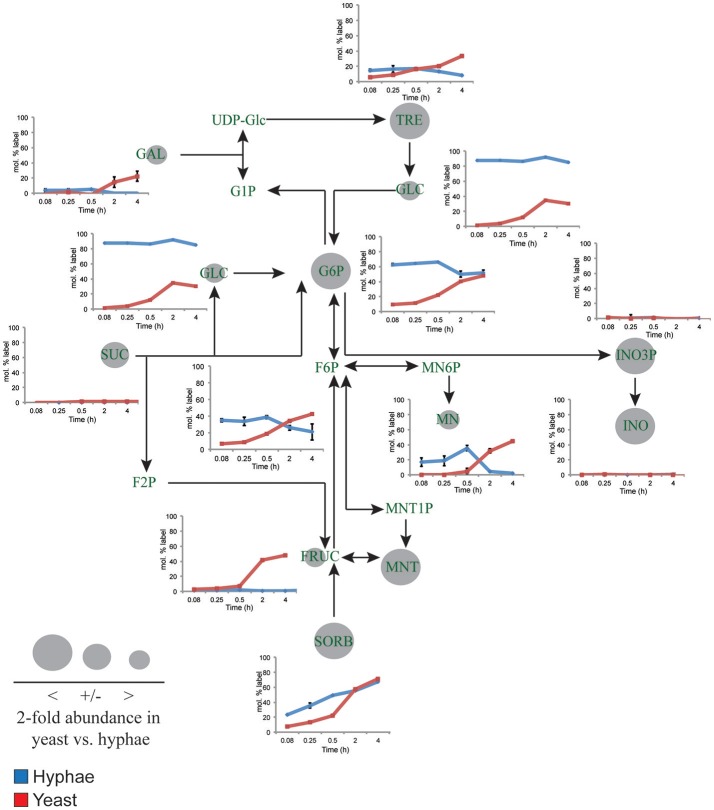
Fungal infections are an increasing public health problem, particularly in immunocompromised individuals. While these pathogenic fungi show polyphyletic origins with closely related non-pathogenic species, many undergo morphological transitions to produce pathogenic cell types that are associated with increased virulence. However, the characteristics of these pathogenic cells that contribute to virulence are poorly defined. grows as a non-pathogenic hyphal form at 25°C but undergoes a dimorphic transition to a pathogenic yeast form at 37°C and following inhalation of asexual conidia by a host. Here we show that this transition is associated with major changes in central carbon metabolism, and that these changes are correlated with increased virulence of the yeast form. Comprehensive metabolite profiling and C-labeling studies showed that hyphal cells exhibited very active glycolytic metabolism and contain low levels of internal carbohydrate reserves. In contrast, yeast cells fully catabolized glucose in the mitochondrial TCA cycle, and store excess glucose in large intracellular pools of trehalose and mannitol. Inhibition of the yeast TCA cycle inhibited replication in culture and in host cells. Yeast, but not hyphae, were also able to use -inositol and amino acids as secondary carbon sources, which may support their survival in host macrophages. These analyses suggest that yeast cells exhibit a more efficient oxidative metabolism and are capable of utilizing a diverse range of carbon sources, which contributes to their virulence in animal tissues, highlighting the importance of dimorphic switching in pathogenic yeast.
真菌感染是一个日益严重的公共卫生问题,在免疫功能低下的个体中尤为突出。虽然这些致病真菌与密切相关的非致病物种具有多系起源,但许多真菌会经历形态转变,产生与毒力增加相关的致病细胞类型。然而,这些致病细胞中导致毒力的特征却鲜为人知。[具体真菌名称]在25°C时以非致病的菌丝形式生长,但在37°C时以及宿主吸入无性分生孢子后会经历双态转变,成为致病的酵母形式。在这里,我们表明这种转变与中心碳代谢的重大变化有关,并且这些变化与酵母形式毒力的增加相关。全面的代谢物谱分析和C标记研究表明,菌丝细胞表现出非常活跃的糖酵解代谢,且内部碳水化合物储备水平较低。相比之下,酵母细胞在线粒体三羧酸循环中完全分解葡萄糖,并将多余的葡萄糖储存在海藻糖和甘露醇的大型细胞内池中。抑制酵母的三羧酸循环会抑制其在培养物和宿主细胞中的复制。酵母而非菌丝,也能够利用肌醇和氨基酸作为次要碳源,这可能有助于它们在宿主巨噬细胞中存活。这些分析表明,酵母细胞表现出更有效的氧化代谢,并且能够利用多种碳源,这有助于它们在动物组织中的毒力,突出了致病酵母中双态转换的重要性。