Bade Michael, Struessel Tamara, Paxton Roger, Winters Joshua, Baym Carol, Stevens-Lapsley Jennifer
Department of Physical Medicine and Rehabilitation, School of Medicine, University of Colorado Anschutz Medical Campus, Aurora, CO.
Department of Physical Medicine and Rehabilitation, School of Medicine, University of Colorado Anschutz Medical Campus, Aurora, CO.
Arch Phys Med Rehabil. 2018 Jan;99(1):99-106. doi: 10.1016/j.apmr.2017.07.013. Epub 2017 Aug 31.
To determine the relation between performance on a clinical quadriceps activation battery with (1) activation measured by doublet interpolation and (2) recovery of quadriceps strength and functional performance after total knee arthroplasty (TKA).
Planned secondary analysis of a randomized controlled trial.
University research laboratory.
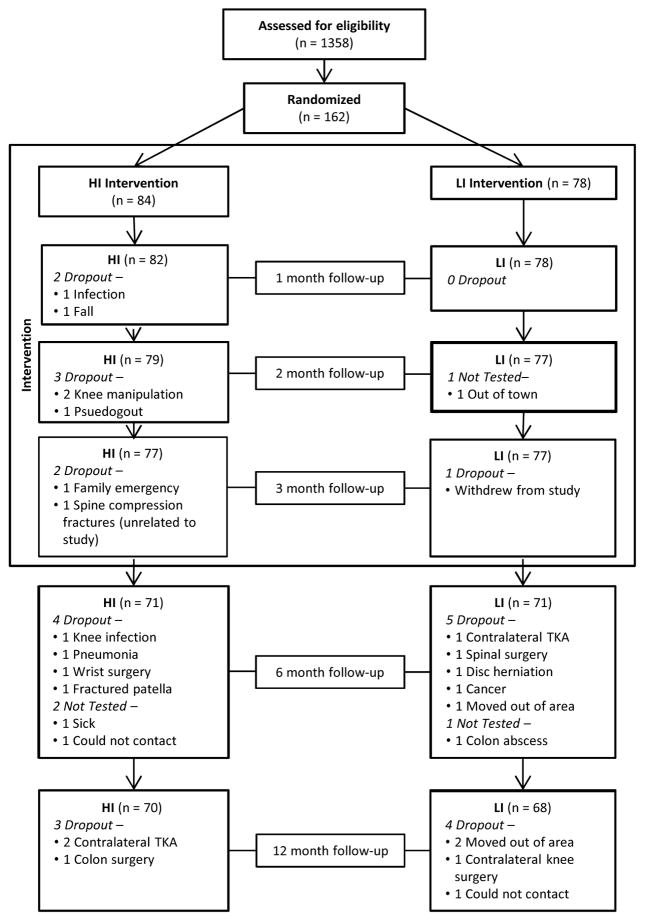
Patients (N=162; mean age, 63±7y; 89 women) undergoing TKA.
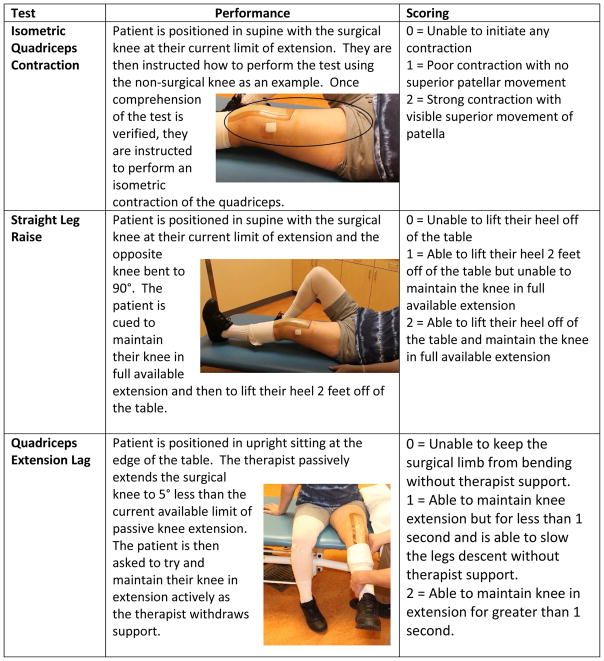
Patients were classified as high (quadriceps activation battery ≥4/6) or low (quadriceps activation battery ≤3/6) based on performance on the quadriceps activation battery measured 4 days after TKA. Differences between groups in activation and recovery at 1, 2, 3, 6, and 12 months after TKA were compared using a repeated-measures maximum likelihood model.
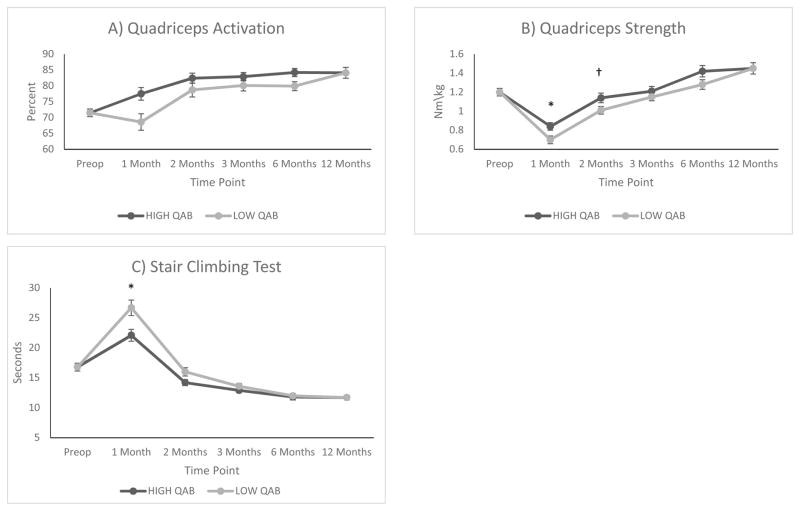
The low quadriceps activation battery group demonstrated poorer quadriceps activation via doublet interpolation (P=.01), greater quadriceps strength loss (P=.01), and greater functional performance decline (all P<.001) at 1 month after TKA compared with the high quadriceps activation battery group. Differences between low and high quadriceps activation battery groups on all measures did not persist at 3 and 12 months (all P>.05).
Poor performance on the quadriceps activation battery early after TKA is related to poor quadriceps activation and poor recovery in the early postoperative period. Patients in the low quadriceps activation battery group took 3 months to recover to the same level as the high quadriceps activation battery group. The quadriceps activation battery may be useful in identifying individuals who need specific interventions to target activation deficits or different care pathways in the early postoperative period to speed recovery after TKA.
确定临床股四头肌激活测试的表现与(1)通过双重刺激插值法测量的激活情况以及(2)全膝关节置换术(TKA)后股四头肌力量和功能表现恢复之间的关系。
对一项随机对照试验进行的计划二次分析。
大学研究实验室。
接受TKA的患者(N = 162;平均年龄,63±7岁;89名女性)。
根据TKA术后4天进行的股四头肌激活测试表现,将患者分为高(股四头肌激活测试≥4/6)或低(股四头肌激活测试≤3/6)两组。使用重复测量最大似然模型比较TKA术后1、2、3、6和12个月两组在激活和恢复方面的差异。
与高股四头肌激活测试组相比,低股四头肌激活测试组在TKA术后1个月时,通过双重刺激插值法显示股四头肌激活较差(P = 0.01),股四头肌力量损失更大(P = 0.01),功能表现下降更明显(所有P < 0.001)。低股四头肌激活测试组和高股四头肌激活测试组在所有测量指标上的差异在3个月和12个月时不再持续(所有P > 0.05)。
TKA术后早期股四头肌激活测试表现不佳与术后早期股四头肌激活不良和恢复不佳有关。低股四头肌激活测试组的患者需要3个月才能恢复到与高股四头肌激活测试组相同的水平。股四头肌激活测试可能有助于识别那些需要特定干预以解决激活缺陷的个体,或在术后早期采用不同的护理途径以加速TKA后的恢复。