Qudsi Rameez A, Roberts Heather J, Bhashyam Abhiram R, Losina Elena, Bae Donald S, Alexis Francel, Dyer George S
Department of Orthopaedic Surgery, Orthopaedic and Arthritis Center for Outcomes Research, Brigham and Women's Hospital, Boston, Massachusetts; Department of Orthopaedic Surgery, Policy and Innovation Evaluation in Orthopaedic Treatments (PIVOT) Center, Brigham and Women's Hospital, Boston, Massachusetts; Department of Orthopaedic Surgery, Boston Children's Hospital, Boston, Massachusetts; Harvard Combined Orthopaedic Residency Program, Harvard University, Boston, Massachusetts; Harvard T.H. Chan School of Public Health, Boston, Massachusetts.
Department of Orthopaedic Surgery, University of California San Francisco, San Francisco, California.
J Surg Educ. 2018 Jan-Feb;75(1):140-146. doi: 10.1016/j.jsurg.2017.06.007. Epub 2017 Aug 31.
The burden of musculoskeletal disease remains high in low-income countries, with a high rate of pediatric disease. Efforts continue for orthopedic education, but there is little guidance on local needs and desires. Our aim was to determine the specific content and modalities that would be most useful for pediatric orthopedic educational programs abroad, and we demonstrate a practical method of identifying country-specific educational deficits through a self-reported needs survey in Haiti.
A cross-sectional survey was administered using an automated response system. We obtained demographic information as well as training and practice patterns, comfort levels with pediatric diagnoses, and desired topics for education using a 5-point Likert Scale.
Haitian Annual Assembly for Orthopaedic Trauma (HAAOT), the only national, continuing medical education conference for orthopedic providers in Haiti.
Of 60 eligible participants, 51 were included in the final analysis.
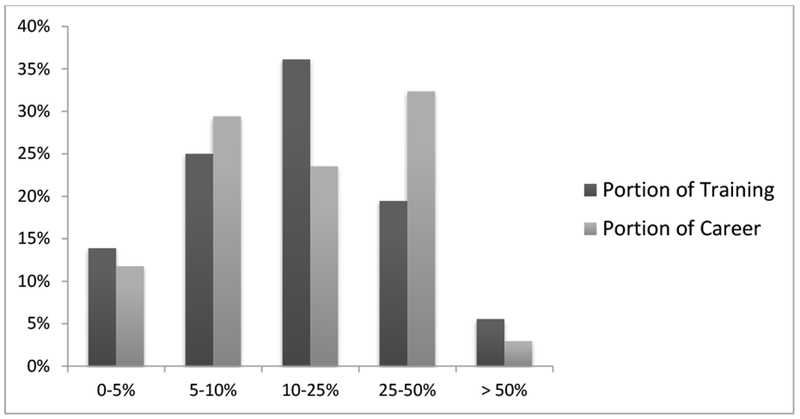
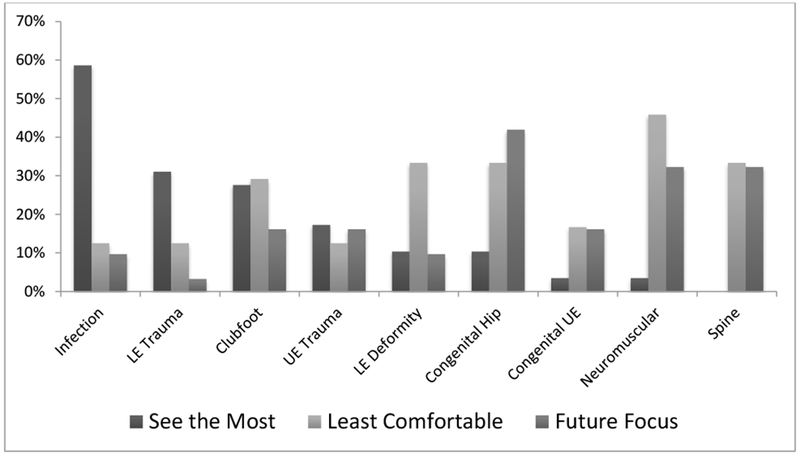
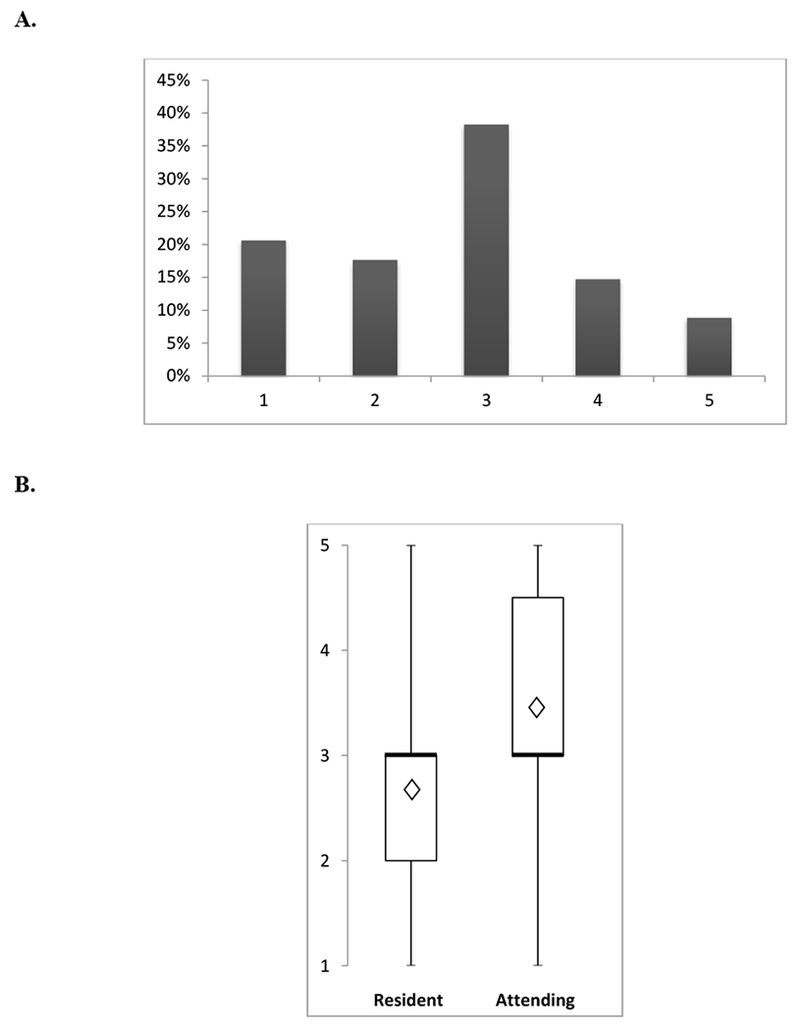
Time spent on pediatric orthopedics varied widely, centered at 10% to 25%. Median comfort level with pediatric orthopedics was 3 of 5. Skills with lowest self-reported competence included spica casting, clubfoot casting, and management of supracondylar humerus fractures. Skills with highest self-reported competence were long-leg casting and Salter-Harris classification. Modes of education highly requested included didactics/lectures, hands-on sessions, dedicated rotations, and exchanges with foreign peers/mentors. Diagnoses most encountered were osteomyelitis, trauma, and clubfoot; lowest comfort levels were in neuromuscular, spine, lower extremity deformity, congenital hip, and clubfoot; and most requested for future teaching were congenital hip, neuromuscular, and spine.
Haitian orthopedic providers express a strong desire and need for ongoing pediatric orthopedic education. They describe a high prevalence of trauma and infection, but convey a requirement for more comprehensive, multimodal teaching that also includes congenital deformities/dysplasias, neuromuscular, and spine. Our results demonstrate the importance of assessing country-specific needs and involving local care providers in curriculum development.
在低收入国家,肌肉骨骼疾病的负担依然很重,儿科疾病的发病率很高。骨科教育工作仍在继续,但针对当地需求和愿望的指导却很少。我们的目的是确定对国外儿科骨科教育项目最有用的具体内容和形式,并且我们展示了一种通过在海地进行的自我报告需求调查来识别特定国家教育缺陷的实用方法。
采用自动应答系统进行横断面调查。我们获取了人口统计学信息以及培训和实践模式、对儿科诊断的熟悉程度,并使用5分李克特量表获取了期望的教育主题。
海地骨科创伤年度大会(HAAOT),这是海地唯一面向骨科医疗服务提供者的全国性继续医学教育会议。
60名符合条件的参与者中,51名被纳入最终分析。
花在儿科骨科上的时间差异很大,集中在10%至25%。儿科骨科的自我报告平均熟悉程度为5分中的3分。自我报告能力最低的技能包括髋人字石膏固定、马蹄内翻足石膏固定以及肱骨髁上骨折的处理。自我报告能力最高的技能是长腿石膏固定和Salter-Harris分型。强烈要求的教育模式包括教学/讲座、实践课程、专门轮转以及与国外同行/导师的交流。最常遇到的诊断是骨髓炎、创伤和马蹄内翻足;熟悉程度最低的是神经肌肉疾病、脊柱疾病、下肢畸形、先天性髋关节疾病和马蹄内翻足;未来教学最需要的是先天性髋关节疾病、神经肌肉疾病和脊柱疾病。
海地的骨科医疗服务提供者表达了对持续进行儿科骨科教育的强烈愿望和需求。他们描述了创伤和感染的高发病率,但表示需要更全面的多模式教学,其中还应包括先天性畸形/发育异常、神经肌肉疾病和脊柱疾病。我们的结果证明了评估特定国家需求并让当地医疗服务提供者参与课程开发的重要性。