From the University of the West of England; University of Bristol; University Hospitals Bristol UK National Health Service (NHS) Trust, Bristol; Nuffield Department of Population Health, University of Oxford; Rheumatology, Nuffield Department of Orthopaedics, Rheumatology and Musculoskeletal Sciences, University of Oxford, Oxford, UK; Department of Public Health Sciences, University of Iceland, Reykjavik, Iceland; Division of Rheumatology, University of Ottawa; Division of Rheumatology, The Ottawa Hospital; Department of Clinical Epidemiology, Ottawa Hospital Research Institute; Ottawa Hospital Research Institute, School of Epidemiology, Public Health and Preventative Medicine, Faculty of Medicine, University of Ottawa; Department of Medicine, Faculty of Medicine, University of Ottawa; Ottawa Hospital Research Institute, Clinical Epidemiology Program, Ottawa, Ontario, Canada; Division of Rheumatology, Maastricht University Medical Centre; Caphri Graduate School, Maastricht, the Netherlands; Vasculitis Foundation, Denver, Colorado; Department of Family Medicine and Community Health, University of Pennsylvania; Epidemiology, Neurology, and Anesthesiology, Department of Biostatistics, Epidemiology, and Informatics, University of Pennsylvania; Department of Medicine, University of Pennsylvania; Clinical Medicine, Division of Rheumatology, University of Pennsylvania; Medicine and Epidemiology, Division of Rheumatology, Department of Biostatistics, Epidemiology, and Informatics, University of Pennsylvania, Philadelphia, Pennsylvania; Division of Biostatistics and Informatics, Department of Pediatrics, University of South Florida, Tampa, Florida; Division of Rheumatology, Department of Medicine, University of California, Los Angeles, USA; Division of Rheumatology, Marmara University, School of Medicine, Marmara, Turkey; Medicine, Hopital Saint Louis, Paris, France.
J.C. Robson, MRCP, PhD, Consultant Senior Lecturer, University of the West of England, and Honorary Senior Lecturer, University of Bristol, and Honorary Consultant in Rheumatology, University Hospitals Bristol UK NHS Trust; G. Tomasson, MD, PhD, Assistant Professor of Medicine, Department of Public Health Sciences, University of Iceland; N. Milman, MD, Assistant Professor, Division of Rheumatology, University of Ottawa, and Division of Rheumatology, The Ottawa Hospital, and Department of Clinical Epidemiology, Ottawa Hospital Research Institute; S. Ashdown, RGN, RM, Patient-Partner; A. Boonen, MD, PhD, Professor of Rheumatology, Division of Rheumatology, Maastricht University Medical Centre, and Caphri Graduate School; George C. Casey, MBA, Patient-Partner, Vasculitis Foundation; P.F. Cronholm, MD, MSCE, Associate Professor of Family Medicine, Department of Family Medicine and Community Health, University of Pennsylvania; D. Cuthbertson, MA, Division of Biostatistics and Informatics, Department of Pediatrics, University of South Florida; J. Dawson, MA, MSc, DPhil, SRN, SCM, Associate Professor, Nuffield Department of Population Health, University of Oxford; H. Direskeneli, MD, Professor of Medicine, Division of Rheumatology, Marmara University, School of Medicine; E. Easley, Department of Family Medicine and Community Health, University of Pennsylvania; T.A. Kermani, MD, MS, Assistant Professor of Medicine, Division of Rheumatology, Department of Medicine, University of California; J.T. Farrar, MD, PhD, Associate Professor of Epidemiology, Neurology, and Anesthesiology, Department of Biostatistics, Epidemiology, and Informatics, University of Pennsylvania; D. Gebhart, MD, Patient-Partner; G. Lanier, Patient-Partner; R.A. Luqmani, DM, FRCP, FRCP(E), Professor of Rheumatology, Nuffield Department of Orthopaedics, Rheumatology and Musculoskeletal Sciences, University of Oxford; A. Mahr, MD, PhD, Professor of Medicine, Hopital Saint Louis; C.A. McAlear, MA, Division of Rheumatology, University of Pennsylvania; J. Peck, RN, Patient-Partner; B. Shea, MSc, PhD, Senior Methodologist, Ottawa Hospital Research Institute, Adjunct Professor School of Epidemiology, Public Health and Preventative Medicine, Faculty of Medicine, University of Ottawa; J.A. Shea, PhD, Professor of Medicine, Department of Medicine, University of Pennsylvania; A.G. Sreih, MD, Assistant Professor of Clinical Medicine, Division of Rheumatology, University of Pennsylvania; P.S. Tugwell, MD, MSc, Professor, Department of Medicine, Faculty of Medicine, University of Ottawa, and Ottawa Hospital Research Institute, Clinical Epidemiology Program, and School of Epidemiology, Public Health and Preventative Medicine, Faculty of Medicine, University of Ottawa; P.A. Merkel, MD, MPH, Professor of Medicine and Epidemiology, Division of Rheumatology, Department of Biostatistics, Epidemiology, and Informatics, and Department of Medicine, University of Pennsylvania.
J Rheumatol. 2017 Oct;44(10):1529-1535. doi: 10.3899/jrheum.161139. Epub 2017 Sep 1.
The antineutrophil cytoplasmic antibody-associated vasculitides (AAV) are multiorgan diseases. Patients with AAV report impairment in their health-related quality of life (HRQOL) and have different priorities regarding disease assessment compared with physicians. The Outcome Measures in Rheumatology (OMERACT) Vasculitis Working Group previously received endorsement for a core set of domains in AAV. Two approaches to measure patient-reported outcomes (PRO) were presented at OMERACT 2016.
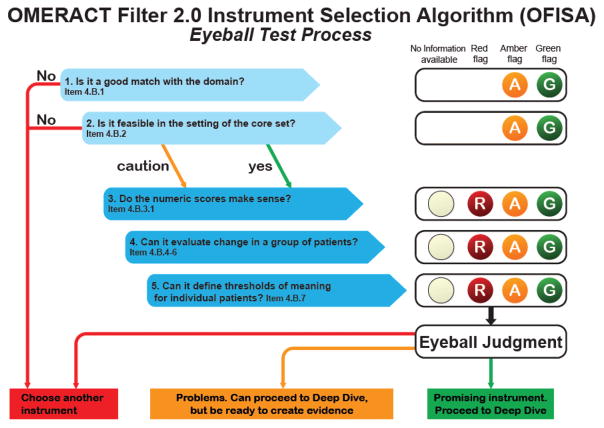
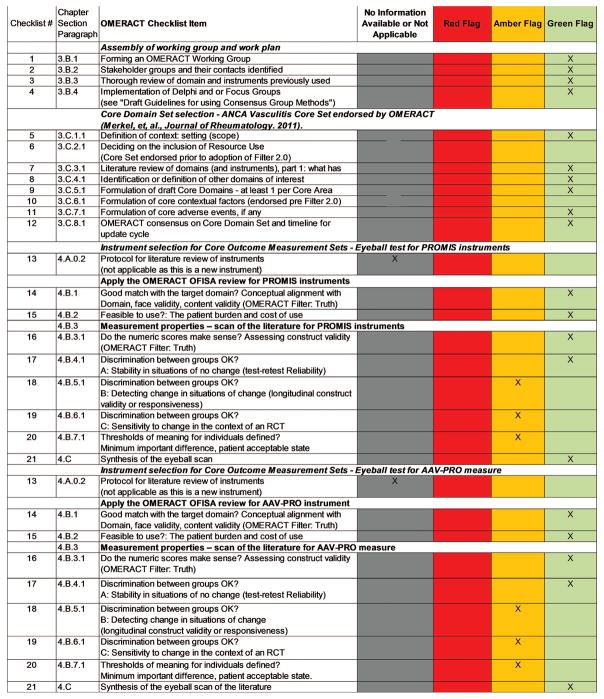
A novel 5-step tool was used to facilitate assessment of the instruments by delegates: the OMERACT Filter 2.0 Instrument Selection Algorithm, with a red-amber-green checklist of questions, including (1) good match with domain (face and content validity), (2) feasibility, (3) do numeric scores make sense (construct validity)?, (4) overall ratings of discrimination, and (5) can individual thresholds of meaning be defined? Delegates gave an overall endorsement. Three generic Patient-Reported Outcomes Measurement Information System (PROMIS) instruments (fatigue, physical functioning, and pain interference) and a disease-specific PRO, the AAV-PRO (6 domains related to symptoms and HRQOL), were presented.
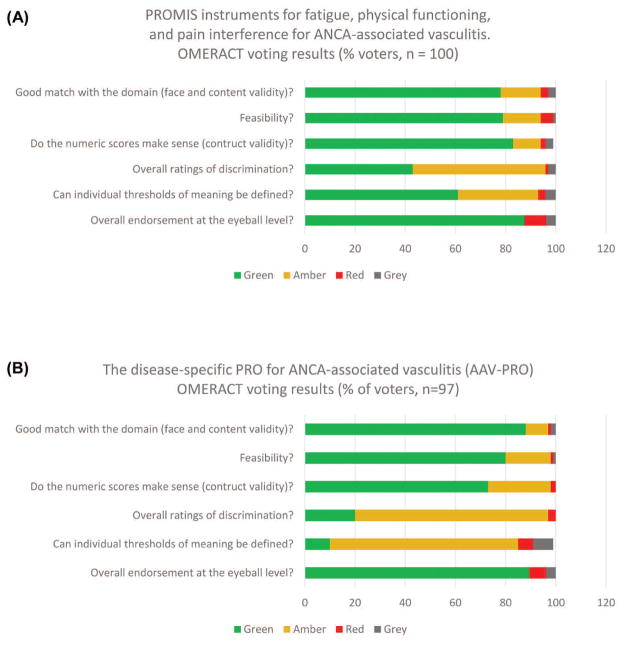
OMERACT delegates endorsed the use of the PROMIS instruments for fatigue, physical functioning, and pain interference (87.6% overall endorsement) and the disease-specific AAV-PRO instrument (89.4% overall endorsement).
The OMERACT Vasculitis Working Group gained endorsement by OMERACT for use of the PROMIS and the AAV-PRO in clinical trials of vasculitis. These instruments are complementary to each other. The PROMIS and the AAV-PRO need further work to assess their utility in longitudinal settings, including their ability to discriminate between treatments of varying efficacy in the setting of a randomized controlled trial.
抗中性粒细胞胞浆抗体相关性血管炎(AAV)是多系统疾病。与医生相比,AAV 患者报告其健康相关生活质量(HRQOL)受损,并且对疾病评估有不同的重点。风湿病学结局测量(OMERACT)血管炎工作组之前获得了 AAV 核心领域的认可。OMERACT 2016 会议提出了两种衡量患者报告结局(PRO)的方法。
一种新的 5 步工具用于促进代表对仪器的评估:OMERACT 过滤器 2.0 仪器选择算法,带有一个红色-琥珀色-绿色检查表,包括(1)与领域的良好匹配(表面和内容有效性),(2)可行性,(3)数字评分是否有意义(构效关系)?,(4)总体区分能力评分,(5)能否定义个体意义阈值?代表们对此给予了全面认可。三种通用的患者报告的测量信息系统(PROMIS)仪器(疲劳、身体功能和疼痛干扰)和一种特定于疾病的 PRO,即 AAV-PRO(与症状和 HRQOL 相关的 6 个领域),也进行了介绍。
OMERACT 代表们认可使用 PROMIS 仪器评估疲劳、身体功能和疼痛干扰(总体认可率为 87.6%),以及特定于疾病的 AAV-PRO 仪器(总体认可率为 89.4%)。
OMERACT 血管炎工作组获得了 OMERACT 的认可,可在血管炎临床试验中使用 PROMIS 和 AAV-PRO。这些仪器相互补充。PROMIS 和 AAV-PRO 需要进一步工作,以评估其在纵向研究中的效用,包括在随机对照试验中区分不同疗效治疗方法的能力。