Key Laboratory of Advanced Energy Materials Chemistry (Ministry of Education) and State Key Laboratory of Elemento-Organic Chemistry, College of Chemistry, Nankai University, Tianjin, 300071, China.
Collaborative Innovation Center of Chemical Science and Engineering, Nankai University, Tianjin, 300071, China.
Nat Commun. 2017 Sep 1;8(1):405. doi: 10.1038/s41467-017-00467-x.
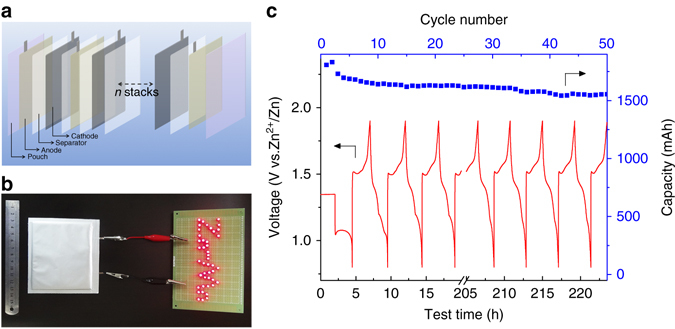
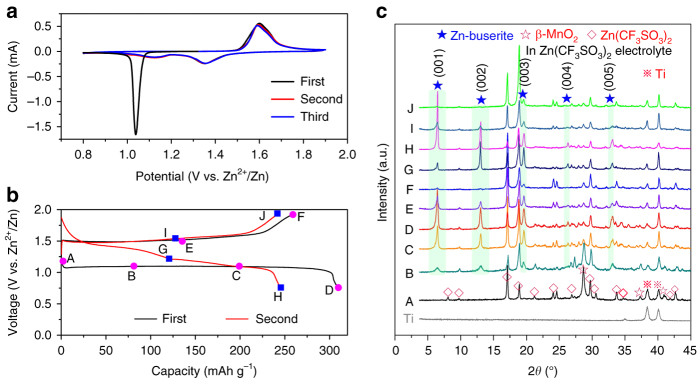
Although alkaline zinc-manganese dioxide batteries have dominated the primary battery applications, it is challenging to make them rechargeable. Here we report a high-performance rechargeable zinc-manganese dioxide system with an aqueous mild-acidic zinc triflate electrolyte. We demonstrate that the tunnel structured manganese dioxide polymorphs undergo a phase transition to layered zinc-buserite on first discharging, thus allowing subsequent intercalation of zinc cations in the latter structure. Based on this electrode mechanism, we formulate an aqueous zinc/manganese triflate electrolyte that enables the formation of a protective porous manganese oxide layer. The cathode exhibits a high reversible capacity of 225 mAh g and long-term cyclability with 94% capacity retention over 2000 cycles. Remarkably, the pouch zinc-manganese dioxide battery delivers a total energy density of 75.2 Wh kg. As a result of the superior battery performance, the high safety of aqueous electrolyte, the facile cell assembly and the cost benefit of the source materials, this zinc-manganese dioxide system is believed to be promising for large-scale energy storage applications.The development of rechargeable aqueous zinc batteries are challenging but promising for energy storage applications. With a mild-acidic triflate electrolyte, here the authors show a high-performance Zn-MnO battery in which the MnO cathode undergoes Zn (de)intercalation.
虽然碱性锌-二氧化锰电池在原电池应用中占据主导地位,但将其制成可充电电池具有挑战性。在此,我们报告了一种具有高性能的可充电锌-二氧化锰系统,采用了水基温和酸性的三氟甲磺酸锌电解液。我们证明隧道结构的二氧化锰多晶型物在首次放电时经历了向层状锌水滑石的相转变,从而允许随后在后者结构中嵌入锌阳离子。基于这种电极机制,我们配制了一种水基锌/三氟甲磺酸锌电解液,能够形成保护性多孔氧化锰层。该阴极具有 225 mAh g 的高可逆容量和 2000 次循环后 94%容量保持率的长期循环稳定性。值得注意的是,软包锌-二氧化锰电池的总能量密度达到 75.2 Wh kg。由于电池性能卓越、水基电解液的高安全性、电池组装简单以及原材料的成本效益,这种锌-二氧化锰系统有望在大规模储能应用中得到应用。开发可充电水系锌电池具有挑战性,但在储能应用中具有广阔的前景。在温和酸性的三氟甲磺酸酯电解液中,作者展示了一种高性能的 Zn-MnO 电池,其中 MnO 阴极经历了 Zn(脱)嵌入。