Institute for Environmental Medicine, Department of Physiology, Perelman School of Medicine of the University of Pennsylvania, Philadelphia, PA 19104, USA.
Institute for Environmental Medicine, Department of Physiology, Perelman School of Medicine of the University of Pennsylvania, Philadelphia, PA 19104, USA.
Redox Biol. 2018 Apr;14:41-46. doi: 10.1016/j.redox.2017.08.008. Epub 2017 Aug 12.
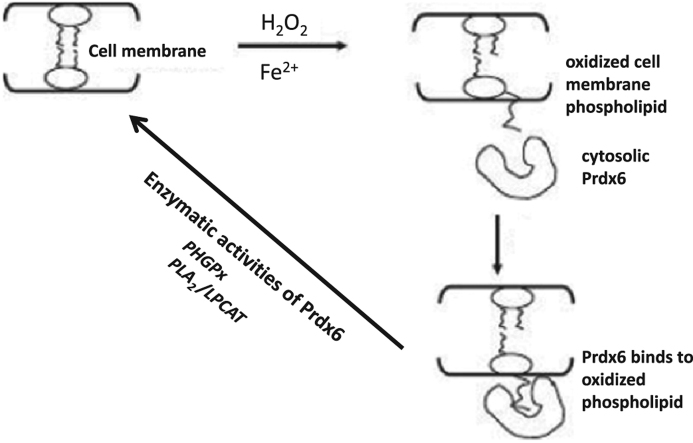
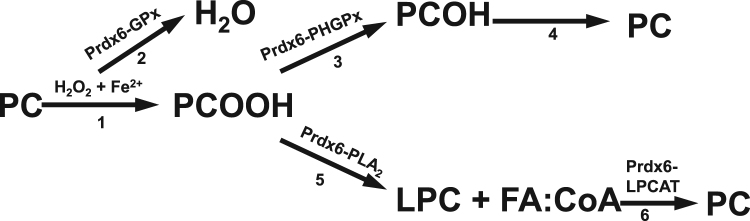
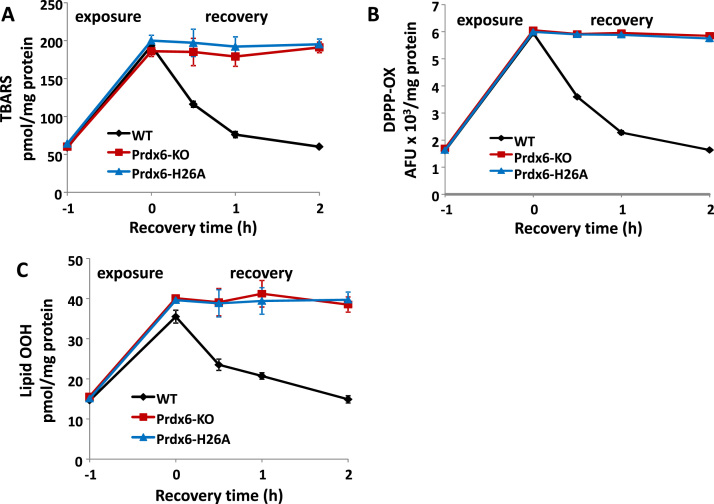
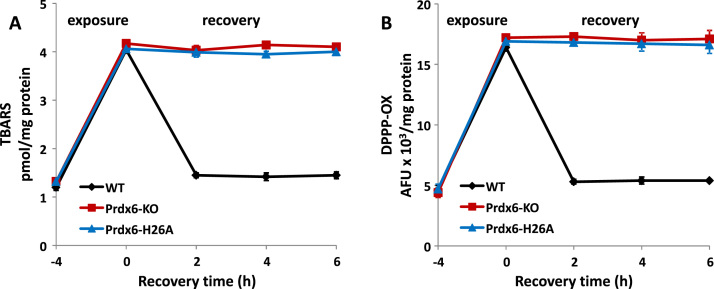
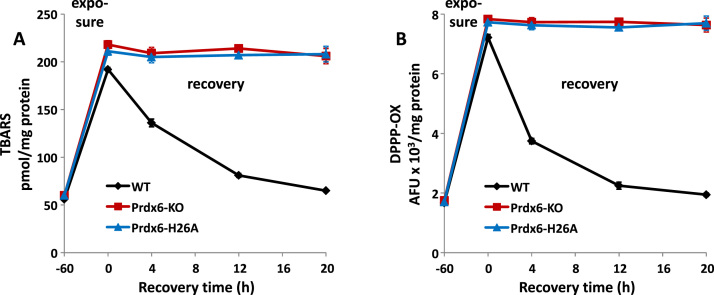
Although lipid peroxidation associated with oxidative stress can result in cellular death, sub-lethal lipid peroxidation can gradually resolve with return to the pre-exposure state. We have shown that resolution of lipid peroxidation is greatly delayed in lungs or cells that are null for peroxiredoxin 6 (Prdx6) and that both the phospholipase A and the GSH peroxidase activities of Prdx6 are required for a maximal rate of recovery. Like other peroxiredoxins, Prdx6 can reduce HO and short chain hydroperoxides, but in addition can directly reduce phospholipid hydroperoxides. This study evaluated the relative role of these two different peroxidase activities of Prdx6 in the repair of peroxidized cell membranes. The His26 residue in Prdx6 is an important component of the binding site for phospholipids. Thus, we evaluated the lungs from H26A-Prdx6 expressing mice and generated H26A-Prdx6 expressing pulmonary microvascular endothelial cells (PMVEC) by lentiviral infection of Prdx6 null cells to compare with wild type in the repair of lipid peroxidation. Isolated lungs and PMVEC were exposed to tert-butyl hydroperoxide and mice were exposed to hyperoxia (> 95% O). Assays for lipid peroxidation in wild type control and mutant lungs and cells showed ~4-fold increase at end-exposure. Control lungs and cells showed gradual resolution during a post-exposure recovery period. However, there was no recovery from lipid peroxidation by H26A-Prdx6 lungs or PMVEC. These studies confirm an important role for Prdx6 in recovery from membrane lipid peroxidation and indicate that reduction of HO or short chain hydroperoxides does not play a role in the recovery process.
尽管与氧化应激相关的脂质过氧化会导致细胞死亡,但亚致死性的脂质过氧化可以随着恢复到暴露前状态而逐渐解决。我们已经表明,过氧化物酶 6(Prdx6)缺失的肺或细胞中脂质过氧化的解决大大延迟,并且 Prdx6 的磷脂酶 A 和 GSH 过氧化物酶活性都需要最大程度的恢复速率。与其他过氧化物酶一样,Prdx6 可以还原 HO 和短链氢过氧化物,但除此之外,还可以直接还原磷脂氢过氧化物。本研究评估了 Prdx6 的这两种不同过氧化物酶活性在修复过氧化细胞膜中的相对作用。Prdx6 中的 His26 残基是磷脂结合位点的重要组成部分。因此,我们评估了表达 H26A-Prdx6 的小鼠的肺,并通过 lentiviral 感染 Prdx6 缺失细胞生成了表达 H26A-Prdx6 的肺微血管内皮细胞(PMVEC),与野生型进行比较在修复脂质过氧化方面。分离的肺和 PMVEC 暴露于叔丁基过氧化物,并且用高氧(>95%O)暴露小鼠。在野生型对照和突变体肺和细胞中进行脂质过氧化测定,结果显示终暴露时增加了约 4 倍。对照肺和细胞在暴露后恢复期间逐渐解决。然而,H26A-Prdx6 肺或 PMVEC 没有从脂质过氧化中恢复。这些研究证实了 Prdx6 在从膜脂质过氧化中恢复的重要作用,并表明 HO 或短链氢过氧化物的还原在恢复过程中不起作用。