Xie Pusheng, Ouyang Hanbin, Deng Yuping, Yang Yang, Xu Jing, Huang Wenhua
Guangdong Provincial Key laboratory of Medical Biomechanics, Department of Anatomy, School of Basic Medicine Science, Southern Medical University, 1023 ShaTai Rd, Guangzhou, 510515, People's Republic of China.
J Orthop Surg Res. 2017 Sep 2;12(1):128. doi: 10.1186/s13018-017-0628-6.
Additive manufacturing (AM) technology has helped to achieve several advances in the medical field, particularly as far as fabrication of implants is concerned. But the application of direct metal laser sintering (DMLS) bone plate is quite limited due to the indeterminate mechanical property. The purposes of this study were to characterize the biomechanical properties of the polished DMLS reconstruction plate and to compare these with the properties of commonly applied implants and to find whether the mechanical performance of DMLS plate meets the requirements for clinical application.
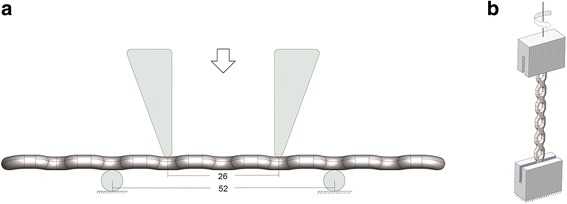
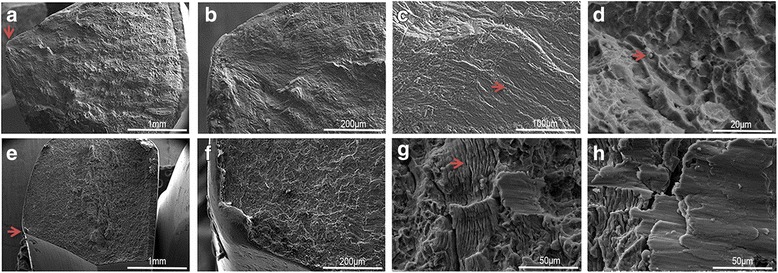
In this study, we fabricated two groups of plates by DMLS and computer numerical control (CNC) techniques. After that, we polished all samples and investigated their roughness, components, hardness, static bending, and torsional performance. Moreover, cyclic bending tests and fractographic analysis were conducted. Statistical comparisons of the group by means of monotonic test data were made, and a qualitative comparison was performed to assess failures in fatigue.
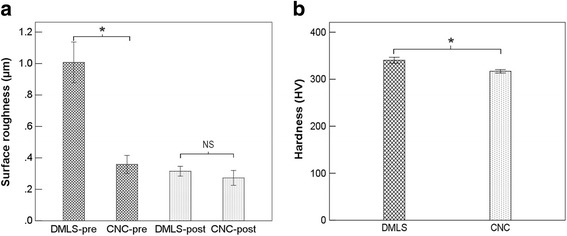
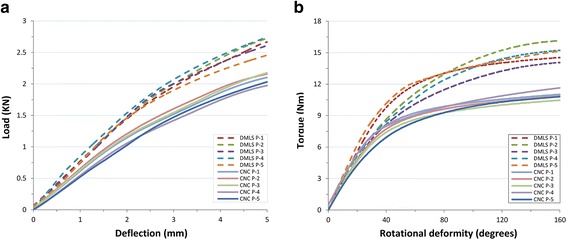
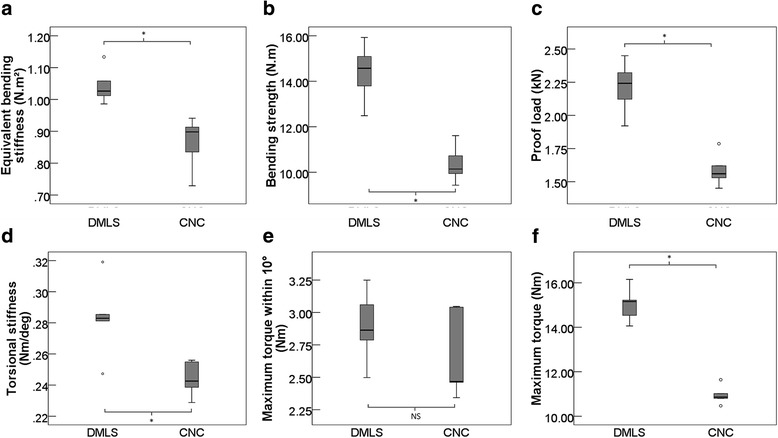
We found no differences in surface roughness or components after polishing, but the DMLS plate hardness is 7.42% (p < 0.01) greater than that of the CNC plates. Compared with the CNC plates, the DMLS plate static bending and torsional performance were significantly greater. In a dynamic test, the DMLS plates survived 10, 10, 32,731, and 33,264 cycles under 0.6, 0.8, 0.9, and 1 kN cyclic loads, respectively, while the CNC plates survived 10, 10, 10, and 283,714 cycles.
These results indicate that the mechanical performances of the DMLS plate are stronger, and the strength under fatigue tests is sufficient. DMLS implant has great potential and may become a better choice for clinical use in the future. However, direct application of these AM instruments in the operating room requires further validation including animal and clinical experiment.
增材制造(AM)技术已助力医学领域取得多项进展,尤其是在植入物制造方面。但由于力学性能不确定,直接金属激光烧结(DMLS)骨板的应用相当有限。本研究的目的是表征抛光后的DMLS重建板的生物力学性能,并将其与常用植入物的性能进行比较,以确定DMLS板的力学性能是否满足临床应用要求。
在本研究中,我们通过DMLS和计算机数控(CNC)技术制造了两组板。之后,我们对所有样品进行抛光,并研究其粗糙度、成分、硬度、静态弯曲和扭转性能。此外,还进行了循环弯曲试验和断口分析。通过单调试验数据对组间进行统计比较,并进行定性比较以评估疲劳失效情况。
我们发现抛光后表面粗糙度或成分没有差异,但DMLS板的硬度比CNC板高7.42%(p<0.01)。与CNC板相比,DMLS板的静态弯曲和扭转性能明显更强。在动态试验中,DMLS板在0.6、0.8、0.9和1kN循环载荷下分别存活了10、10、32731和33264次循环,而CNC板存活了10、10、10和283714次循环。
这些结果表明DMLS板的力学性能更强,疲劳试验下的强度足够。DMLS植入物具有很大潜力,未来可能成为临床应用的更好选择。然而,在手术室直接应用这些增材制造器械需要进一步验证,包括动物和临床试验。