Ge Xiaoyan, Gong Henry, Dumas Kevin, Litwin Jessica, Phillips Joanna J, Waisfisz Quinten, Weiss Marjan M, Hendriks Yvonne, Stuurman Kyra E, Nelson Stanley F, Grody Wayne W, Lee Hane, Kwok Pui-Yan, Shieh Joseph Tc
Department of Pediatrics, Division of Medical Genetics, University of California San Francisco, San Francisco, CA, USA.
Institute for Human Genetics, University of California San Francisco, San Francisco, CA, USA.
NPJ Genom Med. 2016;1:16036-. doi: 10.1038/npjgenmed.2016.36. Epub 2016 Oct 5.
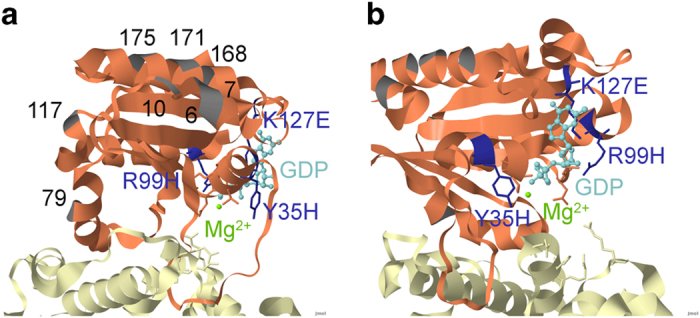
Genomic sequence interpretation can miss clinically relevant missense variants for several reasons. Rare missense variants are numerous in the exome and difficult to prioritise. Affected genes may also not have existing disease association. To improve variant prioritisation, we leverage population exome data to identify intragenic missense-depleted regions (MDRs) genome-wide that may be important in disease. We then use missense depletion analyses to help prioritise undiagnosed disease exome variants. We demonstrate application of this strategy to identify a novel gene association for human brain malformation. We identified missense variants that affect the GDP/GTP-binding site of in three unrelated patients. Corresponding functional analysis suggests ARF1 GDP/GTP-activation is affected by the specific missense mutations associated with heterotopia. These findings expand the genetic pathway underpinning neurologic disease that classically includes . along with add further evidence implicating ARF/GEFs in the brain. Using functional ontology, top MDR-containing genes were highly enriched for nucleotide-binding function, suggesting these may be candidates for human disease. Routine consideration of MDR in the interpretation of exome data for rare diseases may help identify strong genetic factors for many severe conditions, infertility/reduction in reproductive capability, and embryonic conditions contributing to preterm loss.
基因组序列解读可能会因多种原因而遗漏临床相关的错义变异。外显子组中罕见的错义变异数量众多且难以排序。受影响的基因也可能不存在现有的疾病关联。为了改进变异排序,我们利用群体外显子组数据在全基因组范围内识别基因内错义缺失区域(MDR),这些区域可能在疾病中具有重要意义。然后,我们使用错义缺失分析来帮助对未确诊疾病的外显子组变异进行排序。我们展示了该策略在识别与人类脑畸形相关的新基因方面的应用。我们在三名无亲缘关系的患者中鉴定出影响 的GDP/GTP结合位点的错义变异。相应的功能分析表明,ARF1 GDP/GTP激活受与异位症相关的特定错义突变影响。这些发现扩展了支撑神经疾病的遗传途径,经典的神经疾病包括 。 以及 进一步证明了ARF/GEF在大脑中的作用。使用功能本体,含顶级MDR的基因在核苷酸结合功能方面高度富集,表明这些可能是人类疾病的候选基因。在解读罕见病的外显子组数据时常规考虑MDR,可能有助于识别许多严重疾病、不孕/生殖能力下降以及导致早产的胚胎疾病的强大遗传因素。