Jha Ashish Kumar, Jha Sharad Kumar, Kumar Amarendra, Dayal Vishwa Mohan, Jha Sanjeev Kumar
Ashish Kumar Jha, Sharad Kumar Jha, Amarendra Kumar, Vishwa Mohan Dayal, Sanjeev Kumar Jha, Department of Gastroenterology, Indira Gandhi Institute of Medical Sciences, Sheikhpura, Patna 800014, India.
World J Gastrointest Pathophysiol. 2017 Aug 15;8(3):133-141. doi: 10.4291/wjgp.v8.i3.133.
To assess the vitamin D (VD) deficiency as a prognostic factor and effect of replenishment of VD on mortality in decompensated cirrhosis.
Patients with decompensated liver cirrhosis were screened for serum VD levels. A total of 101 VD deficient patients (< 20 ng/mL) were randomly enrolled in two groups: Treatment group ( = 51) and control group ( = 50). Treatment group received VD treatment in the form of intramuscular cholecalciferol 300000 IU as loading dose and 800 IU/d oral as maintenance dose along with 1000 mg oral calcium supplementation. The VD level, clinical parameters and survival of both the groups were compared for 6-mo.
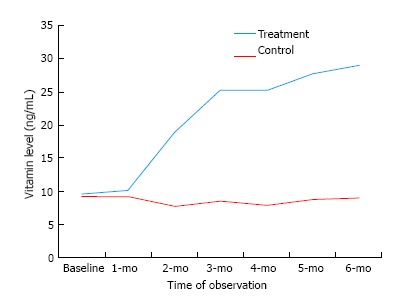
Prevalence of vitamin D deficiency (VDD) in decompensated CLD was 84.31%. The mean (SD) age of the patients in the treatment group (M:F: 40:11) and control group (M:F: 37:13) were 46.2 (± 14.93) years and 43.28 (± 12.53) years, respectively. Baseline mean (CI) VD (ng/mL) in control group and treatment group were 9.15 (8.35-9.94) and 9.65 (8.63-10.7), respectively. Mean (CI) serum VD level (ng/mL) at 6-mo in control group and treatment group were 9.02 (6.88-11.17) and 29 (23-35), respectively. Over the period of time the VD, calcium and phosphorus level was improved in treatment group compared to control group. There was non-significant trend seen in greater survival (69% 64%; > 0.05) and longer survival (155 d 141 d; > 0.05) in treatment group compared to control group. VD level had no significant association with mortality ( > 0.05). In multivariate analysis, treatment with VD supplement was found significantly ( < 0.05; adjusted hazard ratio: 0.48) associated with survival of the patients over 6-mo.
VD deficiency is very common in patients of decompensated CLD. Replenishment of VD may improve survival in patients with decompensated liver cirrhosis.
评估维生素D(VD)缺乏作为失代偿期肝硬化患者预后因素以及补充VD对死亡率的影响。
对失代偿期肝硬化患者进行血清VD水平筛查。共101例VD缺乏患者(<20 ng/mL)被随机分为两组:治疗组(n = 51)和对照组(n = 50)。治疗组接受肌肉注射胆钙化醇300000 IU作为负荷剂量,口服800 IU/d作为维持剂量的VD治疗,并同时口服1000 mg钙补充剂。比较两组患者6个月时的VD水平、临床参数和生存率。
失代偿期慢性肝病患者中维生素D缺乏(VDD)的患病率为84.31%。治疗组(男:女 = 40:11)和对照组(男:女 = 37:13)患者的平均(标准差)年龄分别为46.2(±14.93)岁和43.28(±12.53)岁。对照组和治疗组的基线平均(可信区间)VD(ng/mL)分别为9.15(8.35 - 9.94)和9.65(8.63 - 10.7)。对照组和治疗组6个月时的平均(可信区间)血清VD水平(ng/mL)分别为9.02(6.88 - 11.17)和29(23 - 35)。随着时间推移,与对照组相比,治疗组的VD、钙和磷水平有所改善。与对照组相比,治疗组的生存率更高(69%对64%;P>0.05)和生存时间更长(155天对141天;P>0.05),但差异无统计学意义。VD水平与死亡率无显著相关性(P>0.05)。在多变量分析中,发现补充VD治疗与患者6个月以上的生存率显著相关(P<0.05;调整后风险比:0.48)。
VD缺乏在失代偿期慢性肝病患者中非常常见。补充VD可能改善失代偿期肝硬化患者的生存率。