Department of Pharmacology and Clinical Neuroscience, Umeå University, Umeå, Sweden.
Epidemiology and Global Health Unit, Department of Public Health and Clinical Medicine, Umeå University, Umeå, Sweden.
Acta Neurol Scand. 2018 Jan;137(1):91-98. doi: 10.1111/ane.12812. Epub 2017 Sep 4.
Cognitive decline is common in Parkinson's disease (PD), but the underlying mechanisms for this complication are incompletely understood. Genotypes affecting dopamine transmission may be of importance. This study investigates whether genotypes associated with reduced prefrontal dopaminergic tone and/or reduced dopamine D2-receptor availability (Catechol-O-methyltransferase [COMT] Val Met genotype and DRD2 C T genotype) affect the development of cognitive deficits in PD.
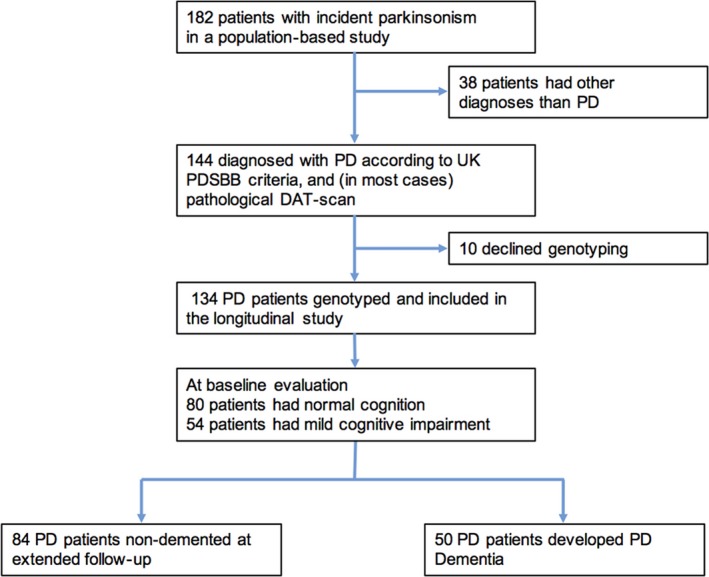
One hundred and 34 patients with idiopathic PD, participating in a regional, population-based study of incident parkinsonism, underwent genotyping. After extensive baseline investigations (including imaging and biomarker analyses), the patients were followed prospectively during 6-10 years with neuropsychological evaluations, covering six cognitive domains. Cognitive decline (defined as the incidence of either Parkinson's disease mild cognitive impairment [PD-MCI] or dementia [PDD], diagnosed according to published criteria and blinded to genotype) was studied as the primary outcome.
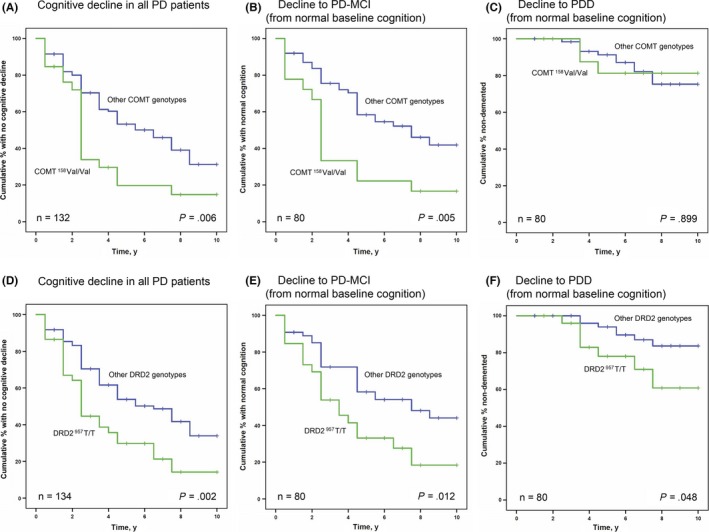
Both genotypes affected cognition, as shown by Cox proportional hazards models. While the COMT Val/Val genotype conferred an increased risk of mild cognitive impairment in patients with normal cognition at baseline (hazard ratio: 2.13, P = .023), the DRD2 T/T genotype conferred an overall increased risk of PD dementia (hazard ratio: 3.22, P < .001). The poorer cognitive performance in DRD2 T/T carriers with PD occurred mainly in episodic memory and attention.
The results favor the hypothesis that dopamine deficiency in PD not only relate to mild cognitive deficits in frontostriatal functions, but also to a decline in memory and attention. This could indicate that dopamine deficiency impairs a wide network of brain areas.
认知衰退在帕金森病(PD)中很常见,但这种并发症的潜在机制尚不完全清楚。影响多巴胺传递的基因型可能很重要。本研究调查了与前额叶多巴胺能张力降低和/或多巴胺 D2 受体可利用性降低相关的基因型(儿茶酚-O-甲基转移酶[COMT] Val Met 基因型和 DRD2 C T 基因型)是否会影响 PD 患者认知缺陷的发展。
134 名特发性 PD 患者参加了一项针对特发性帕金森病的区域、人群为基础的发病研究,进行了基因分型。在广泛的基线调查(包括影像学和生物标志物分析)后,患者在 6-10 年内进行前瞻性随访,进行神经心理学评估,涵盖六个认知领域。认知衰退(根据发表的标准定义为帕金森病轻度认知障碍[PD-MCI]或痴呆[PDD]的发生,并对基因型进行盲法)被作为主要结局进行研究。
Cox 比例风险模型显示,这两种基因型都影响认知。虽然 COMT Val/Val 基因型使基线时认知正常的患者发生轻度认知障碍的风险增加(风险比:2.13,P =.023),但 DRD2 T/T 基因型使 PD 痴呆的总体风险增加(风险比:3.22,P <.001)。DRD2 T/T 携带者的认知表现较差主要发生在情景记忆和注意力方面。
结果支持这样一种假说,即 PD 中的多巴胺缺乏不仅与额纹状体功能的轻度认知缺陷有关,而且与记忆和注意力的下降有关。这可能表明多巴胺缺乏会损害广泛的脑区网络。