Pantoni Leonardo, Poggesi Anna, Diciotti Stefano, Valenti Raffaella, Orsolini Stefano, Della Rocca Eleonora, Inzitari Domenico, Mascalchi Mario, Salvadori Emilia
NEUROFARBA Department, Neuroscience Section, University of Florence, Florence, Italy.
Department of Electrical, Electronic, and Information Engineering 'Guglielmo Marconi', University of Bologna, Cesena, Italy.
J Alzheimers Dis. 2017;60(2):615-624. doi: 10.3233/JAD-170428.
Mild cognitive impairment (MCI) patients with small vessel disease (SVD) are at high dementia risk. We tested the effects of cognitive rehabilitation in these patients using the Attention Process Training-II (APT-II) program in a single-blinded, randomized clinical trial.
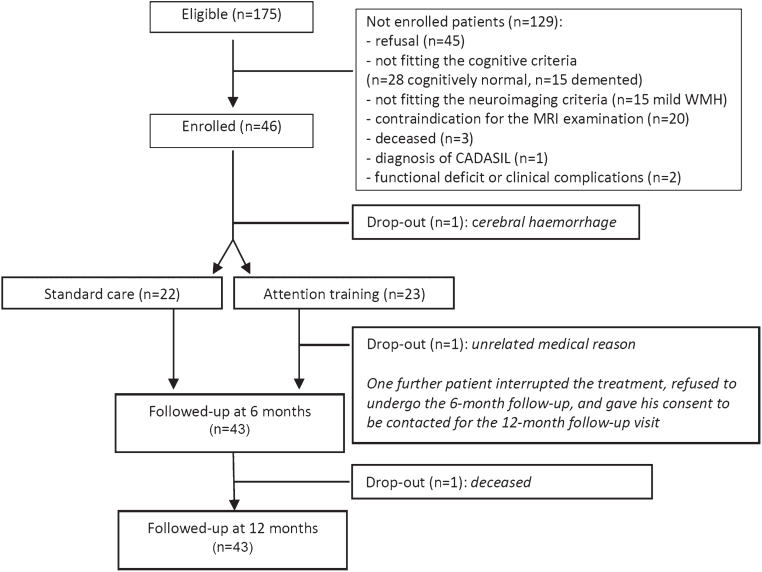
Patients were randomized to APT-II or standard care and evaluated at baseline, 6, and 12 months with functional, quality of life, cognitive tests, and resting state functional MRI (rsfMRI).
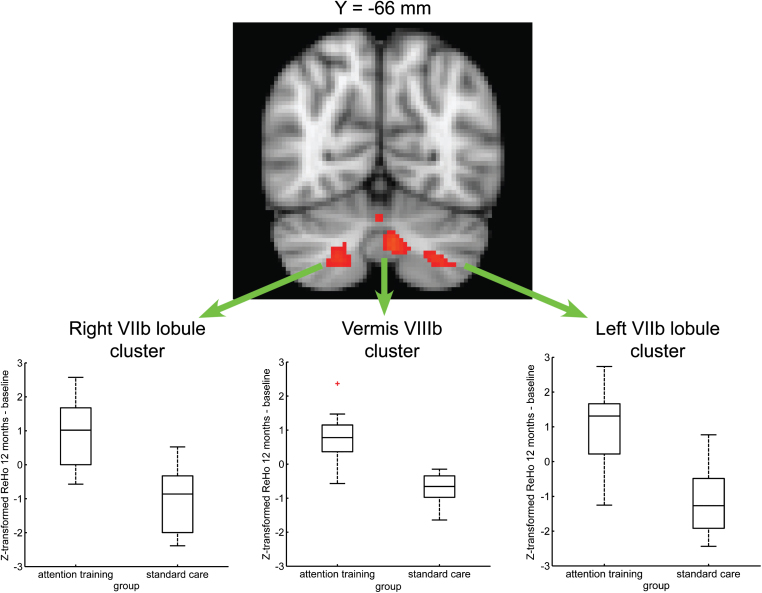
Forty-six patients were enrolled and 43 (mean±SD age 75.1±6.8) completed the study. No change was seen in functionality and quality of life between treated and non-treated patients. However, the Rey Auditory-Verbal Learning Test immediate recall showed a significant improvement in treated compared to non-treated group (change score 6 versus 12 months: 1.8±4.9 and -1.4±3.8, p = 0.021; baseline versus 12 months: 3.8±6.1 and 0.2±4.4, p = 0.032). A higher proportion of treated patients had stable/better evaluation compared to non-treated group on Visual search test (6 versus 12 months: 95% versus 71%, p = 0.038) and Rey-Osterrieth Complex Figure copy (6 versus 12 months: 95% versus 67%, p = 0.027). RsfMRI, performed in a subsample, showed that the difference between follow-up and baseline in synchronization of activity in cerebellar areas was significantly greater in treated than in non-treated patients.
We were unable to show a significant effect in quality of life or functional status in treated patients with MCI and SVD. However, APT-II produces some beneficial effects in focused attention and working memory and seems to increase activity in brain circuits involved in cognitive processes.
患有小血管疾病(SVD)的轻度认知障碍(MCI)患者面临着较高的痴呆风险。在一项单盲随机临床试验中,我们使用注意力过程训练-II(APT-II)项目测试了认知康复对这些患者的影响。
将患者随机分为接受APT-II治疗组或标准护理组,并在基线、6个月和12个月时进行功能、生活质量、认知测试以及静息态功能磁共振成像(rsfMRI)评估。
共招募了46名患者,43名(平均年龄±标准差为75.1±6.8岁)完成了研究。治疗组和未治疗组患者的功能和生活质量均未出现变化。然而,与未治疗组相比,治疗组的雷伊听觉词语学习测验即时回忆有显著改善(6个月与12个月的变化分数:1.8±4.9和 -1.4±3.8,p = 0.021;基线与12个月:3.8±6.1和0.2±4.4,p = 0.032)。在视觉搜索测试中,与未治疗组相比,治疗组有更高比例的患者评估结果稳定/更好(6个月与12个月:95% 与71%,p = 0.038),在雷伊 - 奥斯特里赫复杂图形临摹测试中也是如此(6个月与12个月:95% 与67%,p = 0.027)。在一个子样本中进行的rsfMRI显示,治疗组患者小脑区域活动同步性随访与基线之间的差异显著大于未治疗组患者。
我们未能在患有MCI和SVD的治疗患者的生活质量或功能状态方面显示出显著效果。然而,APT-II在集中注意力和工作记忆方面产生了一些有益影响,并且似乎增加了参与认知过程的脑回路的活动。