Universidade Federal do Ceará, Faculdade de Medicina, Departmento de Fisioterapia, Fortaleza, CE, Brazil; Universidade Federal de Minas Gerais (UFMG), Escola de Educação Física, Fisioterapia e Terapia Ocupacional, Departamento de Fisioterapia, Belo Horizonte, Brazil.
The University of Sydney, Faculty of Health Sciences, Sydney, New South Wales, Australia.
Braz J Phys Ther. 2018 Jan-Feb;22(1):55-63. doi: 10.1016/j.bjpt.2017.06.018. Epub 2017 Aug 10.
Low back pain (LBP) is little explored in the aging population especially when considering age-relevant and culturally dependent outcomes. We aimed to describe socio-demographic and clinical characteristics of Brazilian older people with a new episode of LBP presenting to primary care.
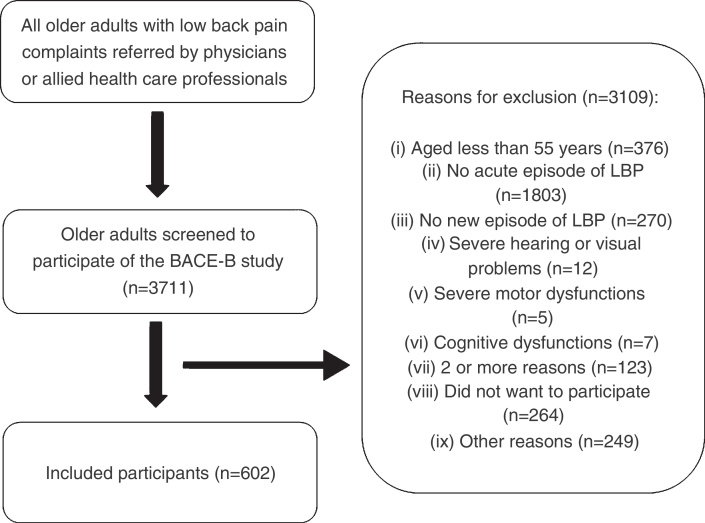
We sourced baseline information on socio-demographic, pain-related and clinical characteristics from 602 older adults from the Brazilian Back Complaints in the Elders (Brazilian BACE) study. We analyzed differences in pain, disability, functional capacity and psychosocial factors between sub-groups based on age (i.e. participants aged 55-74 or ≥75 years), education (i.e. those with four years or less of schooling or those with more than four years of schooling) and income (i.e. participants who reported earning two or less minimal wages or three and more).
Participants presented severe LBP (7.18/10, SD: 2.59). Younger participants were slightly more disabled (mean difference 1.29 points, 95% confidence interval [CI]: 0.03/5.56), reporting poorer physical health, and less fall-related self-efficacy (mean difference of 2.41, 95% CI 0.35/4.46). Those less educated, and those with income equal or less than two minimum wages had more disability, pain catastrophizing and worse functional capacity.
This was the first study showing that Brazilian older adults with LBP present high levels of functional disability and psychological distress, especially those with low socioeconomic status.
腰痛(LBP)在老年人群中研究较少,尤其是在考虑与年龄相关和文化相关的结果时。我们旨在描述在初级保健中出现新腰痛发作的巴西老年人的社会人口学和临床特征。
我们从巴西背部投诉在老年人(巴西 BACE)研究中,对 602 名老年人的社会人口学,疼痛相关和临床特征的基线信息进行了溯源。我们根据年龄(即 55-74 岁或≥75 岁的参与者),教育(即完成四年或以下学业或完成四年以上学业的参与者)和收入(即报告收入为两个或更少最低工资或三个及更多的参与者),分析了疼痛,残疾,功能能力和心理社会因素在亚组之间的差异。
参与者表现出严重的腰痛(7.18/10,SD:2.59)。年轻的参与者稍微更残疾(平均差异 1.29 分,95%置信区间[CI]:0.03/5.56),报告身体更健康,跌倒相关自我效能感较差(平均差异为 2.41,95%CI 0.35/4.46)。受教育程度较低和收入等于或低于两个最低工资的人,残疾,疼痛灾难化和功能能力更差。
这是第一项表明巴西老年腰痛患者功能残疾和心理困扰程度较高的研究,尤其是那些社会经济地位较低的患者。