Ruwe Matthias, Kalinowski Jörn, Persicke Marcus
Microbial Genomics and Biotechnology, Center for Biotechnology, Bielefeld UniversityBielefeld, Germany.
Front Microbiol. 2017 Aug 21;8:1601. doi: 10.3389/fmicb.2017.01601. eCollection 2017.
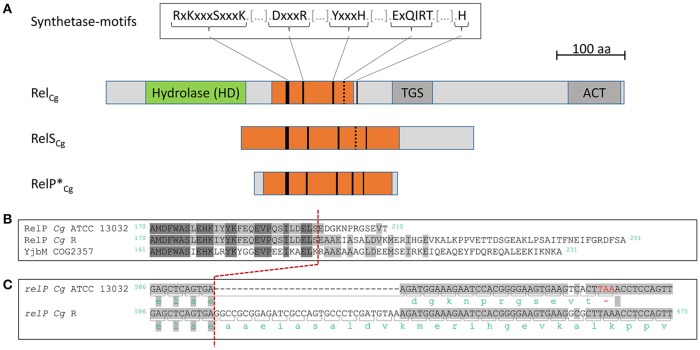
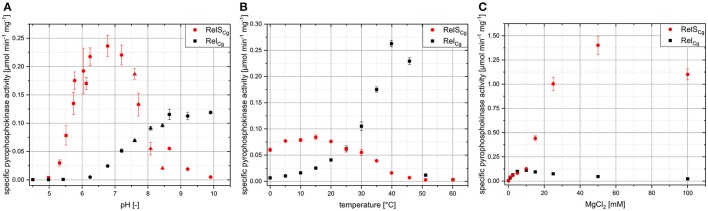
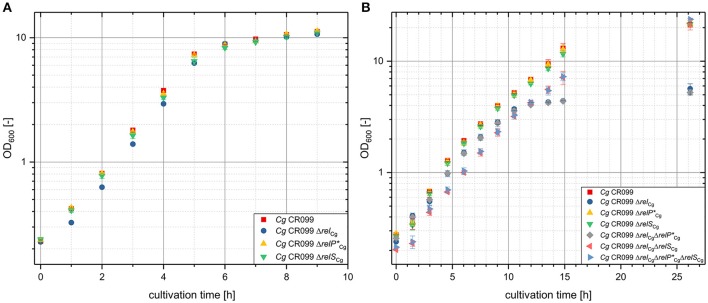
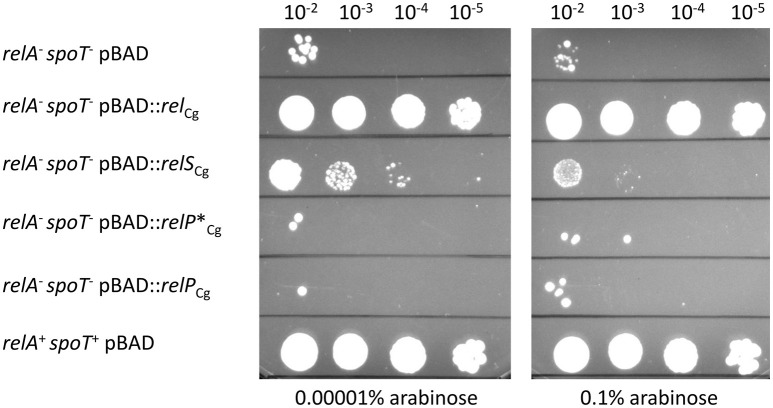
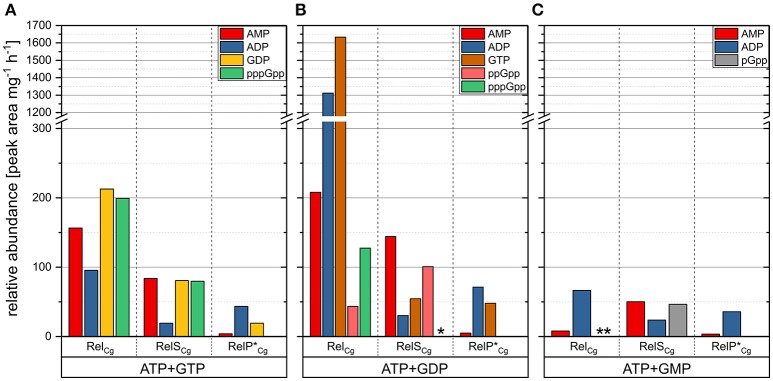
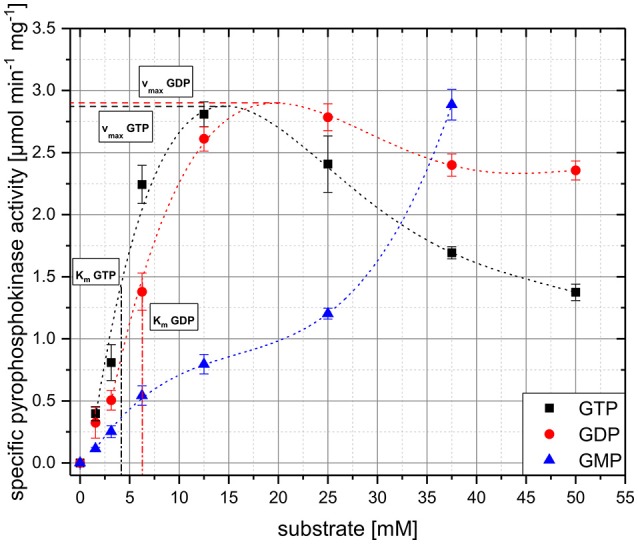
The hyperphosphorylated guanosine derivatives ppGpp and pppGpp represent global regulators of the bacterial stress response, as they act as central elements of the stringent response system. Although it was assumed that both, (p)ppGpp synthesis and hydrolysis, are catalyzed by one bifunctional RSH-protein in the actinobacterial model organism ATCC 13032, two putative short alarmone synthetases (SASs) were identified by bioinformatic analyses. The predicted sequences of both enzymes, designated as RelP and RelS, exhibit high similarities to the conserved (p)ppGpp synthetase catalytic domain. In the context of sequence analysis, significant differences were found between the RelP variants of different isolates. In contrast to the bifunctional RelA/SpoT homolog (RSH) protein Rel, whose gene deletion results in a reduced growth rate, no change in growth characteristics were observed for deletion mutants of the putative SAS proteins under standard growth conditions. The growth deficit of the Δ strain could be restored by the additional deletion of the gene encoding RelS, which clearly indicates a functional relationship between both enzymes. The predicted pyrophosphokinase activity of RelS was demonstrated by means of genetic complementation of an ΔΔ strain. For the expression of RelP , as well as the slightly differing variant RelP from AS1.542, no complementation was observed, concluding that both RelP versions possess no significant pyrophosphokinase activity . The results were confirmed by characterization of the corresponding proteins. In the course of this investigation, the additional conversion of GMP to pGpp was determined for the enzyme RelS. Since the SAS species analyzed extend both the network of stringent response related enzymes and the number of substances involved, the study of this class of enzymes is an important component in understanding the bacterial stress response. In addition to the comprehension of important biological processes, such as growth rate regulation and the survival of pathogenic species in the host organism, SAS enzymes can be used to produce novel hyperphosphorylated nucleotide species, such as pGpp.
超磷酸化鸟苷衍生物ppGpp和pppGpp是细菌应激反应的全局调节因子,因为它们是严谨反应系统的核心要素。尽管人们认为在放线菌模式生物ATCC 13032中,(p)ppGpp的合成和水解均由一种双功能RSH蛋白催化,但通过生物信息学分析鉴定出了两种假定的短警报素合成酶(SAS)。这两种酶(分别命名为RelP和RelS)的预测序列与保守的(p)ppGpp合成酶催化结构域具有高度相似性。在序列分析过程中,发现不同分离株的RelP变体之间存在显著差异。与双功能RelA/SpoT同源(RSH)蛋白Rel不同,Rel的基因缺失会导致生长速率降低,而在标准生长条件下,假定的SAS蛋白缺失突变体的生长特性未观察到变化。Δ菌株的生长缺陷可通过额外缺失编码RelS的基因来恢复,这清楚地表明了这两种酶之间的功能关系。通过对ΔΔ菌株的遗传互补证明了RelS预测的焦磷酸激酶活性。对于RelP以及来自AS1.542的略有不同的变体RelP的表达,未观察到互补现象,得出结论这两种RelP版本均不具有显著的焦磷酸激酶活性。相应蛋白质的表征证实了该结果。在这项研究过程中,确定了RelS酶将GMP额外转化为pGpp的过程。由于所分析的SAS种类扩展了严谨反应相关酶的网络以及所涉及物质的数量,因此对这类酶的研究是理解细菌应激反应的重要组成部分。除了理解重要的生物学过程,如生长速率调节和病原菌在宿主体内的存活外,SAS酶还可用于生产新型超磷酸化核苷酸种类,如pGpp。