Rick Fernanda, Niyibizi Aline Aurore, Shroufi Amir, Onami Kazumi, Steele Sarah-Jane, Kuleile Malehlohonolo, Muleya Innocent, Chiller Tom, Walker Tiffany, Van Cutsem Gilles
Médecins Sans Frontières, Cape Town, South Africa.
Médecins Sans Frontières, Maseru, Lesotho.
PLoS One. 2017 Sep 6;12(9):e0183656. doi: 10.1371/journal.pone.0183656. eCollection 2017.
Cryptococcal meningitis is one of the leading causes of death among people with HIV in Africa, primarily due to delayed presentation, poor availability and high cost of treatment. Routine cryptococcal antigen (CrAg) screening of patients with a CD4 count less than 100 cells/mm3, followed by pre-emptive therapy if positive, might reduce mortality in high prevalence settings. Using the cryptococcal antigen (CrAg) lateral flow assay (LFA), screening is possible at the point of care (POC). However, critical shortages of health staff may limit adoption. This study investigates the feasibility of lay counsellors conducting CrAg LFA screening in rural primary care clinics in Lesotho.
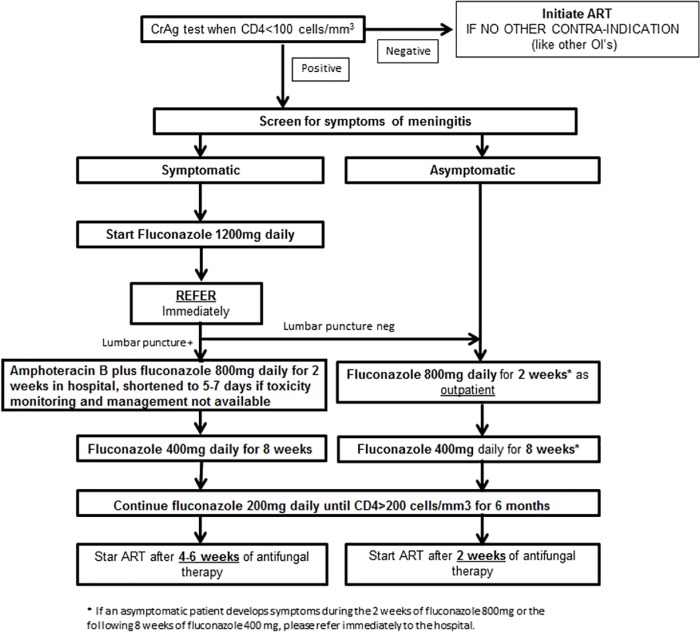
From May 2014 to June 2015, individuals who tested positive for HIV were tested for CD4 count and those with CD4 <100 cells/mm3 were screened with CrAg LFA. All tests were performed by lay counsellors. CrAg-positive asymptomatic patients received fluconazole, while symptomatic patients were referred to hospital. Lay counsellors were trained and supervised by a laboratory technician and counsellor activity supervisor. Additionally, nurses and doctors were trained on CrAg screening and appropriate treatment.
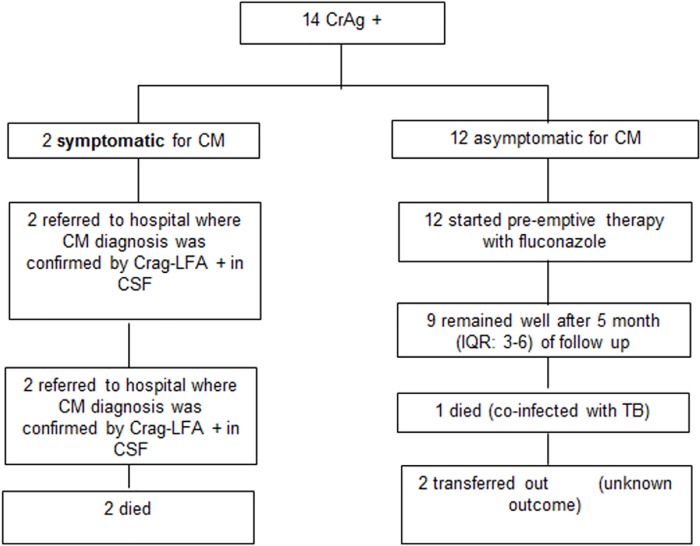
During the study period, 1,388 people were newly diagnosed with HIV, of whom 129 (9%) presented with a CD4 count <100 cells/mm3. Of these, 128 (99%) were screened with CrAg LFA and 14/128 (11%) tested positive. Twelve of the 14 (86%) were asymptomatic, and received outpatient fluconazole. All commenced ART with a median time to initiation of 15.5 days [IQR: 14-22]. Of the asymptomatic patients, nine (75%) remained asymptomatic after a median time of 5 months [IQR; 3-6] of follow up. One (8%) became co-infected with tuberculosis and died and two were transferred out. The two patients with symptomatic cryptococcal meningitis (CM) were referred to hospital, where they later died.
CrAg LFA screening by lay counsellors followed by pre-emptive fluconazole treatment for asymptomatic cases, or referral to hospital for symptomatic cases, proved feasible. However, regular follow-up to ensure proper management of cryptococcal disease was needed. These early results support the wider use of CrAg LFA screening in remote primary care settings where upper cadres of healthcare staff may be in short supply.
隐球菌性脑膜炎是非洲艾滋病毒感染者的主要死亡原因之一,主要是由于就诊延迟、治疗药物供应不足和成本高昂。对CD4细胞计数低于100个细胞/mm³的患者进行常规隐球菌抗原(CrAg)筛查,若结果呈阳性则进行预防性治疗,这可能会降低高流行地区的死亡率。使用隐球菌抗原(CrAg)侧向流动分析法(LFA),可以在护理点(POC)进行筛查。然而,卫生工作人员的严重短缺可能会限制该方法的采用。本研究调查了在莱索托农村初级保健诊所由非专业顾问进行CrAg LFA筛查的可行性。
2014年5月至2015年6月,对HIV检测呈阳性的个体进行CD4细胞计数检测,CD4细胞计数<100个细胞/mm³的个体用CrAg LFA进行筛查。所有检测均由非专业顾问进行。CrAg检测呈阳性的无症状患者接受氟康唑治疗,有症状的患者转诊至医院。非专业顾问由实验室技术员和顾问活动主管进行培训和监督。此外,护士和医生也接受了CrAg筛查和适当治疗方面的培训。
在研究期间,1388人新诊断为HIV,其中129人(9%)的CD4细胞计数<100个细胞/mm³。其中,128人(99%)接受了CrAg LFA筛查,14/128人(11%)检测呈阳性。14名患者中有12名(86%)无症状,接受了门诊氟康唑治疗。所有患者均开始接受抗逆转录病毒治疗,开始治疗的中位时间为15.5天[四分位间距:14 - 22]。在无症状患者中,9名(75%)在中位随访时间5个月[四分位间距;3 - 6]后仍无症状。1名(8%)患者合并感染结核病并死亡,2名患者转出。2名有症状的隐球菌性脑膜炎(CM)患者转诊至医院,后来死亡。
由非专业顾问进行CrAg LFA筛查,对无症状病例进行预防性氟康唑治疗,对有症状病例转诊至医院,这一方法被证明是可行的。然而,需要进行定期随访以确保对隐球菌病进行妥善管理。这些早期结果支持在偏远的初级保健环境中更广泛地使用CrAg LFA筛查,因为那里可能缺乏高级医疗人员。