Division of Experimental Medicine, Department of Oncology and Surgery, McGill University, Montréal, PQ, H3A 0G4, Canada.
Segal Cancer Center, Lady Davis Institute for Medical Research, Sir Mortimer B. Davis Jewish General Hospital, McGill University, Montréal, PQ, H3T 1E2, Canada.
Breast Cancer Res. 2017 Sep 6;19(1):104. doi: 10.1186/s13058-017-0897-3.
The primary cilium is a microtubule-based and nonmotile organelle functioning as a cellular antenna that is involved in the regulation of cell proliferation, differentiation, and migration. In breast cancer cells, the primary cilium is a structure that decreases in incidence with increasing degrees of transformation and may be biologically more important in estrogen receptor (ERα)-negative breast cancer cells. Split ends (SPEN) is an ERα corepressor that we have identified as a tumor suppressor protein in ERα-positive breast cancer cells whose hormone-independent roles in breast cancer have never been explored.
We determined the hormone-independent transcriptional program regulated by the ERα cofactor SPEN in breast cancer using DNA microarrays. The biological functions regulated by SPEN independently of hormones were studied in vitro in ERα-positive and ERα-negative breast cancer cells. Finally, we examined the clinical relevance of SPEN expression in cohorts of breast cancer samples with outcome data.
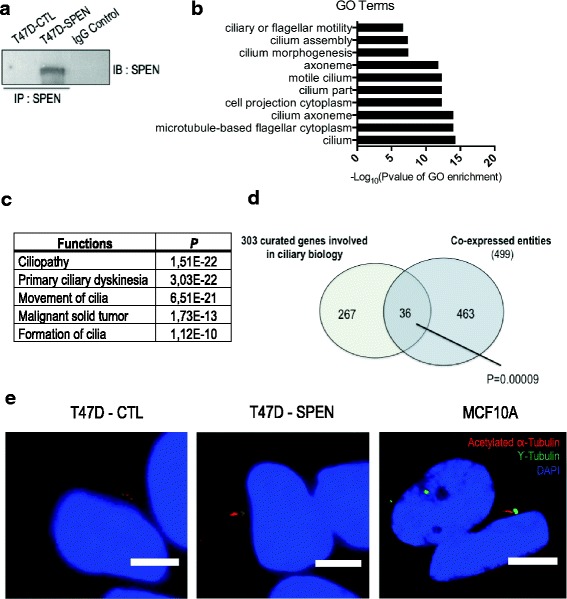
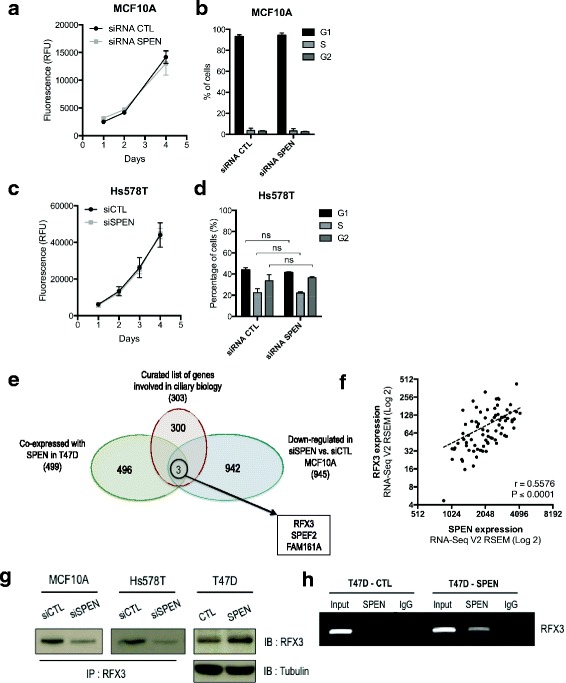
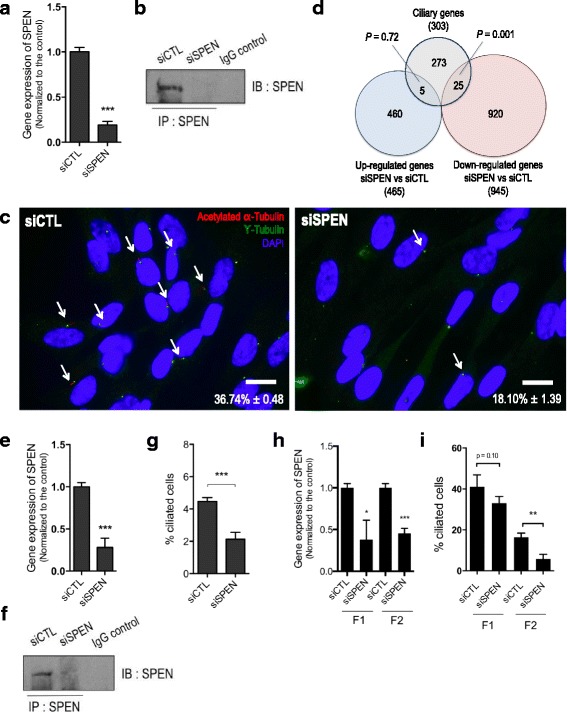
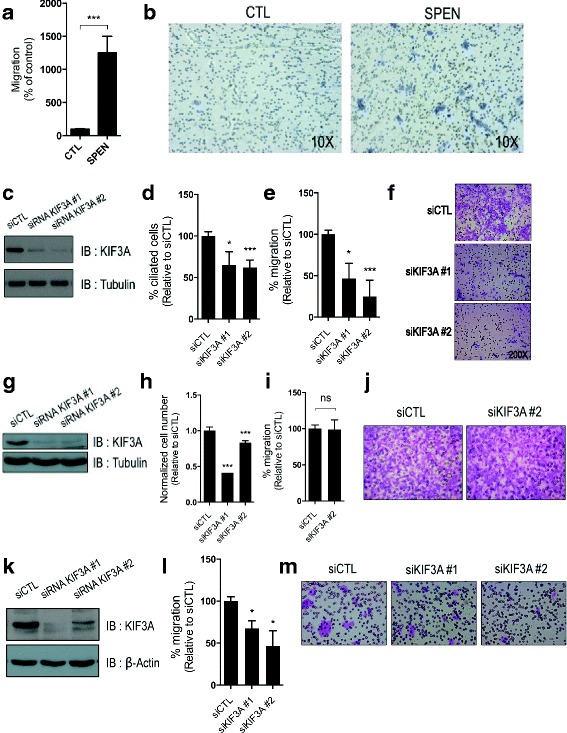
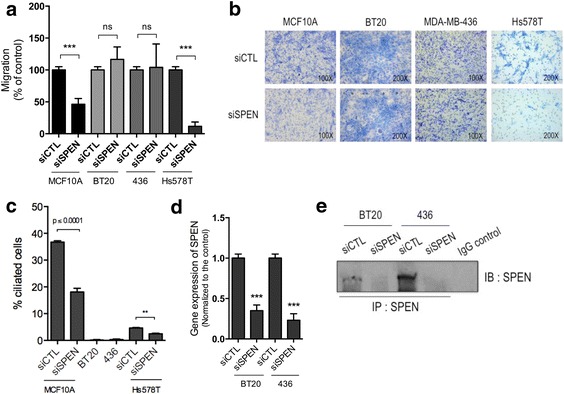
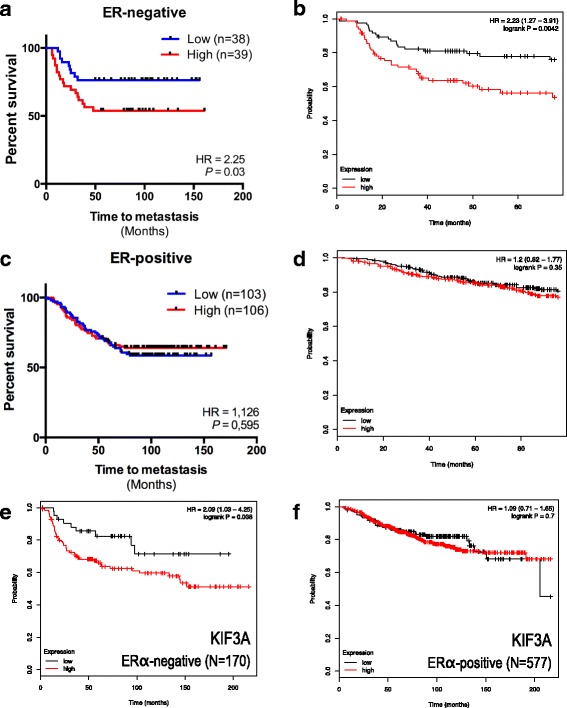
We found that SPEN is coexpressed with a number of genes involved in ciliary biology, including the ciliogenic transcription factor RFX3, in a hormone-independent manner. SPEN reexpression in T47D cells containing a nonsense mutation in SPEN restored the primary cilium, whereas its knockdown in MCF10A and Hs578T cells considerably decreased primary cilia levels. We also report that SPEN regulates migration in breast cells, but only in those harboring primary cilia, and that KIF3A silencing, a critical factor in primary cilia, partially reverses SPEN's effects, suggesting that SPEN may coordinate cellular movement through primary cilia-dependent mechanisms. Finally, we found that high SPEN RNA levels were predictive of early metastasis in two independent cohorts of 77 (HR 2.25, P = 0.03) and 170 (HR = 2.23, P = 0.004) patients with ERα-negative breast cancer.
Together, our data demonstrate a role for SPEN in the regulation of primary cilia formation and cell migration in breast cancer cells, which may collectively explain why its expression is associated with time to metastasis in cohorts of patients with ERα-negative breast cancers.
初级纤毛是一种基于微管的非运动细胞器,作为细胞天线发挥作用,参与细胞增殖、分化和迁移的调控。在乳腺癌细胞中,初级纤毛是一种结构,随着转化程度的增加而发生率降低,在雌激素受体(ERα)阴性乳腺癌细胞中可能具有更重要的生物学意义。剪接因子 ENSP00000214116(SPEN)是一种 ERα 核心抑制因子,我们已经将其鉴定为 ERα 阳性乳腺癌细胞中的肿瘤抑制蛋白,但其在乳腺癌中的激素非依赖性作用从未被探索过。
我们使用 DNA 微阵列确定了 ERα 共因子 SPEN 在乳腺癌中调节的激素非依赖性转录程序。在 ERα 阳性和 ERα 阴性乳腺癌细胞中,我们研究了 SPEN 独立于激素调节的生物学功能。最后,我们在具有结局数据的乳腺癌样本队列中检查了 SPEN 表达的临床相关性。
我们发现,SPEN 与许多参与纤毛生物学的基因共同表达,包括纤毛发生转录因子 RFX3,其表达方式不受激素影响。在含有 SPEN 无意义突变的 T47D 细胞中重新表达 SPEN 可恢复初级纤毛,而在 MCF10A 和 Hs578T 细胞中敲低 SPEN 可显著降低初级纤毛水平。我们还报告称,SPEN 调节乳腺癌细胞的迁移,但仅在具有初级纤毛的细胞中调节,并且 KIF3A 沉默(初级纤毛的关键因子)部分逆转了 SPEN 的作用,这表明 SPEN 可能通过依赖于初级纤毛的机制来协调细胞运动。最后,我们发现,在两个独立的包含 77 例(HR 2.25,P = 0.03)和 170 例(HR 2.23,P = 0.004)ERα 阴性乳腺癌患者的队列中,高 SPEN RNA 水平预示着早期转移。
总之,我们的数据表明 SPEN 在调节乳腺癌细胞中初级纤毛形成和细胞迁移方面的作用,这可能共同解释了为什么其表达与 ERα 阴性乳腺癌患者队列中转移时间相关。