Tsutsumi Ryouhei, Harizanova Jana, Stockert Rabea, Schröder Katrin, Bastiaens Philippe I H, Neel Benjamin G
Laura and Isaac Perlmutter Cancer Center, NYU Langone Health, 430 East 29th Street, New York, NY, 10016, USA.
Department of Systemic Cell Biology, Max Planck Institute of Molecular Physiology, Otto-Hahn-Street 11, 44227, Dortmund, Germany.
Nat Commun. 2017 Sep 6;8(1):466. doi: 10.1038/s41467-017-00503-w.
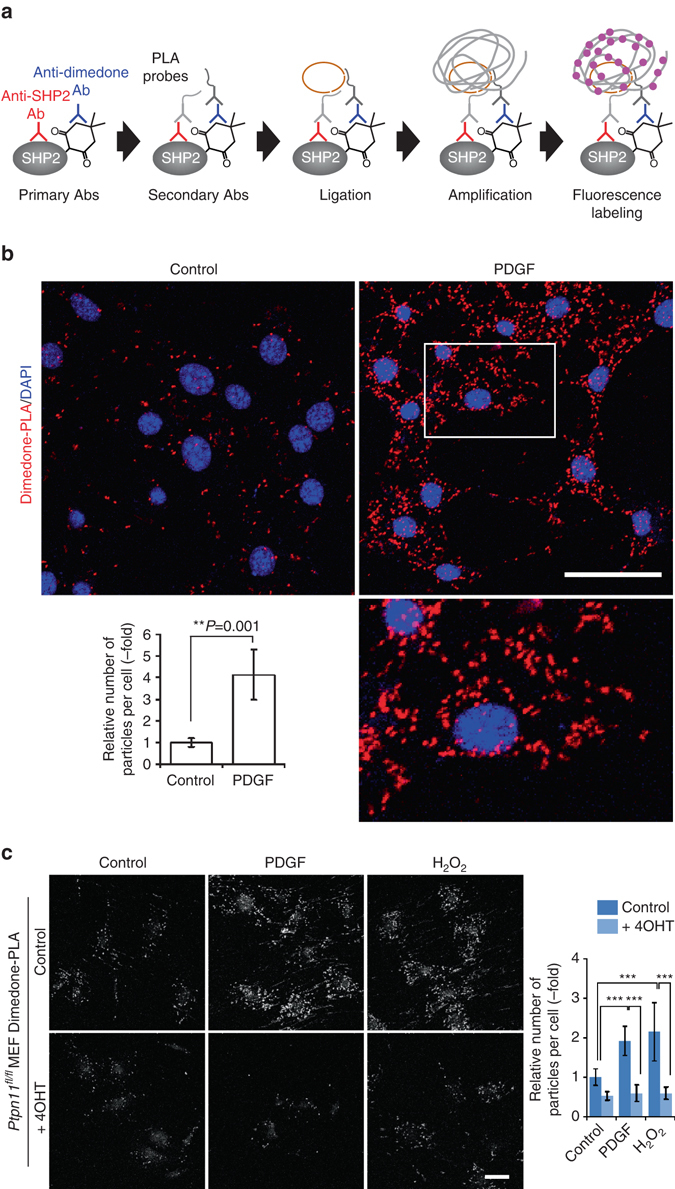
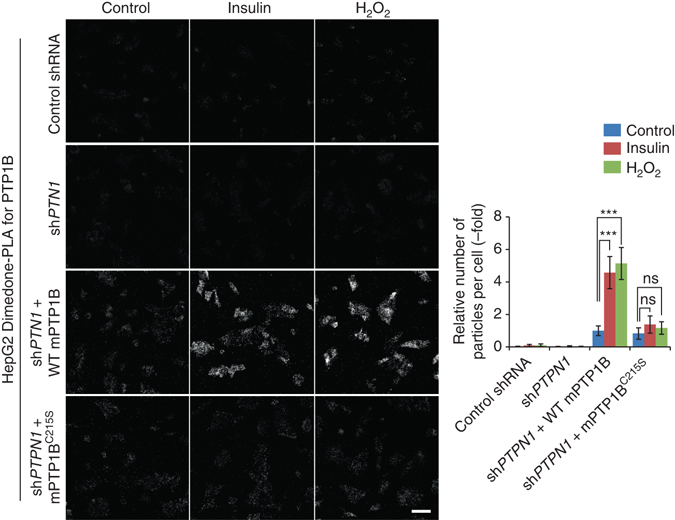
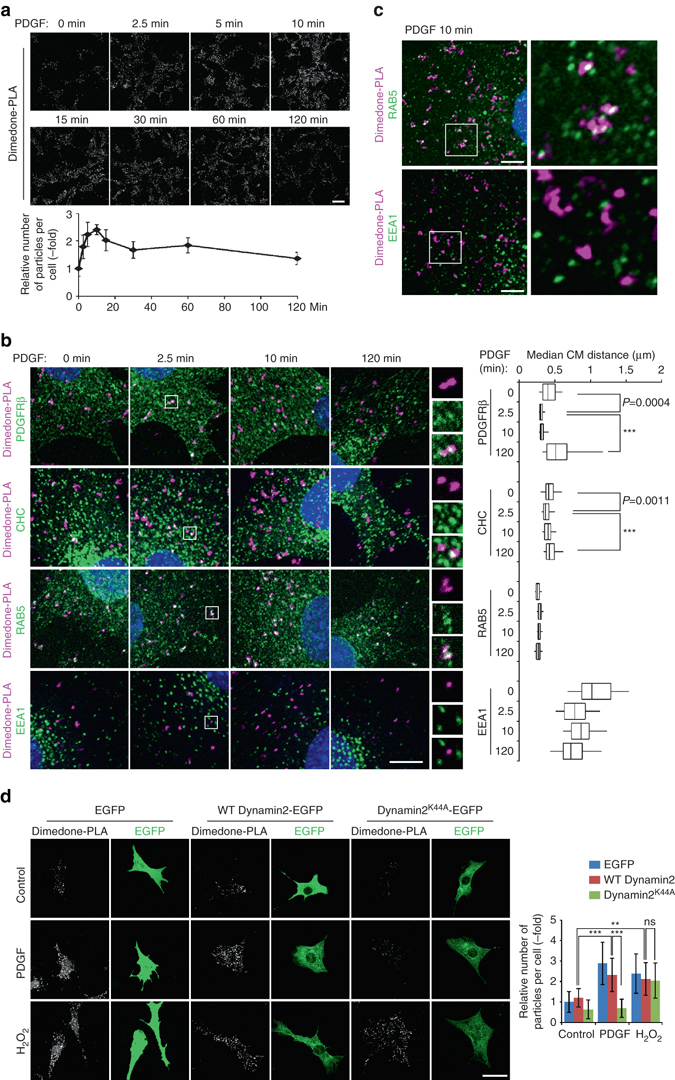
Reactive oxygen species are produced transiently in response to cell stimuli, and function as second messengers that oxidize target proteins. Protein-tyrosine phosphatases are important reactive oxygen species targets, whose oxidation results in rapid, reversible, catalytic inactivation. Despite increasing evidence for the importance of protein-tyrosine phosphatase oxidation in signal transduction, the cell biological details of reactive oxygen species-catalyzed protein-tyrosine phosphatase inactivation have remained largely unclear, due to our inability to visualize protein-tyrosine phosphatase oxidation in cells. By combining proximity ligation assay with chemical labeling of cysteine residues in the sulfenic acid state, we visualize oxidized Src homology 2 domain-containing protein-tyrosine phosphatase 2 (SHP2). We find that platelet-derived growth factor evokes transient oxidation on or close to RAB5+/ early endosome antigen 1- endosomes. SHP2 oxidation requires NADPH oxidases (NOXs), and oxidized SHP2 co-localizes with platelet-derived growth factor receptor and NOX1/4. Our data demonstrate spatially and temporally limited protein oxidation within cells, and suggest that platelet-derived growth factor-dependent "redoxosomes," contribute to proper signal transduction.Protein-tyrosine phosphatases (PTPs) are thought to be major targets of receptor-activated reactive oxygen species (ROS). Here the authors describe a method that allows the localized visualization of oxidized intermediates of PTPs inside cells during signaling, and provide support for the "redoxosome" model.
活性氧在细胞受到刺激时短暂产生,并作为氧化靶蛋白的第二信使发挥作用。蛋白酪氨酸磷酸酶是重要的活性氧靶点,其氧化会导致快速、可逆的催化失活。尽管越来越多的证据表明蛋白酪氨酸磷酸酶氧化在信号转导中很重要,但由于我们无法在细胞中可视化蛋白酪氨酸磷酸酶的氧化过程,活性氧催化的蛋白酪氨酸磷酸酶失活的细胞生物学细节在很大程度上仍不清楚。通过将邻近连接分析与处于亚磺酸状态的半胱氨酸残基的化学标记相结合,我们可视化了氧化的含Src同源2结构域蛋白酪氨酸磷酸酶2(SHP2)。我们发现血小板衍生生长因子在RAB5 + /早期内体抗原1 - 内体上或其附近引发短暂氧化。SHP2氧化需要NADPH氧化酶(NOXs),并且氧化的SHP2与血小板衍生生长因子受体和NOX1/4共定位。我们的数据证明了细胞内空间和时间上有限的蛋白质氧化,并表明血小板衍生生长因子依赖性的“氧化还原体”有助于正确的信号转导。蛋白酪氨酸磷酸酶(PTPs)被认为是受体激活的活性氧(ROS)的主要靶点。本文作者描述了一种方法,该方法可以在信号传导过程中对细胞内PTPs的氧化中间体进行局部可视化,并为“氧化还原体”模型提供支持。