Meyers Adrienne F A, Sandstrom Paul, Denny Thomas N, Hurlston Mackenzie, Ball Terry B, Peeling Rosanna W, Boeras Debrah I
QASI, National HIV & Retrovirology Laboratories, Public Health Agency of Canada, JC Wilt Infectious Diseases Research Centre, Winnipeg, Manitoba, Canada.
Department of Medical Microbiology and Infectious Diseases, University of Manitoba, Winnipeg, Manitoba, Canada.
Afr J Lab Med. 2016 Oct 17;5(2):557. doi: 10.4102/ajlm.v5i2.557. eCollection 2016.
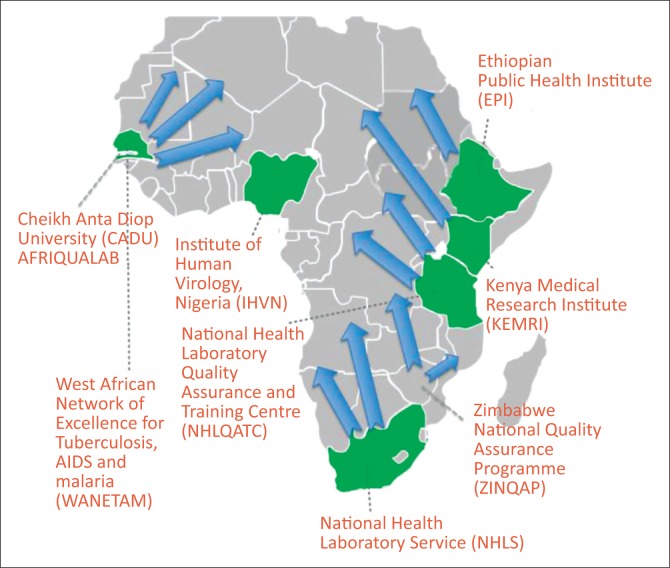
In 2015, UNAIDS launched the 90-90-90 targets aimed at increasing the number of people infected with HIV to become aware of their status, access antiretroviral therapies and ultimately be virally suppressed. To achieve these goals, countries may need to scale up point-of-care (POC) testing in addition to strengthening central laboratory services. While decentralising testing increases patient access to diagnostics, it presents many challenges with regard to training and assuring the quality of tests and testing. To ensure synergies, the London School of Hygiene & Tropical Medicine held a series of consultations with countries with an interest in quality assurance and their implementing partners, and agreed on an external quality assessment (EQA) programme to ensure reliable results so that the results lead to the best possible care for HIV patients. As a result of the consultations, EQA International was established, bringing together EQA providers and implementers to develop a strategic plan for countries to establish national POC EQA programmes and to estimate the cost of setting up and maintaining the programme. With the dramatic increase in the number of proficiency testing panels required for thousands of POC testing sites across Africa, it is important to facilitate technology transfer from global EQA providers to a network of regional EQA centres in Africa for regional proficiency testing panel production. EQA International will continue to identify robust and cost-effective EQA technologies for quality POC testing, integrating novel technologies to support sustainable country-owned EQA programmes in Africa.
2015年,联合国艾滋病规划署发起了“90-90-90”目标,旨在让更多感染艾滋病毒的人了解自身感染状况,接受抗逆转录病毒治疗,并最终实现病毒抑制。为实现这些目标,各国除加强中央实验室服务外,可能还需要扩大即时检测(POC)。虽然检测的去中心化增加了患者获得诊断的机会,但在培训以及确保检测和测试质量方面带来了诸多挑战。为确保协同效应,伦敦卫生与热带医学院与关注质量保证的国家及其实施伙伴进行了一系列磋商,并商定了一项外部质量评估(EQA)计划,以确保获得可靠结果,从而为艾滋病毒患者提供尽可能最佳的治疗。磋商的结果是成立了EQA国际组织,将EQA提供者和实施者聚集在一起,为各国制定国家即时检测EQA计划并估算设立和维持该计划的成本制定战略计划。鉴于非洲数千个即时检测点所需的能力验证样本数量急剧增加,促进从全球EQA提供者向非洲区域EQA中心网络的技术转让以进行区域能力验证样本生产非常重要。EQA国际组织将继续为高质量的即时检测确定强大且具有成本效益的EQA技术,整合新技术以支持非洲可持续的国家自主EQA计划。