Hosang Georgina M, Fisher Helen L, Uher Rudolf, Cohen-Woods Sarah, Maughan Barbara, McGuffin Peter, Farmer Anne E
Psychology Department, Goldsmiths, University of London, Lewisham Way, London, SE14 6NW, UK.
MRC Social, Genetic and Developmental Psychiatry Centre, Institute of Psychiatry, Psychology & Neuroscience, King's College London, De Crespigny Park, London, SE5 8AF, UK.
Int J Bipolar Disord. 2017 Sep 7;5(1):30. doi: 10.1186/s40345-017-0099-z.
Childhood maltreatment (abuse and neglect) can have long-term deleterious consequences, including increased risk for medical and psychiatric illnesses, such as bipolar disorder in adulthood. Emerging evidence suggests that a history of childhood maltreatment is linked to the comorbidity between medical illnesses and mood disorders. However, existing studies on bipolar disorder have not yet explored the specific influence of child neglect and have not included comparisons with individuals without mood disorders (controls). This study aimed to extend the existing literature by examining the differential influence of child abuse and child neglect on medical morbidity in a sample of bipolar cases and controls.
The study included 72 participants with bipolar disorder and 354 psychiatrically healthy controls (average age of both groups was 48 years), who completed the Childhood Trauma Questionnaire, and were interviewed regarding various medical disorders.
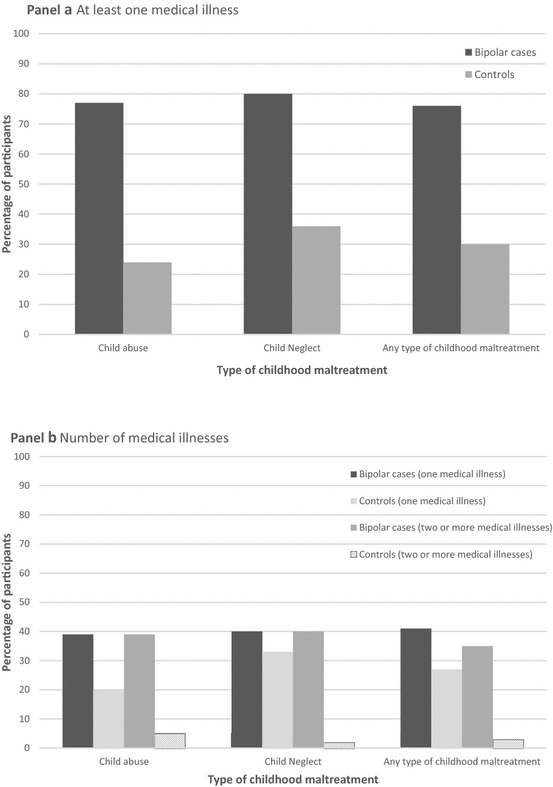
A history of any type of childhood maltreatment was significantly associated with a diagnosis of any medical illness (adjusted OR = 6.28, 95% confidence intervals 1.70-23.12, p = 0.006) and an increased number of medical illnesses (adjusted OR = 3.77, 95% confidence intervals 1.34-10.57, p = 0.012) among adults with bipolar disorder. Exposure to child abuse was more strongly associated with medical disorders than child neglect. No association between childhood maltreatment and medical morbidity was detected among controls.
To summarise, individuals with bipolar disorder who reported experiencing maltreatment during childhood, especially abuse, were at increased risk of suffering from medical illnesses and warrant greater clinical attention.
童年期受虐(虐待与忽视)会产生长期有害后果,包括成年后患内科疾病和精神疾病(如双相情感障碍)的风险增加。新出现的证据表明,童年期受虐史与内科疾病和情绪障碍的共病有关。然而,现有的关于双相情感障碍的研究尚未探讨儿童忽视的具体影响,也未纳入与无情绪障碍个体(对照组)的比较。本研究旨在通过考察儿童期虐待和儿童忽视对双相情感障碍病例组和对照组样本中内科疾病发病率的差异影响,来拓展现有文献。
该研究纳入了72名双相情感障碍患者和354名精神健康的对照者(两组平均年龄均为48岁),他们完成了儿童期创伤问卷,并接受了关于各种内科疾病的访谈。
在双相情感障碍成年患者中,任何类型的童年期受虐史都与任何内科疾病的诊断显著相关(调整后的比值比=6.28,95%置信区间为1.70 - 23.12,p = 0.006),且内科疾病数量增加(调整后的比值比=3.77,95%置信区间为1.34 - 10.57,p = 0.012)。与儿童忽视相比,儿童期虐待与内科疾病的关联更强。在对照组中未发现童年期受虐与内科疾病发病率之间存在关联。
总之,报告童年期曾遭受虐待(尤其是受虐)的双相情感障碍患者患内科疾病的风险增加,值得临床给予更多关注。