Quinn Kylie M, Kan Wan-Ting, Watson Katherine A, Liddicoat Brian J, Swan Natasha G, McQuilten Hayley, Denton Alice E, Li Jasmine, Chen Weisan, Brown Lorena E, Jackson David C, Reading Patrick C, Doherty Peter C, Kedzierska Katherine, Kedzierski Lukasz, Turner Stephen J, La Gruta Nicole L
Infection and Immunity Program and Department of Biochemistry and Molecular Biology, Biomedicine Discovery Institute, Monash University, Clayton, Victoria, Australia.
Department of Microbiology and Immunology, Peter Doherty Institute for Infection and Immunity, University of Melbourne, Parkville, Victoria, Australia.
PLoS One. 2017 Sep 8;12(9):e0184732. doi: 10.1371/journal.pone.0184732. eCollection 2017.
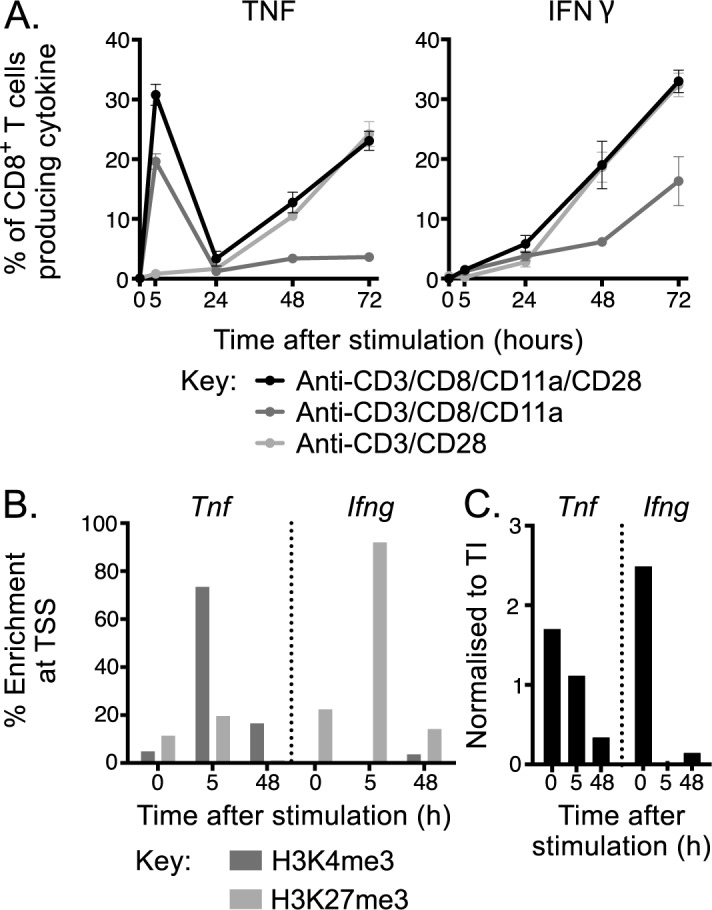
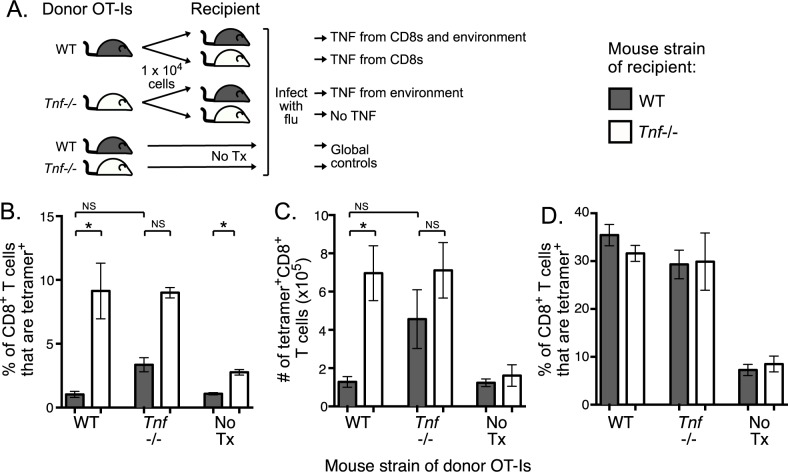
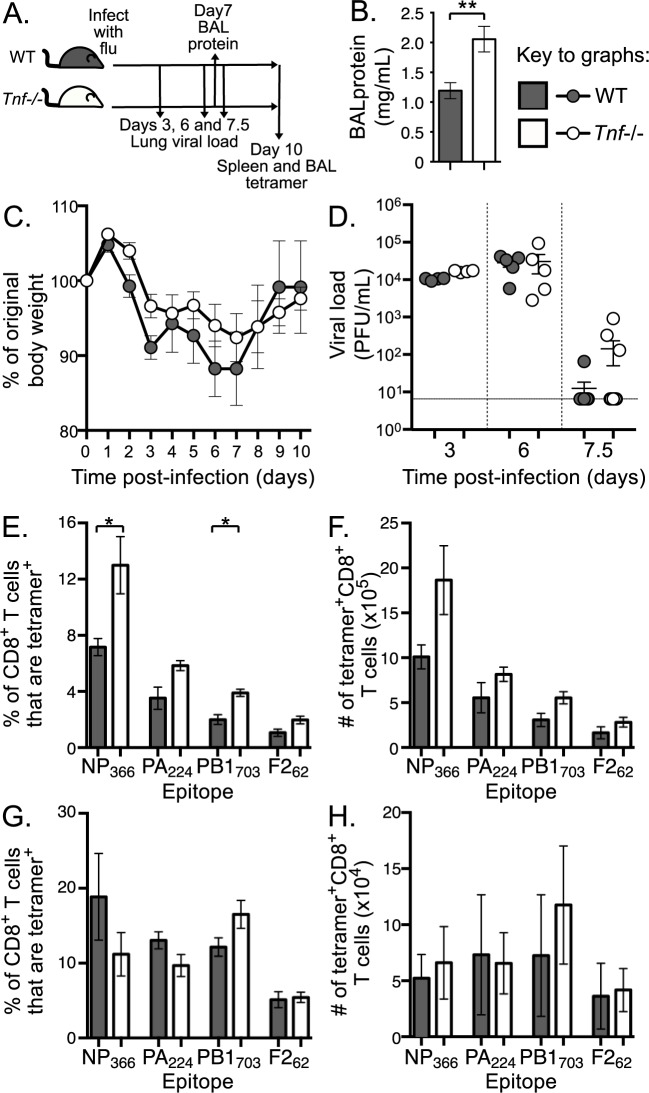
TNF is a pro-inflammatory cytokine produced by both lymphoid and non-lymphoid cells. As a consequence of the widespread expression of its receptors (TNFR1 and 2), TNF plays a role in many important biological processes. In the context of influenza A virus (IAV) infection, TNF has variably been implicated in mediating immunopathology as well as suppression of the immune response. Although a number of cell types are able to produce TNF, the ability of CD8+ T cells to produce TNF following viral infection is a hallmark of their effector function. As such, the regulation and role of CD8+ T cell-derived TNF following viral infection is of great interest. Here, we show that the biphasic production of TNF by CD8+ T cells following in vitro stimulation corresponds to distinct patterns of epigenetic modifications. Further, we show that a global loss of TNF during IAV infection results in an augmentation of the peripheral virus-specific CD8+ T cell response. Subsequent adoptive transfer experiments demonstrated that this attenuation of the CD8+ T cell response was largely, but not exclusively, conferred by extrinsic TNF, with intrinsically-derived TNF making only modest contributions. In conclusion, TNF exerts an immunoregulatory role on CD8+ T cell responses following IAV infection, an effect that is largely mediated by extrinsically-derived TNF.
肿瘤坏死因子(TNF)是一种由淋巴细胞和非淋巴细胞产生的促炎细胞因子。由于其受体(TNFR1和TNFR2)广泛表达,TNF在许多重要的生物学过程中发挥作用。在甲型流感病毒(IAV)感染的情况下,TNF在介导免疫病理以及抑制免疫反应方面有着不同的作用。虽然许多细胞类型都能够产生TNF,但病毒感染后CD8 + T细胞产生TNF的能力是其效应功能的一个标志。因此,病毒感染后CD8 + T细胞来源的TNF的调节和作用备受关注。在这里,我们表明,体外刺激后CD8 + T细胞产生TNF的双相过程对应于不同的表观遗传修饰模式。此外,我们表明,IAV感染期间TNF的整体缺失导致外周病毒特异性CD8 + T细胞反应增强。随后的过继转移实验表明,CD8 + T细胞反应的这种减弱在很大程度上但并非完全由外源性TNF引起,内源性TNF的贡献较小。总之,TNF对IAV感染后的CD8 + T细胞反应发挥免疫调节作用,这种作用很大程度上由外源性TNF介导。