• 文献检索
  • 文档翻译
  • 深度研究
  • 学术资讯
  • Suppr Zotero 插件Zotero 插件
  • 邀请有礼
  • 套餐&价格
  • 历史记录
应用&插件
Suppr Zotero 插件Zotero 插件浏览器插件Mac 客户端Windows 客户端微信小程序
定价
高级版会员购买积分包购买API积分包
服务
文献检索文档翻译深度研究API 文档MCP 服务
关于我们
关于 Suppr公司介绍联系我们用户协议隐私条款
关注我们

Suppr 超能文献

核心技术专利:CN118964589B侵权必究
粤ICP备2023148730 号-1Suppr @ 2026

文献检索

告别复杂PubMed语法,用中文像聊天一样搜索,搜遍4000万医学文献。AI智能推荐,让科研检索更轻松。

立即免费搜索

文件翻译

保留排版,准确专业,支持PDF/Word/PPT等文件格式,支持 12+语言互译。

免费翻译文档

深度研究

AI帮你快速写综述,25分钟生成高质量综述,智能提取关键信息,辅助科研写作。

立即免费体验

从经验观察中洞察鲨鱼的磁场感知。

Insight into shark magnetic field perception from empirical observations.

机构信息

Hawai'i Institute of Marine Biology, University of Hawai'i at Mānoa, Kāne'ohe, HI, 96744, USA.

Department of Biology, University of Hawai'i at Mānoa, Honolulu, HI, 96822, USA.

出版信息

Sci Rep. 2017 Sep 8;7(1):11042. doi: 10.1038/s41598-017-11459-8.

DOI:10.1038/s41598-017-11459-8
PMID:28887553
原文链接:https://pmc.ncbi.nlm.nih.gov/articles/PMC5591188/
Abstract

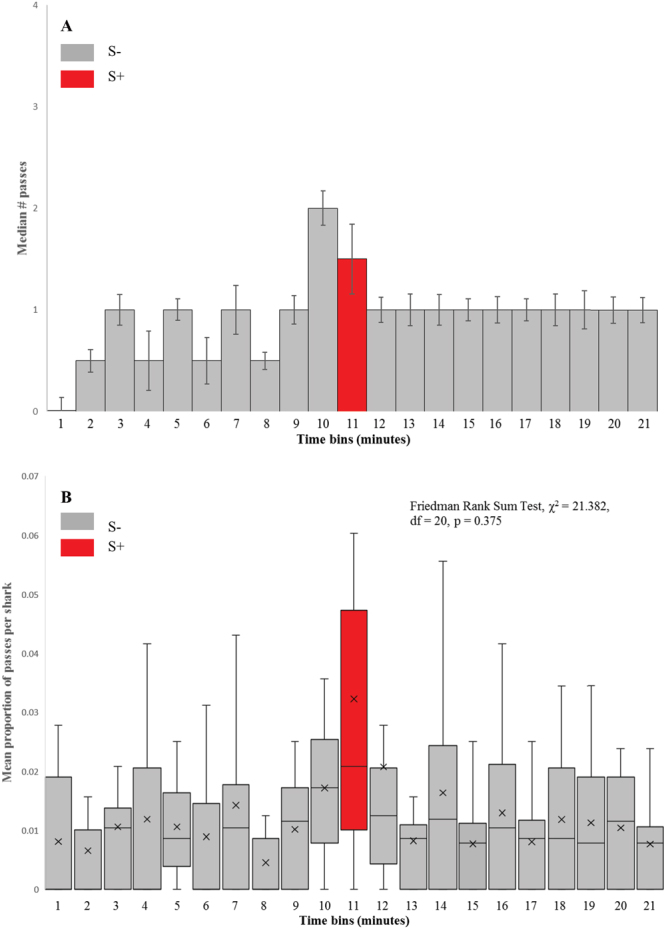
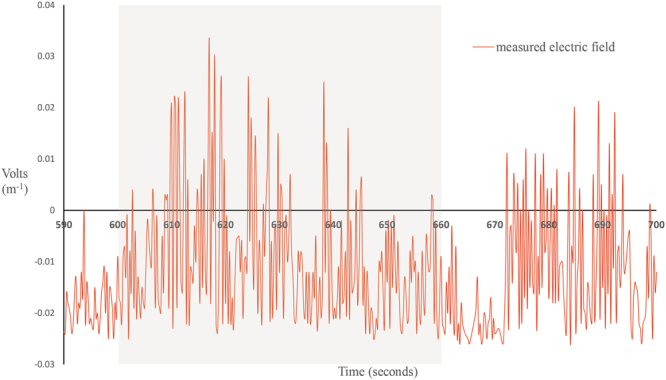
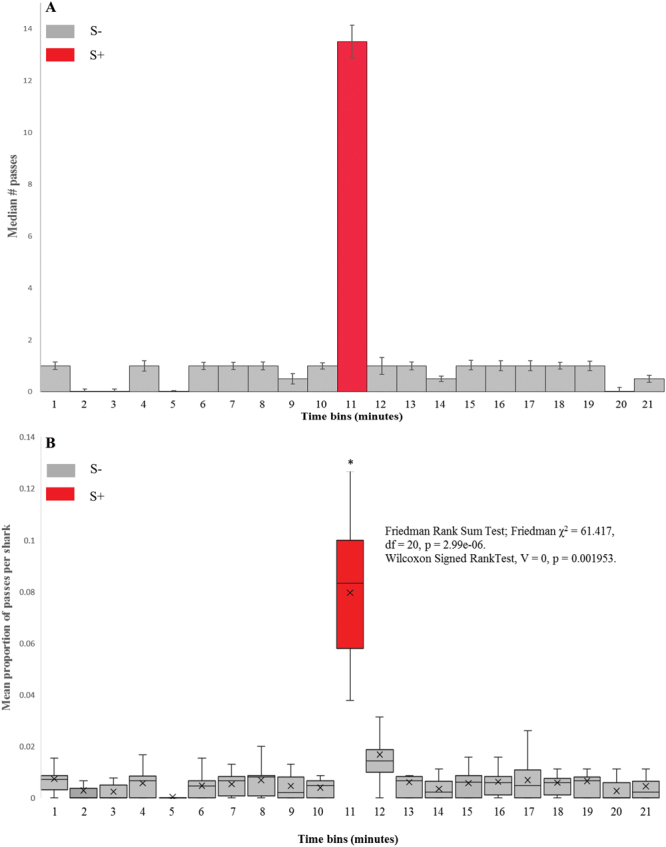
Elasmobranch fishes are among a broad range of taxa believed to gain positional information and navigate using the earth's magnetic field, yet in sharks, much remains uncertain regarding the sensory receptors and pathways involved, or the exact nature of perceived stimuli. Captive sandbar sharks, Carcharhinus plumbeus were conditioned to respond to presentation of a magnetic stimulus by seeking out a target in anticipation of reward (food). Sharks in the study demonstrated strong responses to magnetic stimuli, making significantly more approaches to the target (p = < 0.01) during stimulus activation (S+) than before or after activation (S-). Sharks exposed to reversible magnetosensory impairment were less capable of discriminating changes to the local magnetic field, with no difference seen in approaches to the target under the S+ and S- conditions (p = 0.375). We provide quantified detection and discrimination thresholds of magnetic stimuli presented, and quantify associated transient electrical artefacts. We show that the likelihood of such artefacts serving as the stimulus for observed behavioural responses was low. These impairment experiments support hypotheses that magnetic field perception in sharks is not solely performed via the electrosensory system, and that putative magnetoreceptor structures may be located in the naso-olfactory capsules of sharks.

摘要

板鳃鱼类被认为是能够利用地球磁场来获取位置信息和进行导航的广泛生物类群之一,但在鲨鱼中,对于涉及的感觉受体和途径,或者所感知刺激的确切性质,仍然存在很多不确定性。我们对圈养的沙虎鲨(Carcharhinus plumbeus)进行了条件反射训练,使它们在感知到磁场刺激时,通过寻找目标来获得奖励(食物)。研究中的鲨鱼对磁场刺激表现出强烈的反应,在刺激激活期间(S+),它们比在激活之前或之后(S-)更频繁地接近目标(p = < 0.01)。暴露在可逆转的磁感觉损伤中的鲨鱼,对于局部磁场变化的辨别能力降低,在 S+和 S-条件下,它们接近目标的次数没有差异(p = 0.375)。我们提供了所呈现的磁场刺激的量化检测和辨别阈值,并量化了相关的瞬态电干扰。我们表明,这些电干扰不太可能成为观察到的行为反应的刺激。这些损伤实验支持了以下假说:鲨鱼对磁场的感知不仅仅是通过电感觉系统进行的,而且假定的磁受体结构可能位于鲨鱼的鼻-嗅觉囊中。
https://cdn.ncbi.nlm.nih.gov/pmc/blobs/a112/5591188/bff7ce42ea8f/41598_2017_11459_Fig6_HTML.jpg
https://cdn.ncbi.nlm.nih.gov/pmc/blobs/a112/5591188/82996681d50e/41598_2017_11459_Fig1_HTML.jpg
https://cdn.ncbi.nlm.nih.gov/pmc/blobs/a112/5591188/c1c064bea2b8/41598_2017_11459_Fig2_HTML.jpg
https://cdn.ncbi.nlm.nih.gov/pmc/blobs/a112/5591188/1df0f1ebc3fe/41598_2017_11459_Fig3_HTML.jpg
https://cdn.ncbi.nlm.nih.gov/pmc/blobs/a112/5591188/1dfd9c379d85/41598_2017_11459_Fig4_HTML.jpg
https://cdn.ncbi.nlm.nih.gov/pmc/blobs/a112/5591188/d84375286e77/41598_2017_11459_Fig5_HTML.jpg
https://cdn.ncbi.nlm.nih.gov/pmc/blobs/a112/5591188/bff7ce42ea8f/41598_2017_11459_Fig6_HTML.jpg
https://cdn.ncbi.nlm.nih.gov/pmc/blobs/a112/5591188/82996681d50e/41598_2017_11459_Fig1_HTML.jpg
https://cdn.ncbi.nlm.nih.gov/pmc/blobs/a112/5591188/c1c064bea2b8/41598_2017_11459_Fig2_HTML.jpg
https://cdn.ncbi.nlm.nih.gov/pmc/blobs/a112/5591188/1df0f1ebc3fe/41598_2017_11459_Fig3_HTML.jpg
https://cdn.ncbi.nlm.nih.gov/pmc/blobs/a112/5591188/1dfd9c379d85/41598_2017_11459_Fig4_HTML.jpg
https://cdn.ncbi.nlm.nih.gov/pmc/blobs/a112/5591188/d84375286e77/41598_2017_11459_Fig5_HTML.jpg
https://cdn.ncbi.nlm.nih.gov/pmc/blobs/a112/5591188/bff7ce42ea8f/41598_2017_11459_Fig6_HTML.jpg

相似文献

1
Insight into shark magnetic field perception from empirical observations.从经验观察中洞察鲨鱼的磁场感知。
Sci Rep. 2017 Sep 8;7(1):11042. doi: 10.1038/s41598-017-11459-8.
2
Aversive responses of captive sandbar sharks Carcharhinus plumbeus to strong magnetic fields.圈养的沙虎鲨(Carcharhinus plumbeus)对强磁场的厌恶反应。
J Fish Biol. 2016 Sep;89(3):1603-11. doi: 10.1111/jfb.13064. Epub 2016 Jun 20.
3
Sharks can detect changes in the geomagnetic field.鲨鱼能够探测地磁场的变化。
J R Soc Interface. 2005 Mar 22;2(2):129-30. doi: 10.1098/rsif.2004.0021.
4
Electroreception in juvenile scalloped hammerhead and sandbar sharks.幼年扇形锤头鲨和沙洲鲨的电感受
J Exp Biol. 2002 Dec;205(Pt 23):3609-21. doi: 10.1242/jeb.205.23.3609.
5
Map-like use of Earth's magnetic field in sharks.鲨鱼对地球磁场的地图式利用。
Curr Biol. 2021 Jul 12;31(13):2881-2886.e3. doi: 10.1016/j.cub.2021.03.103. Epub 2021 May 6.
6
Histological and morphological aspects of reproduction in the sandbar shark Carcharhinus plumbeus in the U.S. south-eastern Atlantic Ocean and Gulf of Mexico.美国东南大西洋和墨西哥湾铅灰真鲨繁殖的组织学和形态学特征
J Fish Biol. 2016 May;88(5):1708-30. doi: 10.1111/jfb.12945. Epub 2016 Mar 29.
7
Electric and magnetic field detection in elasmobranch fishes.软骨鱼类的电场和磁场探测
Science. 1982 Nov 26;218(4575):916-8. doi: 10.1126/science.7134985.
8
Confirmation of the occurrence of the sandbar shark Carcharhinus plumbeus (Nardo, 1827) at Norfolk Island, Tasman Sea.塔斯曼海诺福克岛出现铅灰真鲨(Carcharhinus plumbeus,纳尔多,1827年)的确认。
Zootaxa. 2016 Sep 26;4171(1):187-190. doi: 10.11646/zootaxa.4171.1.11.
9
First report on the serum chemistry and haematology of free-ranging dusky () and sandbar () sharks in the eastern Mediterranean Sea.关于地中海东部野生暗体真鲨()和沙虎鲨()血清化学和血液学的首次报告。
Conserv Physiol. 2023 May 30;11(1):coad037. doi: 10.1093/conphys/coad037. eCollection 2023.
10
Determinants of coronary blood flow in sandbar sharks, Carcharhinus plumbeus.沙虎鲨(Carcharhinus plumbeus)冠状动脉血流的决定因素。
J Comp Physiol B. 2017 Feb;187(2):315-327. doi: 10.1007/s00360-016-1033-x. Epub 2016 Sep 27.

引用本文的文献

1
The lateral line and electrosensory systems of two holocephalans.两种全头亚纲鱼类的侧线和电感应系统。
Sci Rep. 2025 Feb 28;15(1):7163. doi: 10.1038/s41598-025-87499-2.
2
Passive electroreception in bottlenose dolphins (Tursiops truncatus): implication for micro- and large-scale orientation.宽吻海豚(Tursiops truncatus)的被动电感受:对微观和宏观方向的启示。
J Exp Biol. 2023 Nov 15;226(22). doi: 10.1242/jeb.245845. Epub 2023 Nov 30.
3
Collective evolution learning model for vision-based collective motion with collision avoidance.

本文引用的文献

1
Magnetic field discrimination, learning, and memory in the yellow stingray (Urobatis jamaicensis).黄斑魟(Urobatis jamaicensis)的磁场辨别、学习与记忆
Anim Cogn. 2017 Jul;20(4):603-614. doi: 10.1007/s10071-017-1084-8. Epub 2017 Mar 25.
2
Aversive responses of captive sandbar sharks Carcharhinus plumbeus to strong magnetic fields.圈养的沙虎鲨(Carcharhinus plumbeus)对强磁场的厌恶反应。
J Fish Biol. 2016 Sep;89(3):1603-11. doi: 10.1111/jfb.13064. Epub 2016 Jun 20.
3
Telemetry and random-walk models reveal complex patterns of partial migration in a large marine predator.
基于视觉的避碰集体运动的集体进化学习模型。
PLoS One. 2023 May 10;18(5):e0270318. doi: 10.1371/journal.pone.0270318. eCollection 2023.
4
Head anatomy of a lantern shark wet-collection specimen (Chondrichthyes: Etmopteridae).灯笼鲨鱼湿制标本的头部解剖结构(软骨鱼纲:灯笼鱼科)。
J Anat. 2023 May;242(5):872-890. doi: 10.1111/joa.13822. Epub 2023 Jan 25.
5
Smart sharks: a review of chondrichthyan cognition.聪明的鲨鱼:软骨鱼认知综述。
Anim Cogn. 2023 Jan;26(1):175-188. doi: 10.1007/s10071-022-01708-3. Epub 2022 Nov 17.
6
Anthropogenic electromagnetic fields (EMF) influence the behaviour of bottom-dwelling marine species.人为电磁场(EMF)会影响底栖海洋物种的行为。
Sci Rep. 2020 Mar 6;10(1):4219. doi: 10.1038/s41598-020-60793-x.
7
Bridging disciplines to advance elasmobranch conservation: applications of physiological ecology.跨学科推进板鳃亚纲动物保护:生理生态学的应用
Conserv Physiol. 2019 May 15;7(1):coz011. doi: 10.1093/conphys/coz011. eCollection 2019.
遥测和随机游走模型揭示了大型海洋捕食者部分洄游的复杂模式。
Ecology. 2013 Nov;94(11):2595-606. doi: 10.1890/12-2014.1.
4
Magnetotactic bacteria form magnetite from a phosphate-rich ferric hydroxide via nanometric ferric (oxyhydr)oxide intermediates.趋磁细菌通过纳米级的铁(氧)氢氧化物中间产物,从富含磷酸盐的氢氧化铁中形成磁铁矿。
Proc Natl Acad Sci U S A. 2013 Sep 10;110(37):14883-8. doi: 10.1073/pnas.1307119110. Epub 2013 Aug 26.
5
Learning and memory in the Port Jackson shark, Heterodontus portusjacksoni.杰克逊港鲨鱼(Heterodontus portusjacksoni)的学习与记忆
Anim Cogn. 2014 Mar;17(2):415-25. doi: 10.1007/s10071-013-0673-4. Epub 2013 Aug 18.
6
Bioelectric fields of marine organisms: voltage and frequency contributions to detectability by electroreceptive predators.海洋生物的生物电场:电压和频率对电感受性捕食者可探测性的影响
Physiol Biochem Zool. 2013 May-Jun;86(3):298-311. doi: 10.1086/669973. Epub 2013 Apr 2.
7
Magnetic compass orientation in the European eel.欧洲鳗的磁罗盘定向。
PLoS One. 2013;8(3):e59212. doi: 10.1371/journal.pone.0059212. Epub 2013 Mar 15.
8
Social learning in juvenile lemon sharks, Negaprion brevirostris.幼年柠檬鲨(Negaprion brevirostris)的社会学习。
Anim Cogn. 2013 Jan;16(1):55-64. doi: 10.1007/s10071-012-0550-6. Epub 2012 Aug 30.
9
Scales of orientation, directed walks and movement path structure in sharks.鲨鱼的定向游动、定向游动轨迹和运动轨迹结构。
J Anim Ecol. 2011 Jul;80(4):864-74. doi: 10.1111/j.1365-2656.2011.01815.x. Epub 2011 Mar 1.
10
Structure and function of the vertebrate magnetic sense.脊椎动物磁感觉的结构和功能。
Nature. 1997 Nov 27;390(6658):371-6. doi: 10.1038/37057.