Zakiniaeiz Yasmin, Yip Sarah W, Balodis Iris M, Lacadie Cheryl M, Scheinost Dustin, Constable R Todd, Mayes Linda C, Sinha Rajita, Potenza Marc N
Interdepartmental Neuroscience Program, Yale University School of Medicine, New Haven, CT, USA.
Department of Psychiatry, Yale University School of Medicine, New Haven, CT, USA; The National Center of Addiction and Substance Abuse, Yale University School of Medicine, New Haven, CT, USA.
Drug Alcohol Depend. 2017 Nov 1;180:129-136. doi: 10.1016/j.drugalcdep.2017.07.030. Epub 2017 Aug 19.
Prenatal cocaine exposure (PCE) is linked to addiction and obesity vulnerability. Neural responses to stressful and appetitive cues in adolescents with PCE versus those without have been differentially linked to substance-use initiation. However, no prior studies have assessed cue-reactivity responses among PCE adolescents using a connectivity-based approach.
Twenty-two PCE and 22 non-prenatally drug-exposed (NDE) age-, sex-, IQ- and BMI-matched adolescents participated in individualized guided imagery with appetitive (favorite-food), stressful and neutral-relaxing cue scripts during functional magnetic resonance imaging. Subjective favorite-food craving scores were collected before and after script exposure. A data-driven voxel-wise intrinsic connectivity distribution analysis was used to identify between-group differences and examine relationships with craving scores.
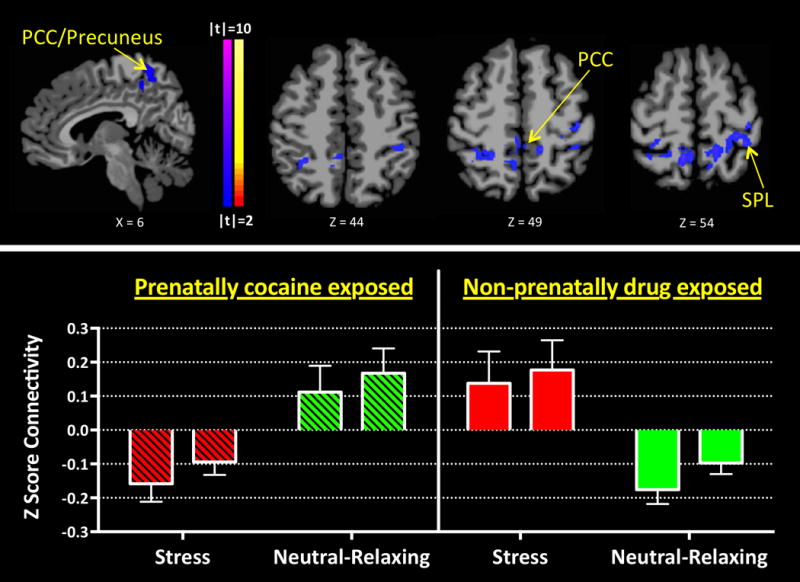
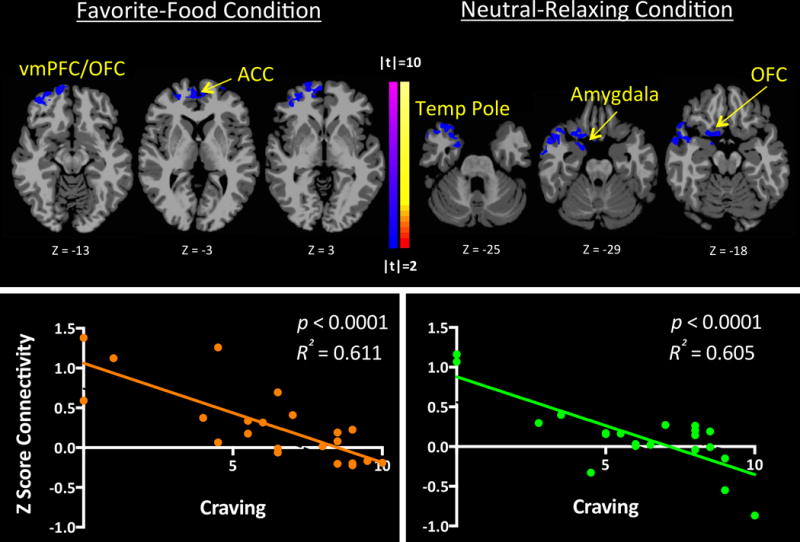
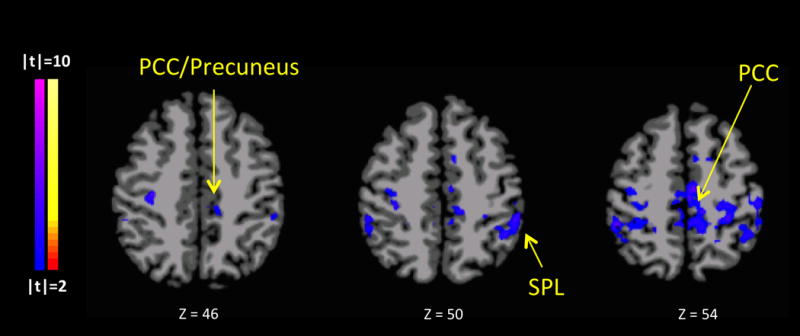
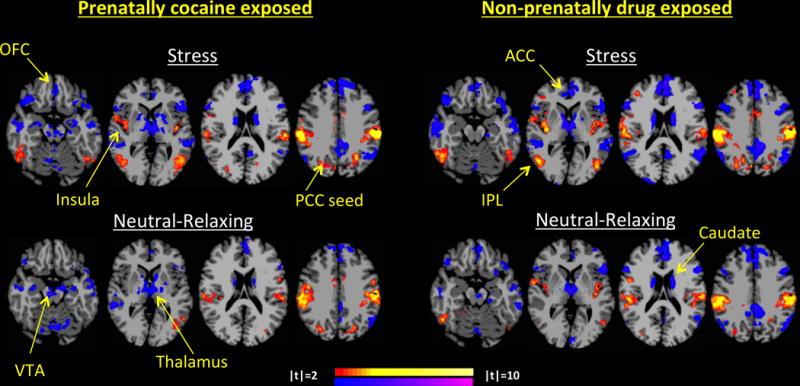
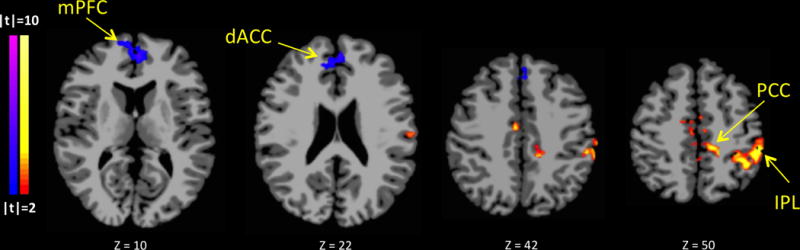
A group-by-cue interaction effect identified a parietal lobe cluster where PCE versus NDE adolescents showed less connectivity during stressful and more connectivity during neutral-relaxing conditions. Follow-up seed-based connectivity analyses revealed that, among PCE adolescents, the parietal seed was positively connected to inferior parietal and sensory areas and negatively connected to corticolimbic during both stress and neutral-relaxing conditions. For NDE, greater parietal connectivity to parietal, cingulate and sensory areas and lesser parietal connectivity to medial prefrontal areas were found during stress compared to neutral-relaxing cueing. Craving scores inversely correlated with corticolimbic connectivity in PCE, but not NDE adolescents, during the favorite-food condition.
Findings from this first data-driven intrinsic connectivity analysis of PCE influences on adolescent brain function indicate differences relating to PCE status and craving. These findings provide insight into the developmental impact of in utero drug exposure.
产前可卡因暴露(PCE)与成瘾和肥胖易感性有关。与未暴露于可卡因的青少年相比,暴露于可卡因的青少年对压力和食欲线索的神经反应与物质使用的开始存在不同的关联。然而,以前没有研究使用基于连通性的方法评估PCE青少年的线索反应性。
22名产前暴露于可卡因的青少年和22名未产前暴露于药物(NDE)的青少年,年龄、性别、智商和体重指数相匹配,在功能磁共振成像期间参与了带有食欲(最喜欢的食物)、压力和中性放松线索脚本的个性化引导式意象。在脚本暴露前后收集主观的最喜欢食物渴望分数。使用数据驱动的体素内禀连通性分布分析来识别组间差异,并检查与渴望分数的关系。
一个组×线索交互效应确定了一个顶叶簇,在压力条件下,PCE青少年与NDE青少年相比连通性较低,而在中性放松条件下连通性较高。后续基于种子的连通性分析显示,在压力和中性放松条件下,PCE青少年中,顶叶种子与顶叶下部和感觉区域呈正连接,与皮质边缘区域呈负连接。对于NDE青少年,与中性放松线索相比,在压力条件下发现顶叶与顶叶、扣带回和感觉区域的连通性更高,而与内侧前额叶区域的连通性更低。在最喜欢的食物条件下,渴望分数与PCE青少年的皮质边缘连通性呈负相关,但与NDE青少年无关。
这项首次对PCE对青少年脑功能影响进行数据驱动的内禀连通性分析的结果表明,与PCE状态和渴望有关的差异。这些发现为子宫内药物暴露的发育影响提供了见解。