• 文献检索
  • 文档翻译
  • 深度研究
  • 学术资讯
  • Suppr Zotero 插件Zotero 插件
  • 邀请有礼
  • 套餐&价格
  • 历史记录
应用&插件
Suppr Zotero 插件Zotero 插件浏览器插件Mac 客户端Windows 客户端微信小程序
定价
高级版会员购买积分包购买API积分包
服务
文献检索文档翻译深度研究API 文档MCP 服务
关于我们
关于 Suppr公司介绍联系我们用户协议隐私条款
关注我们

Suppr 超能文献

核心技术专利:CN118964589B侵权必究
粤ICP备2023148730 号-1Suppr @ 2026

文献检索

告别复杂PubMed语法,用中文像聊天一样搜索,搜遍4000万医学文献。AI智能推荐,让科研检索更轻松。

立即免费搜索

文件翻译

保留排版,准确专业,支持PDF/Word/PPT等文件格式,支持 12+语言互译。

免费翻译文档

深度研究

AI帮你快速写综述,25分钟生成高质量综述,智能提取关键信息,辅助科研写作。

立即免费体验

在一项针对尼日利亚城市居民的定性研究中,除绝育和堕胎外,生育间隔过短被认为比所有计划生育方法都更具风险。

Inadequate birth spacing is perceived as riskier than all family planning methods, except sterilization and abortion, in a qualitative study among urban Nigerians.

作者信息

Schwandt Hilary M, Skinner Joanna, Hebert Luciana Estelle, Cobb Lisa, Saad Abdulmumin, Odeku Mojisola

机构信息

Center for Communication Programs, Johns Hopkins Bloomberg School of Public Health, Baltimore, Maryland, USA.

Fairhaven College, Western Washington University, 516 High Street, MS 9118, Bellingham, WA, 98225, USA.

出版信息

BMC Womens Health. 2017 Sep 11;17(1):80. doi: 10.1186/s12905-017-0439-2.

DOI:10.1186/s12905-017-0439-2
PMID:28893235
原文链接:https://pmc.ncbi.nlm.nih.gov/articles/PMC5594467/
Abstract

BACKGROUND

Fertility is high in Nigeria and contraceptive use is low. Little is known about how urban Nigerians perceive the risk of contraceptive use in relation to pregnancy and birth. This study examines and compares the risk perception of family planning methods and pregnancy related scenarios among urban Nigerians.

METHODS

A total of 26 focus group discussions with 243 participants were conducted in September and October 2010 in Ibadan and Kaduna. The groups were stratified by sex, age, family planning use, and city. Study participants were asked to identify the risk associated with six different family planning methods and four pregnancy related risks. The data were coded in ATLAS.ti 6 and analyzed using the thematic content analysis approach.

RESULTS

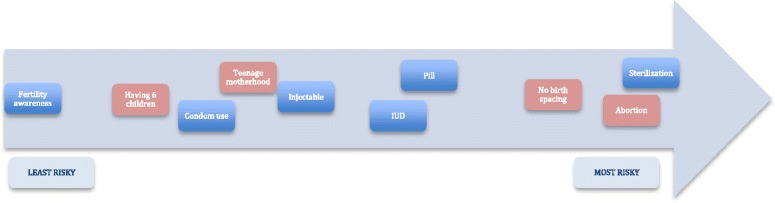
The ten family planning and pregnancy related items ranked as follows from most to least risky: sterilization, abortion, getting pregnant soon after having a baby (no birth spacing), pill, IUD, injectable, having a birth under 18 years of age (teenage motherhood), condom use, having six children, and fertility awareness methods. Risk of family planning methods was often categorized in terms of side effects and complications. Positive perceptions of teenage motherhood and having many children influenced the low ranking of these items.

CONCLUSION

Inadequate birth spacing was rated as more risky than all contraceptive methods and pregnancy related events except for sterilization and abortion. Some of the participants' risk perceptions of contraceptives and pregnancy related scenarios does not correspond to actual risk of methods and practices. Instead, the items' perceived riskiness largely correspond with prevailing social norms. However, there was a high level of understanding of the risks of inadequate birth spacing.

TRIAL REGISTRATION NUMBER

This study is not a randomized control trial so the study has not been registered as such.

摘要

背景

尼日利亚的生育率很高,而避孕药具的使用率很低。对于尼日利亚城市居民如何看待避孕措施使用与怀孕和生育相关的风险,人们知之甚少。本研究调查并比较了尼日利亚城市居民对计划生育方法和与怀孕相关情况的风险认知。

方法

2010年9月和10月在伊巴丹和卡杜纳共进行了26次焦点小组讨论,共有243名参与者。这些小组按性别、年龄、计划生育使用情况和城市进行分层。研究参与者被要求识别与六种不同计划生育方法和四种与怀孕相关风险相关的风险。数据在ATLAS.ti 6中进行编码,并使用主题内容分析方法进行分析。

结果

十种与计划生育和怀孕相关的项目按风险从高到低排序如下:绝育、堕胎、产后很快怀孕(无生育间隔)、避孕药、宫内节育器、注射剂、18岁以下生育(少女怀孕)、使用避孕套、生育六个孩子以及生育意识方法。计划生育方法的风险通常根据副作用和并发症进行分类。对少女怀孕和多子女的积极看法影响了这些项目的低排名。

结论

除绝育和堕胎外,生育间隔不足被认为比所有避孕方法和与怀孕相关的事件风险更高。一些参与者对避孕药具和与怀孕相关情况的风险认知与这些方法和做法的实际风险不符。相反,这些项目的感知风险在很大程度上与普遍的社会规范相符。然而,人们对生育间隔不足的风险有很高的认识。

试验注册号

本研究不是随机对照试验,因此未按此类进行注册。

https://cdn.ncbi.nlm.nih.gov/pmc/blobs/abfe/5594467/c5dfd770bff1/12905_2017_439_Fig1_HTML.jpg

相似文献

1
Inadequate birth spacing is perceived as riskier than all family planning methods, except sterilization and abortion, in a qualitative study among urban Nigerians.在一项针对尼日利亚城市居民的定性研究中,除绝育和堕胎外,生育间隔过短被认为比所有计划生育方法都更具风险。
BMC Womens Health. 2017 Sep 11;17(1):80. doi: 10.1186/s12905-017-0439-2.
2
Perceived Risks Associated with Contraceptive Method Use among Men and Women in Ibadan and Kaduna, Nigeria.尼日利亚伊巴丹和卡杜纳地区男性和女性使用避孕方法的感知风险
Afr J Reprod Health. 2015 Dec;19(4):31-40.
3
Family planning knowledge, attitudes and practices in refugee and migrant pregnant and post-partum women on the Thailand-Myanmar border - a mixed methods study.泰国-缅甸边境地区难民及移民孕产妇和产后妇女的计划生育知识、态度与实践——一项混合方法研究
Reprod Health. 2016 Aug 19;13(1):94. doi: 10.1186/s12978-016-0212-2.
4
"Doctors are in the best position to know…": The perceived medicalization of contraceptive method choice in Ibadan and Kaduna, Nigeria.“医生最有资格了解……”:尼日利亚伊巴丹和卡杜纳地区避孕方法选择的医学化认知
Patient Educ Couns. 2016 Aug;99(8):1400-5. doi: 10.1016/j.pec.2016.03.026. Epub 2016 Mar 25.
5
Factors determining the choice of contraceptive methods at the Family Planning Clinic, University College Hospital, Ibadan, Nigeria.尼日利亚伊巴丹大学学院医院计划生育诊所避孕方法选择的决定因素
Br J Fam Plann. 1998 Oct;24(3):107-10.
6
Male perceptions on female sterilization: a community-based study in rural Central India.男性对女性绝育的看法:印度中部农村的一项基于社区的研究。
Int Perspect Sex Reprod Health. 2009 Sep;35(3):131-8. doi: 10.1363/ipsrh.35.131.09.
7
Contraceptive use and fertility in Guatemala.危地马拉的避孕措施使用情况与生育情况
Stud Fam Plann. 1985 Sep-Oct;16(5):279-88.
8
Contraceptive use intentions and unmet need for family planning among reproductive-aged women in the Upper East Region of Ghana.加纳上东部地区育龄期妇女的避孕使用意愿和计划生育未满足需求。
Reprod Health. 2019 Mar 4;16(1):26. doi: 10.1186/s12978-019-0693-x.
9
Contraceptive use in Matlab, Bangladesh in 1990: levels, trends, and explanations.1990年孟加拉国马特莱地区的避孕措施使用情况:水平、趋势及解释
Stud Fam Plann. 1992 Nov-Dec;23(6 Pt 1):352-64.
10
Gender norms and modern contraceptive use in urban Nigeria: a multilevel longitudinal study.尼日利亚城市地区的性别规范与现代避孕方法的使用:一项多层次纵向研究。
BMC Womens Health. 2018 Oct 29;18(1):178. doi: 10.1186/s12905-018-0664-3.

引用本文的文献

1
Who actualizes postpartum contraceptive intentions? A trajectory cluster analysis.谁能实现产后避孕意愿?轨迹聚类分析。
Reprod Health. 2024 Nov 21;21(1):169. doi: 10.1186/s12978-024-01899-7.
2
Current practice of family planning among teachers in public secondary school in Enugu East Senatorial District, Nigeria.尼日利亚埃努古东区公立中学教师当前的计划生育实践。
Afr Health Sci. 2022 Sep;22(3):34-46. doi: 10.4314/ahs.v22i3.6.
3
Evaluating Shared Decision-Making in Postpartum Contraceptive Counseling Using Objective Structured Clinical Examinations.

本文引用的文献

1
Perceived Risks Associated with Contraceptive Method Use among Men and Women in Ibadan and Kaduna, Nigeria.尼日利亚伊巴丹和卡杜纳地区男性和女性使用避孕方法的感知风险
Afr J Reprod Health. 2015 Dec;19(4):31-40.
2
"Doctors are in the best position to know…": The perceived medicalization of contraceptive method choice in Ibadan and Kaduna, Nigeria.“医生最有资格了解……”:尼日利亚伊巴丹和卡杜纳地区避孕方法选择的医学化认知
Patient Educ Couns. 2016 Aug;99(8):1400-5. doi: 10.1016/j.pec.2016.03.026. Epub 2016 Mar 25.
3
Assessing the effect of introducing a new method into family planning programs in India, Peru, and Rwanda.
使用客观结构化临床考试评估产后避孕咨询中的共同决策。
Womens Health Rep (New Rochelle). 2022 Dec 26;3(1):1029-1036. doi: 10.1089/whr.2022.0067. eCollection 2022.
4
Rural-urban disparities in birth interval among women of reproductive age in Nigeria.尼日利亚育龄妇女生育间隔的城乡差异。
Sci Rep. 2022 Oct 19;12(1):17488. doi: 10.1038/s41598-022-22142-y.
5
Causes of short birth interval (kunika) in Bauchi State, Nigeria: systematizing local knowledge with fuzzy cognitive mapping.尼日利亚包奇州短生育间隔(kunika)的原因:运用模糊认知图对地方知识进行系统化。
Reprod Health. 2021 Apr 6;18(1):74. doi: 10.1186/s12978-021-01066-2.
6
Factors Associated with Inadequate Birth Intervals in the BRISA Birth Cohort, Brazil.巴西 BRISA 出生队列研究中与出生间隔不足相关的因素。
Rev Bras Ginecol Obstet. 2020 Feb;42(2):67-73. doi: 10.1055/s-0040-1701463. Epub 2020 Mar 30.
7
Birth Intervals and Associated Factors among Women Attending Young Child Clinic in Yumbe Hospital, Uganda.乌干达尤姆贝医院幼儿诊所就诊女性的生育间隔及相关因素
Int J Reprod Med. 2020 Jan 4;2020:1326596. doi: 10.1155/2020/1326596. eCollection 2020.
评估在印度、秘鲁和卢旺达的计划生育项目中引入新方法的效果。
Reprod Health. 2012 Sep 1;9:17. doi: 10.1186/1742-4755-9-17.
4
Managing unplanned pregnancies in five countries: perspectives on contraception and abortion decisions.管理五个国家的意外怀孕:避孕和堕胎决策的观点。
Glob Public Health. 2011;6 Suppl 1(0 1):S1-24. doi: 10.1080/17441692.2011.597413. Epub 2011 Jul 14.
5
Contraceptive practice, unwanted pregnancies and induced abortion in Southwest Nigeria.尼日利亚西南部的避孕实践、意外怀孕和人工流产。
Glob Public Health. 2011;6 Suppl 1:S52-72. doi: 10.1080/17441692.2011.594073. Epub 2011 Jul 4.
6
Breaking the barrier: the Health Belief Model and patient perceptions regarding contraception.打破障碍:健康信念模型与患者对避孕的认知。
Contraception. 2011 May;83(5):453-8. doi: 10.1016/j.contraception.2010.09.010. Epub 2010 Nov 6.
7
Influence of mothers-in-law on young couples' family planning decisions in rural India.印度农村地区婆婆对年轻夫妇计划生育决策的影响。
Reprod Health Matters. 2010 May;18(35):154-62. doi: 10.1016/S0968-8080(10)35497-8.
8
Determinants of use of maternal health services in Nigeria--looking beyond individual and household factors.尼日利亚产妇保健服务利用的决定因素——超越个人和家庭因素。
BMC Pregnancy Childbirth. 2009 Sep 15;9:43. doi: 10.1186/1471-2393-9-43.
9
Limits to modern contraceptive use among young women in developing countries: a systematic review of qualitative research.发展中国家年轻女性现代避孕方法使用的限制因素:定性研究的系统评价
Reprod Health. 2009 Feb 19;6:3. doi: 10.1186/1742-4755-6-3.
10
Do perceived health risks outweigh the benefits of modern contraceptives? A qualitative study in a suburban population in Istanbul, Turkey.人们认为的健康风险是否超过了现代避孕方法的益处?在土耳其伊斯坦布尔郊区人群中的一项定性研究。
Eur J Contracept Reprod Health Care. 2007 Jun;12(2):154-61. doi: 10.1080/13625180701300822.