Stanfill Ansley, Simpson Claire, Sherwood Paula, Poloyac Samuel, Crago Elizabeth, Kim Hyungsuk, Conley Yvette
Acute and Tertiary Care, College of Nursing, The University of Tennessee Health Science Center, Memphis, TN, USA.
Health Promotion & Development, School of Nursing, University of Pittsburgh, Pittsburgh, PA, USA.
SAGE Open Med. 2017 Aug 31;5:2050312117726725. doi: 10.1177/2050312117726725. eCollection 2017.
Many that survive an aneurysmal subarachnoid hemorrhage experience lasting physical disability, which might be improved by medications with effects on the dopaminergic, serotonergic, and brain-derived neurotrophic factor neurotransmitter systems. But it is not clear which patients are most likely to benefit from these therapies. The purpose of this pilot study was to explore the relationship of genetic polymorphisms in these pathways with 12-month functional outcomes after aneurysmal subarachnoid hemorrhage.
Subjects were recruited at the time of admission as a part of a larger parent study. Genotypes were generated using the Affymetrix genome-wide human single-nucleotide polymorphism array 6.0. Those within dopaminergic, serotonergic, and brain-derived neurotrophic factor pathways were analyzed for associations with functional outcomes at 12 months post aneurysmal subarachnoid hemorrhage using the Glasgow Outcome Scale and the Modified Rankin Scale.
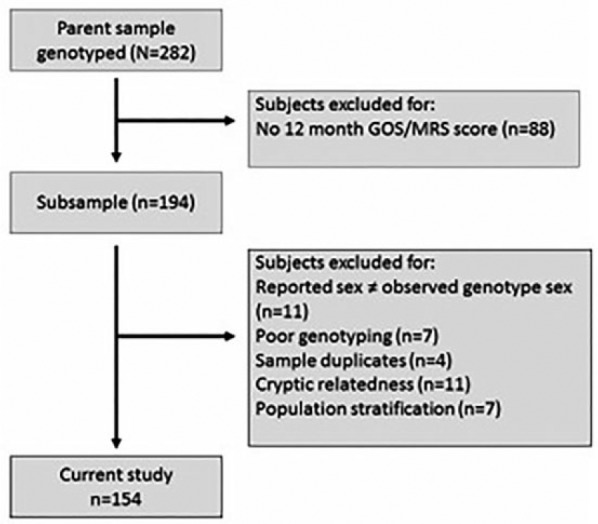
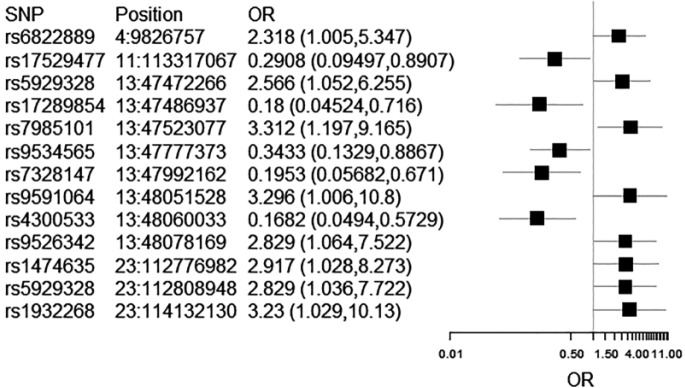
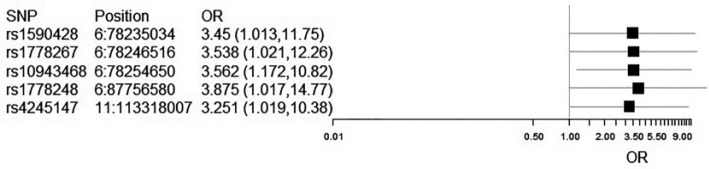
The 154 subjects were 55.8 ± 11.3 years old and 74% female; they had Fisher scores of 2.95 ± 0.67, Hunt/Hess scores of 2.66 ± 1.13, and admission Glasgow Coma Scale scores of 12.52 ± 3.79. Single-nucleotide polymorphisms in the serotonin receptor genes 1B and 1E and dopamine receptor D2 were associated with greater disability (odds ratio: 3.88-3.25, confidence interval: 1.01-14.77), while single-nucleotide polymorphisms in the serotonin receptor genes 2A and 2C and dopamine receptor D5 conferred a risk of poor recovery (odds ratio: 3.31-2.32, confidence interval: 1.00-10.80). Single-nucleotide polymorphisms within the same serotonin genes, and within the dopamine receptor gene D2, were associated with greater recovery after aneurysmal subarachnoid hemorrhage (odds ratio: 0.17-0.34, confidence interval: 0.05-0.89).
These data demonstrate that there may be an association between genetic factors and functional outcomes post stroke.
许多动脉瘤性蛛网膜下腔出血幸存者会经历长期身体残疾,而作用于多巴胺能、血清素能和脑源性神经营养因子神经递质系统的药物可能会改善这种情况。但尚不清楚哪些患者最有可能从这些治疗中获益。这项初步研究的目的是探讨这些通路中的基因多态性与动脉瘤性蛛网膜下腔出血后12个月功能转归之间的关系。
作为一项更大规模母研究的一部分,在患者入院时招募受试者。使用Affymetrix全基因组人类单核苷酸多态性阵列6.0生成基因型。采用格拉斯哥预后量表和改良Rankin量表,分析多巴胺能、血清素能和脑源性神经营养因子通路中的基因多态性与动脉瘤性蛛网膜下腔出血后12个月功能转归的相关性。
154名受试者年龄为55.8±11.3岁,74%为女性;他们的Fisher评分为2.95±0.67,Hunt/Hess评分为2.66±1.13,入院时格拉斯哥昏迷量表评分为12.52±3.79。血清素受体基因1B和1E以及多巴胺受体D2中的单核苷酸多态性与更严重的残疾相关(比值比:3.88 - 3.25,置信区间:1.01 - 14.77),而血清素受体基因2A和2C以及多巴胺受体D5中的单核苷酸多态性会带来恢复不良的风险(比值比:3.31 - 2.32,置信区间:1.00 - 10.80)。同一血清素基因内以及多巴胺受体基因D2内的单核苷酸多态性与动脉瘤性蛛网膜下腔出血后更好的恢复相关(比值比:0.17 - 0.34,置信区间:0.05 - 0.89)。
这些数据表明,遗传因素与卒中后的功能转归之间可能存在关联。