School of Medicine, Federal University of Uberlandia (UFU), Av. Pará, n° 1720, Bloco 2U, Campus Umuarama, Uberlandia 38400-902, Minas Gerais, Brazil.
Exercise Biology Research Group (BioEx), Federal University of Triangulo Mineiro (UFTM), Uberaba 38061-500, Minas Gerais, Brazil.
Nutrients. 2017 Sep 12;9(9):1007. doi: 10.3390/nu9091007.
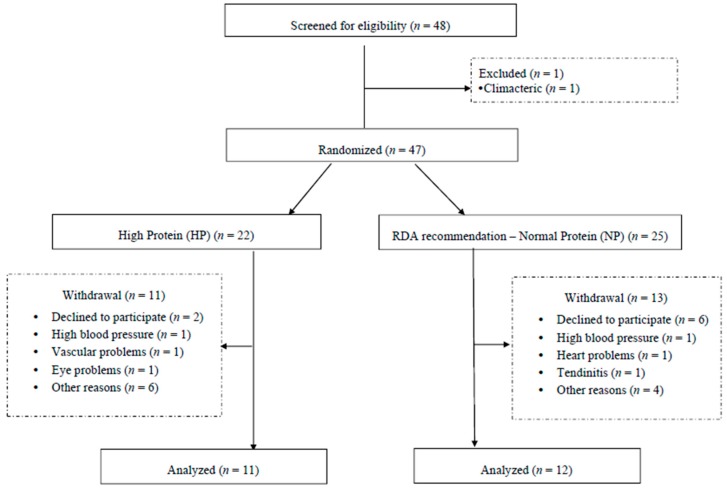
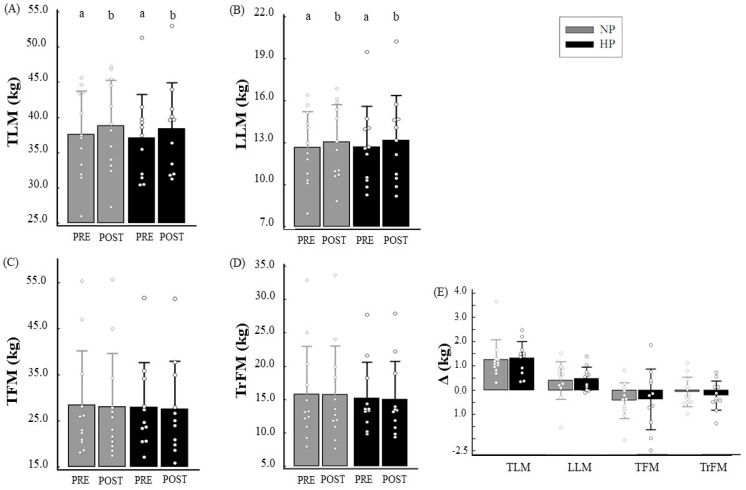
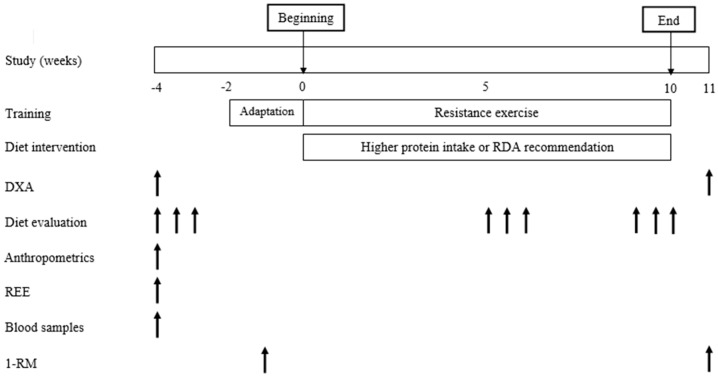
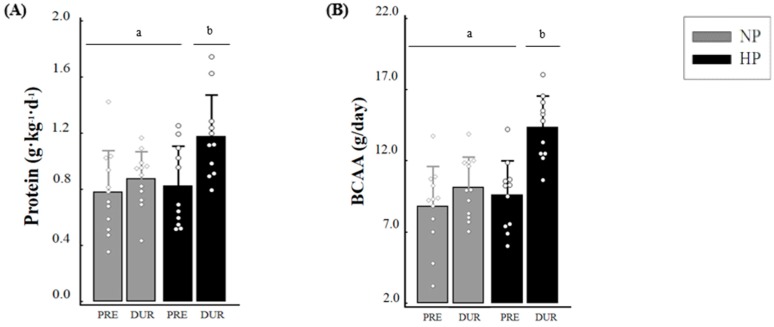
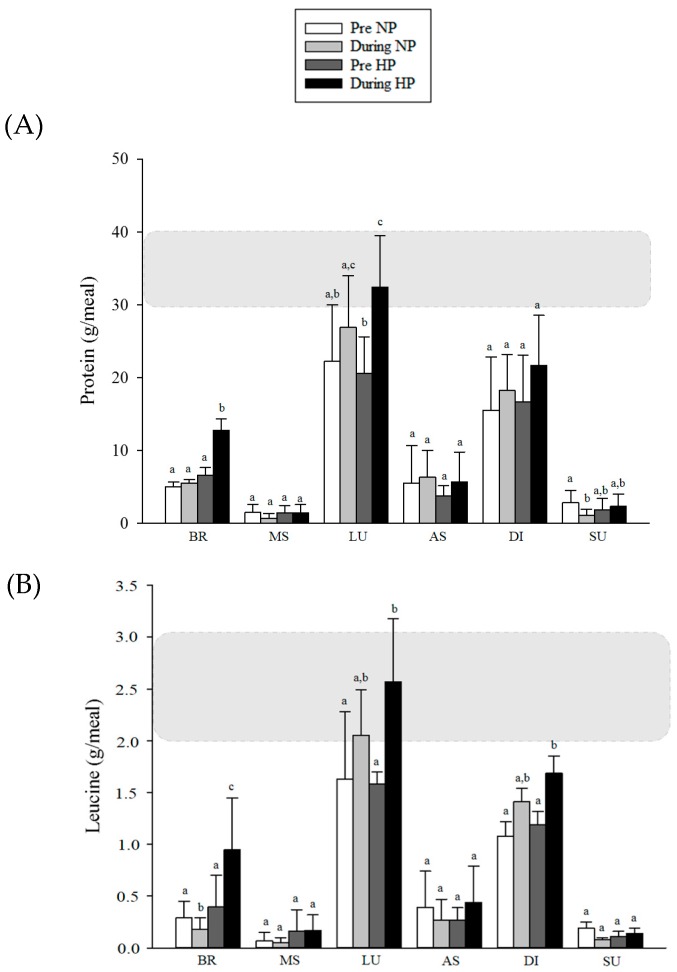
The aim of this study was to evaluate the effect of a higher protein intake on lean body mass (LBM) gain in postmenopausal women practicing resistance exercise and compare it to the Recommended Dietary Allowance (RDA) recommendation. Twenty-three postmenopausal women (63.2 ± 7.8 years) were randomized into two groups. The group with higher protein intake ( = 11) (HP) received a dietary plan with ~1.2 g·kg·day of protein, while the normal protein (NP) group ( = 12) was instructed to ingest ~0.8 g·kg·day of protein (RDA recommendation). Both groups performed the same resistance training protocol, 3 times a week, with progression of the number of sets (from 1 to 6 sets) and 8-12 repetitions. The intervention occurred over 10 weeks. Body composition evaluation was performed by dual-energy X-ray absorptiometry. The diet was evaluated by nine 24-h food recall summaries over the course of the study. During the intervention period, the HP group presented a higher protein (1.18 ± 0.3 vs. 0.87 ± 0.2 g·kg·day, = 0.008) and leucine (6.0 ± 1.4 vs. 4.3 ± 0.9 g/day, < 0.001) intake than the NP group, respectively. At the end of the intervention, there were increases in LBM both in HP (37.1 ± 6.2 to 38.4 ± 6.5 kg, = 0.004) and in NP (37.6 ± 6.2 to 38.8 ± 6.4 kg, < 0.001), with no differences between the groups ( = 0.572). In conclusion, increased protein intake did not promote higher LBM gain when compared to RDA recommendation in postmenopausal women performing resistance exercise during 10 weeks. This trial was registered at ClinicalTrials.gov as NCT03024125.
这项研究的目的是评估高蛋白摄入对绝经后进行抗阻运动女性的瘦体重(LBM)增加的影响,并将其与推荐膳食允许量(RDA)的建议进行比较。23 名绝经后女性(63.2 ± 7.8 岁)被随机分为两组。高蛋白摄入组( = 11)(HP)接受了一种含有约 1.2 g·kg·day 蛋白质的饮食计划,而正常蛋白组( = 12)则被指示摄入约 0.8 g·kg·day 的蛋白质(RDA 推荐量)。两组均进行相同的抗阻训练方案,每周 3 次,逐步增加组数(从 1 组增加到 6 组)和重复次数(8-12 次)。干预持续 10 周。通过双能 X 射线吸收法评估身体成分。通过 9 次 24 小时食物回顾总结评估饮食。在干预期间,HP 组的蛋白质(1.18 ± 0.3 比 0.87 ± 0.2 g·kg·day, = 0.008)和亮氨酸(6.0 ± 1.4 比 4.3 ± 0.9 g/天, < 0.001)摄入均高于 NP 组。干预结束时,HP 组(37.1 ± 6.2 至 38.4 ± 6.5 kg, = 0.004)和 NP 组(37.6 ± 6.2 至 38.8 ± 6.4 kg, < 0.001)的 LBM 均增加,但两组之间无差异( = 0.572)。结论:在进行 10 周抗阻运动的绝经后女性中,与 RDA 推荐量相比,增加蛋白质摄入并不能促进更高的 LBM 增加。本试验在 ClinicalTrials.gov 注册为 NCT03024125。