Sesmilo Gemma, Resmini Eugenia, Sambo Marcel, Blanco Concepción, Calvo Fernando, Pazos Fernando, Fernández-Catalina Pablo, Martínez de Icaya Purificación, Páramo Concepción, Fajardo Carmen, Marazuela Mónica, Álvarez-Escolá Cristina, Díez Juan Jose, Perea Verónica
Servicio de endocrinología, Hospital Quirón-Dexeus/Clínica del Sueño Estivill, Barcelona, Spain.
IIB- Sant Pau y Servicio de Endocrinología, Departamento de Medicina, Centro de Investigación Biomédica en Enfermedades Raras (CIBER-ER Unidad 747), Hospital Sant Pau, Universitat Autònoma de Barcelona, Barcelona, Spain.
PLoS One. 2017 Sep 12;12(9):e0183539. doi: 10.1371/journal.pone.0183539. eCollection 2017.
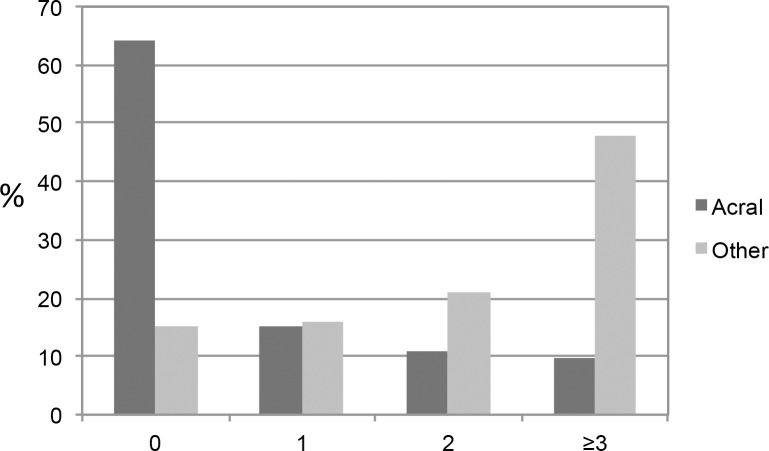
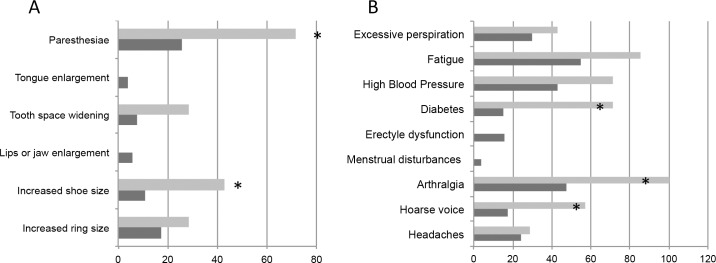
Acromegaly is a rare disease with nonspecific symptoms with acral enlargement being almost universally present at diagnosis. The estimated prevalence is 40-125 cases/million but targeted universal screening studies have found a higher prevalence (about 10 fold). The aim of the ACROSAHS study was to investigate the prevalence of acromegaly and acromegaly comorbidities in patients with sleep apnea symptoms and acral enlargement. ACROSAHS was a Spanish prospective non-interventional epidemiological study in 13 Hospital sleep referral units. Facial and acral enlargement symptoms including: ring size and shoe size increase, tongue, lips and jaws enlargement, paresthesia or carpal tunnel syndrome and widening of tooth spaces, as well as other typical acromegaly comorbidities were recorded with a self-administered questionnaire of patients who attended a first visit for sleep apnea symptoms between 09/2013 and 07/2014. Serum insulin-like growth factor type 1 (IGF1) was measured in patients with ≥1 acral symptom to determine the prevalence of acromegaly. Of the 1557 patients enrolled, 1477 with complete data (72% male) were analyzed. 530 patients (36%) reported at least 1 acral enlargement symptom and were tested for IGF-1, 41 were above range, persisted in 7, and among those, 2 cases of acromegaly were diagnosed (prevalence of at least 1.35 cases/1000). Overall, 1019 patients (69%) had ≥2 acromegaly symptoms and should have been screened according to guidelines; moreover 373 patients (25%) had ≥1 symptom of acral enlargement plus ≥3 other acromegaly symptoms. In conclusion, in patients with sleep apnea symptoms and acral enlargement, we found an acromegaly prevalence of at least 1.35 cases per 1000 and a high prevalence of typical acromegaly symptoms. It is important that sleep specialists are aware of acromegaly symptoms to aid with acromegaly diagnosis.
肢端肥大症是一种罕见疾病,症状不具特异性,诊断时几乎普遍存在肢端肥大。估计患病率为每百万40 - 125例,但针对性的普查研究发现患病率更高(约为10倍)。ACROSAHS研究的目的是调查有睡眠呼吸暂停症状和肢端肥大的患者中肢端肥大症及肢端肥大症合并症的患病率。ACROSAHS是一项在西班牙13家医院睡眠转诊科室开展的前瞻性非干预性流行病学研究。通过一份自填式问卷,记录了2013年9月至2014年7月期间因睡眠呼吸暂停症状首次就诊患者的面部和肢端肥大症状,包括:戒指尺寸和鞋子尺寸增大、舌头、嘴唇和颌骨增大、感觉异常或腕管综合征以及牙间隙增宽,以及其他典型的肢端肥大症合并症。对有≥1项肢端症状的患者检测血清1型胰岛素样生长因子(IGF1)以确定肢端肥大症的患病率。在纳入的1557例患者中,对1477例有完整数据的患者(72%为男性)进行了分析。530例患者(36%)报告至少有1项肢端肥大症状并接受了IGF - 1检测,41例高于正常范围,7例持续异常,其中确诊肢端肥大症2例(患病率至少为1.35例/1000)。总体而言,1019例患者(69%)有≥2项肢端肥大症症状,应根据指南进行筛查;此外,373例患者(25%)有≥1项肢端肥大症状加≥3项其他肢端肥大症症状。总之,在有睡眠呼吸暂停症状和肢端肥大的患者中,我们发现肢端肥大症患病率至少为每1000例中有1.35例,且典型肢端肥大症症状的患病率很高。睡眠专家了解肢端肥大症症状对于协助诊断肢端肥大症很重要。