Department of Hematopathology, Tianjin Medical University General HospitalTianjinP.R. China.
Department of Hematology, Shijiazhuang Pingan HospitalShijiazhuang, HebeiP.R. China.
Oncol Res. 2018 Apr 10;26(3):421-429. doi: 10.3727/096504017X15049221237147. Epub 2017 Sep 11.
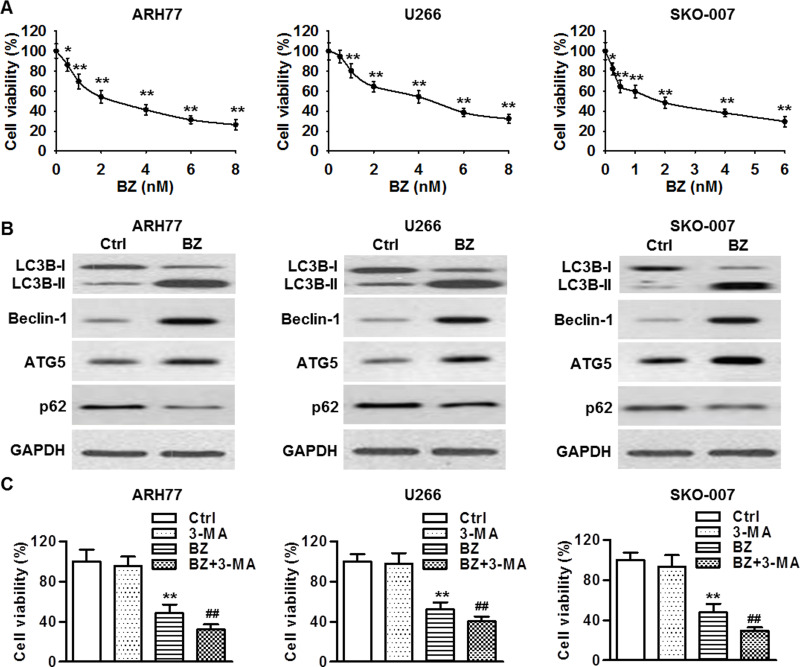
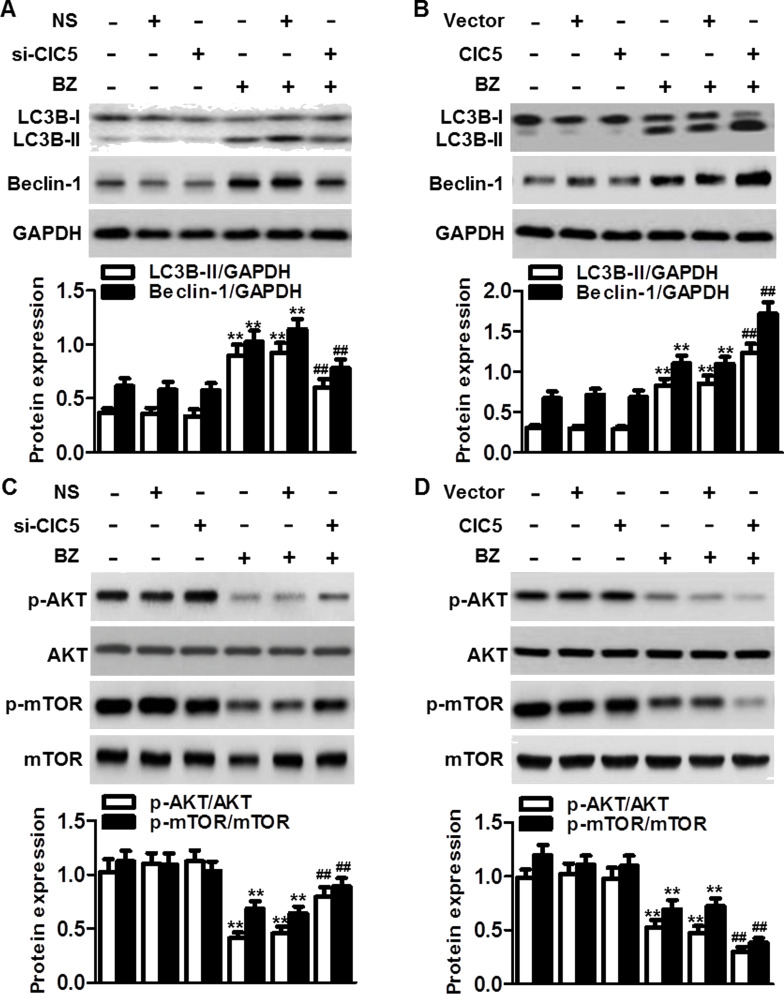
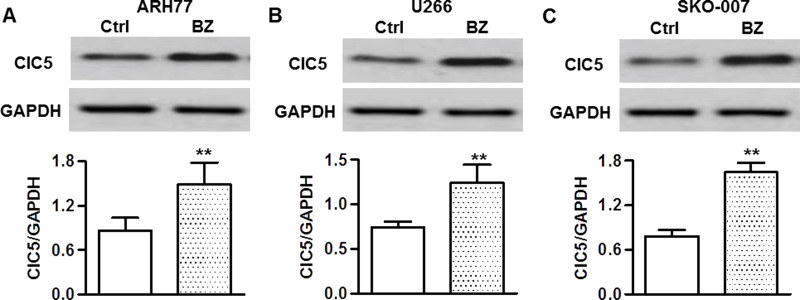
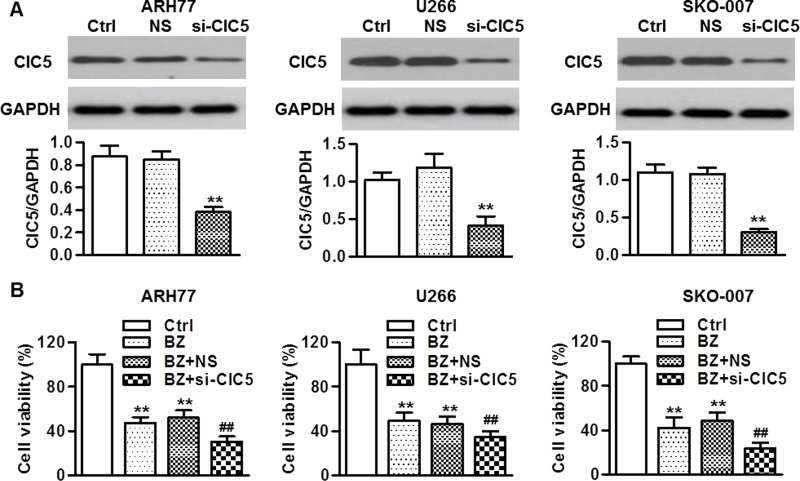
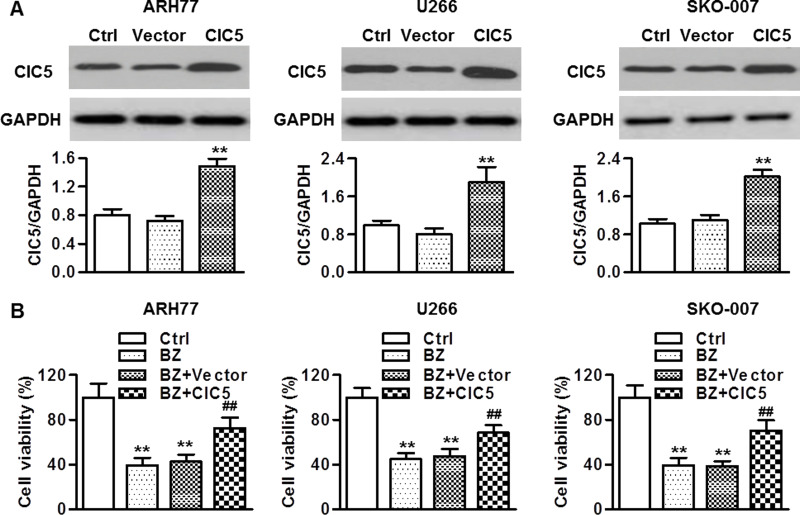
Resistance to bortezomib (BZ) is the major problem that largely limits its clinical application in multiple myeloma treatment. In the current study, we investigated whether ClC5, a member of the chloride channel family, is involved in this process. The MTT assay showed that BZ treatment decreased cell viability in three multiple myeloma cell lines (ARH77, U266, and SKO-007), with IC values of 2.83, 4.37, and 1.91 nM, respectively. Moreover, BZ increased the conversion of LC3B-I to LC3B-II and expressions of beclin-1 and ATG5, concomitantly with a decreased p62 expression. Pharmacological inhibition of autophagy with 3-MA facilitated cell death in response to BZ treatment. Additionally, BZ increased ClC5 protein expression in ARH77, U266, and SKO-007 cells. Knockdown of ClC5 with small interfering RNA sensitized cells to BZ treatment, and upregulation of ClC5 induced chemoresistance to BZ. Furthermore, ClC5 downregulation promoted BZ-induced LC3B-I to LC3B-II conversion and beclin-1 expression, whereas overexpression of ClC5 showed the opposite results in ARH77 cells. Finally, BZ induced dephosphorylation of AKT and mTOR, which was significantly attenuated by ClC5 inhibition. However, ClC5 upregulation further enhanced AKT and mTOR dephosphorylation induced by BZ. Our study demonstrates that ClC5 induces chemoresistance of multiple myeloma cells to BZ via increasing prosurvival autophagy by inhibiting the AKT-mTOR pathway. These data suggest that ClC5 may play a critical role in future multiple myeloma treatment strategies.
硼替佐米(BZ)耐药性是限制其在多发性骨髓瘤治疗中临床应用的主要问题。在本研究中,我们研究了氯离子通道家族成员 ClC5 是否参与了这一过程。MTT 检测表明,BZ 处理降低了三种多发性骨髓瘤细胞系(ARH77、U266 和 SKO-007)的细胞活力,其 IC 值分别为 2.83、4.37 和 1.91 nM。此外,BZ 增加了 LC3B-I 向 LC3B-II 的转化以及 beclin-1 和 ATG5 的表达,同时降低了 p62 的表达。用 3-MA 抑制自噬可促进细胞对 BZ 处理的死亡。此外,BZ 增加了 ARH77、U266 和 SKO-007 细胞中 ClC5 蛋白的表达。用小干扰 RNA 敲低 ClC5 可使细胞对 BZ 处理敏感,上调 ClC5 可诱导对 BZ 的耐药性。此外,ClC5 的下调促进了 BZ 诱导的 LC3B-I 向 LC3B-II 的转化和 beclin-1 的表达,而在 ARH77 细胞中过表达 ClC5 则显示出相反的结果。最后,BZ 诱导 AKT 和 mTOR 的去磷酸化,而 ClC5 抑制显著减弱了这一过程。然而,ClC5 的上调进一步增强了 BZ 诱导的 AKT 和 mTOR 的去磷酸化。我们的研究表明,ClC5 通过抑制 AKT-mTOR 通路增加促生存自噬,诱导多发性骨髓瘤细胞对 BZ 的耐药性。这些数据表明,ClC5 可能在未来的多发性骨髓瘤治疗策略中发挥关键作用。