Vreeland Timothy J, Berry Iv John S, Schneble Erika, Jackson Doreen O, Herbert Garth S, Hale Diane F, Martin Jonathon M, Flores Madeline, Pattyn Adam R, Hata Kai, Clifton Guy T, Kirkpatrick Aaron D, Peoples George E
Womack Army Medical Center. Department of Surgery. Fort Bragg, NC USA.
Washington University School of Medicine. Department of Surgery. St. Louis, MO USA.
J Cancer. 2017 Jul 23;8(13):2442-2448. doi: 10.7150/jca.16738. eCollection 2017.
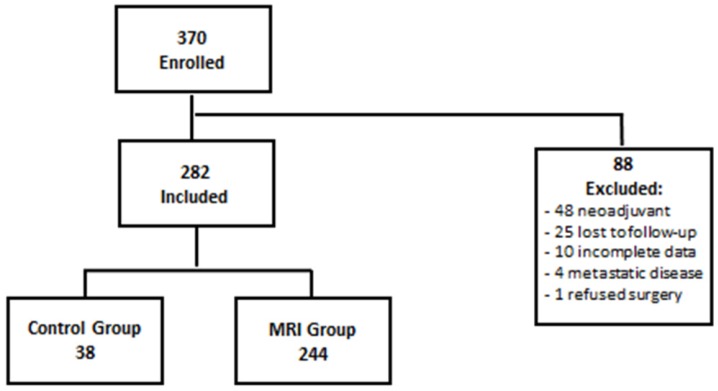
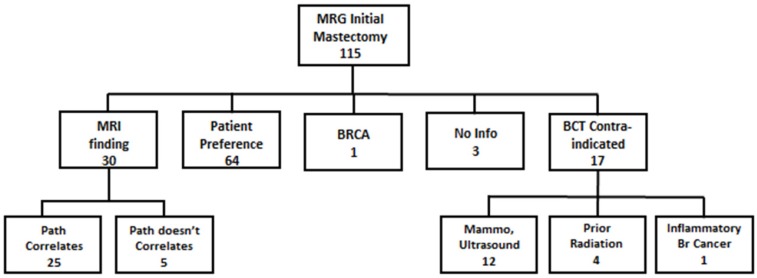
: Pre-operative MRI is being used with increasing frequency to evaluate breast cancer patients, but the debate surrounding risks and benefits of this use continues. At our institution, we instituted a standardized protocol for pre-operative MRI. Here, we compare patients seen prior to routine use of MRI to those seen after and examine effects on surgical choices, timing and outcomes. : This is a retrospective review of a prospectively collected database of all new invasive breast cancers seen from January 2007 to December 2012. The control group (CG) did not receive MRI, while the MRI group (MRG) underwent MRI according to our pretreatment protocol. Groups were compared with regards to basic demographics, initial surgical choices, need for re-excision, and surgical timing. The electronic medical records of patients in the MRG who underwent mastectomy as their initial surgery were examined closely to determine the main factors leading to their choice of surgery. Finally, correlation between findings on MRI and final surgical pathology was analyzed. : Of 282 patients included, 38 were in the CG and 244 in the MRG; the groups were well matched. The MRG had a significantly higher percentage of patients choosing initial mastectomy (MRG: 47.1% vs CG 21.1%, p=0.003). Patients seen in the first 2 years of the study were less likely to choose mastectomy than those enrolled in the latter years (29.2%vs 48.6%, p=0.004). The MRG had a lower chance of return to the operating room for re-excision (15.2% vs 28.9%, p=0.035). The average time from initial imaging to initial surgery was approximately the same between groups (MRG: 39.7 days vs CG 42.1 days, p=0.45) and the MRG actually had shorter time to definitive (margin-negative) surgical management (MRG: 43.5 days vs CG: 50.3 days, p=0.079). One hundred-fifteen patients in the MRG underwent mastectomy as initial surgery. Of these, 64 (55.7%) had no additional findings on MRI and chose mastectomy based on patient preference; 30 patients (26.1%) (29 unilateral, 1 bilateral) had mastectomy because of MRI findings. Of the 31 breasts removed (29 unilateral and 1 bilateral mastectomies) because of MRI findings, 26 (83.9%) had histologic findings that correlated with the MRI findings, while 5 (16.1%) did not. : Patients receiving routine pre-treatment MRI had an increased mastectomy rate, but had a lower re-excision rate. We found no delay to initial surgical therapy and, perhaps more importantly, a slight decrease in time to margin-negative surgical therapy in the MRI group. Women choosing mastectomy after MRI did so because of personal preference over half of the time, while MRI findings influenced this choice in 26% of these women. When MRI findings did lead to mastectomy, these findings were confirmed by pathology results in the vast majority of cases.
术前磁共振成像(MRI)在评估乳腺癌患者中的应用频率日益增加,但围绕这种应用的风险和益处的争论仍在继续。在我们机构,我们制定了术前MRI的标准化方案。在此,我们比较了在常规使用MRI之前和之后就诊的患者,并研究其对手术选择、时机和结果的影响。
这是一项对2007年1月至2012年12月期间所有新诊断的浸润性乳腺癌患者的前瞻性收集数据库进行的回顾性研究。对照组(CG)未接受MRI检查,而MRI组(MRG)根据我们的预处理方案接受了MRI检查。比较两组患者的基本人口统计学特征、初始手术选择、再次切除的必要性和手术时机。对MRG组中最初接受乳房切除术的患者的电子病历进行了仔细检查,以确定导致他们选择手术的主要因素。最后,分析了MRI检查结果与最终手术病理之间的相关性。
纳入的282例患者中,38例在CG组,244例在MRG组;两组匹配良好。MRG组中选择初始乳房切除术的患者比例显著更高(MRG组:47.1% vs CG组21.1%,p = 0.003)。研究前两年就诊的患者比后几年就诊的患者选择乳房切除术的可能性更小(29.2% vs 48.6%,p = 0.004)。MRG组再次返回手术室进行再次切除的几率更低(15.2% vs 28.9%,p = 0.035)。两组从初始影像学检查到初始手术的平均时间大致相同(MRG组:39.7天 vs CG组42.1天,p = 0.45),实际上MRG组达到确定性(切缘阴性)手术治疗的时间更短(MRG组:43.5天 vs CG组:50.3天,p = 0.079)。MRG组中有115例患者最初接受了乳房切除术。其中,64例(55.7%)在MRI检查中没有其他发现,基于患者偏好选择了乳房切除术;30例患者(26.1%)(29例单侧,1例双侧)因MRI检查结果而接受了乳房切除术。在因MRI检查结果而切除的31个乳房(29例单侧和1例双侧乳房切除术)中,26个(83.9%)有与MRI检查结果相关的组织学发现,而5个(16.1%)没有。
接受常规术前MRI检查的患者乳房切除率增加,但再次切除率降低。我们发现初始手术治疗没有延迟,也许更重要的是,MRI组达到切缘阴性手术治疗的时间略有缩短。在MRI检查后选择乳房切除术的女性中,超过一半是出于个人偏好,而MRI检查结果在26%的此类女性中影响了这一选择。当MRI检查结果确实导致乳房切除术时,在绝大多数情况下病理结果证实了这些发现。