Sajed Dipti P, Faquin William C, Carey Chris, Severson Eric A, H Afrogheh Amir, A Johnson Carl, Blacklow Stephen C, Chau Nicole G, Lin Derrick T, Krane Jeffrey F, Jo Vickie Y, Garcia Joaquín J, Sholl Lynette M, Aster Jon C
*Department of Pathology, Massachusetts General Hospital ¶Department of Surgery, Massachusetts General Hospital ‡Department of Pathology, Brigham and Women's Hospital §Department of Biological Chemistry and Molecular Pharmacology, Harvard Medical School ∥Department of Medical Oncology, Dana Farber Cancer Institute, Boston, MA #Department of Laboratory Medicine & Pathology, Mayo Clinic, Rochester, MN †Northern Institute for Cancer Research, University of Newcastle, Newcastle on Tyne, UK.
Am J Surg Pathol. 2017 Nov;41(11):1473-1482. doi: 10.1097/PAS.0000000000000945.
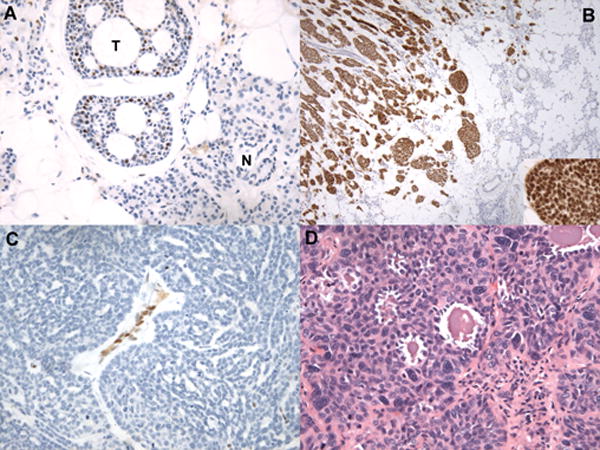
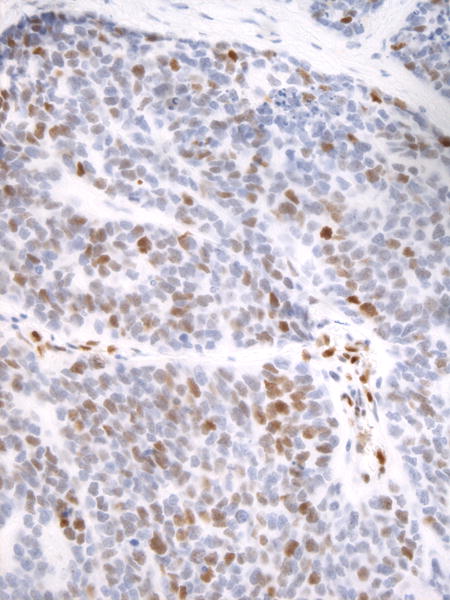
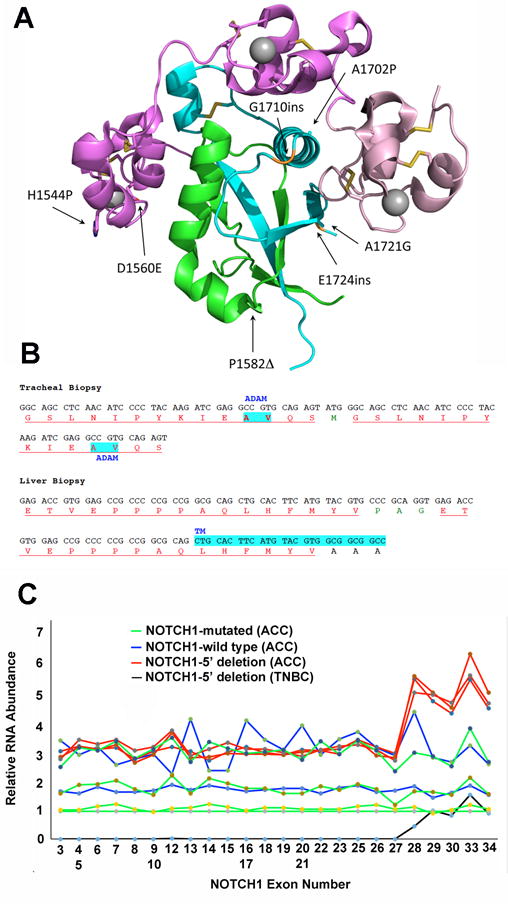
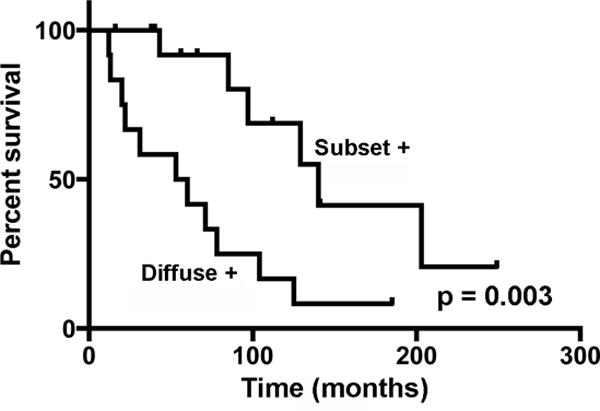
NOTCH1 is frequently mutated in adenoid cystic carcinoma (ACC). To test the idea that immunohistochemical (IHC) staining can identify ACCs with NOTCH1 mutations, we performed IHC for activated NOTCH1 (NICD1) in 197 cases diagnosed as ACC from 173 patients. NICD1 staining was positive in 194 cases (98%) in 2 major patterns: subset positivity, which correlated with tubular/cribriform histology; and diffuse positivity, which correlated with a solid histology. To determine the relationship between NICD1 staining and NOTCH1 mutational status, targeted exome sequencing data were obtained on 14 diffusely NICD1-positive ACC specimens from 11 patients and 15 subset NICD1-positive ACC specimens from 15 patients. This revealed NOTCH1 gain-of-function mutations in 11 of 14 diffusely NICD1-positive ACC specimens, whereas all subset-positive tumors had wild-type NOTCH1 alleles. Notably, tumors with diffuse NICD1 positivity were associated with significantly worse outcomes (P=0.003). To determine whether NOTCH1 activation is unique among tumors included in the differential diagnosis with ACC, we performed NICD1 IHC on a cohort of diverse salivary gland and head and neck tumors. High fractions of each of these tumor types were positive for NICD1 in a subset of cells, particularly in basaloid squamous cell carcinomas; however, sequencing of basaloid squamous cell carcinomas failed to identify NOTCH1 mutations. These findings indicate that diffuse NICD1 positivity in ACC correlates with solid growth pattern, the presence of NOTCH1 gain-of-function mutations, and unfavorable outcome, and suggest that staining for NICD1 can be helpful in distinguishing ACC with solid growth patterns from other salivary gland and head and neck tumors.
NOTCH1在腺样囊性癌(ACC)中经常发生突变。为了验证免疫组织化学(IHC)染色能够识别具有NOTCH1突变的ACC这一想法,我们对173例患者诊断为ACC的197例病例进行了活化NOTCH1(NICD1)的IHC检测。NICD1染色在194例(98%)病例中呈阳性,有两种主要模式:亚组阳性,与管状/筛状组织学相关;弥漫性阳性,与实性组织学相关。为了确定NICD1染色与NOTCH1突变状态之间的关系,我们获取了11例患者的14个弥漫性NICD1阳性ACC标本和15例患者的15个亚组NICD1阳性ACC标本的靶向外显子组测序数据。这显示在14个弥漫性NICD1阳性ACC标本中有11个存在NOTCH1功能获得性突变,而所有亚组阳性肿瘤均具有野生型NOTCH1等位基因。值得注意的是,弥漫性NICD1阳性的肿瘤预后明显更差(P = 0.003)。为了确定NOTCH1激活在与ACC进行鉴别诊断的肿瘤中是否具有独特性,我们对一组不同的涎腺和头颈部肿瘤进行了NICD1 IHC检测。这些肿瘤类型中的每一种在一部分细胞中NICD1呈高比例阳性,特别是在基底样鳞状细胞癌中;然而,基底样鳞状细胞癌的测序未能鉴定出NOTCH1突变。这些发现表明,ACC中弥漫性NICD1阳性与实性生长模式、NOTCH1功能获得性突变的存在以及不良预后相关,并提示NICD1染色有助于将具有实性生长模式的ACC与其他涎腺和头颈部肿瘤区分开来。